One of the key goals of the fieldtrip to Ecuador (August-September) was to sample organic and volcanic (tephra) layers from sedimentary exposures with the aim of obtaining new information about past envrionmental change in the region. Our Ecuadorian collaborator, Dr Patricia Mothes (Instituto Geofisico), had identified four of sites she thought might be useful too us: El Fatima Dique, Mera “2” Dique, El Rosol and Vinillos.
At the Fatima site, near Puyo, a thin organic bed was sampled sandwiched between volcanic ash deposits. Wood macrofossils from this deposit have been dated to the last glacial period.
For further descriptions of what we found and field photos read on…
The second part of our Ecuadorian expedition took in lakes and sections close to the towns of Papallacta and Cosanga. The variation in climatic conditions was marked as we experienced first hand the transition from freezing fog and driving rain to burning sun and heat within a few tens of kilometers as we travelled from >4000 m down to around 1000 m elevation.
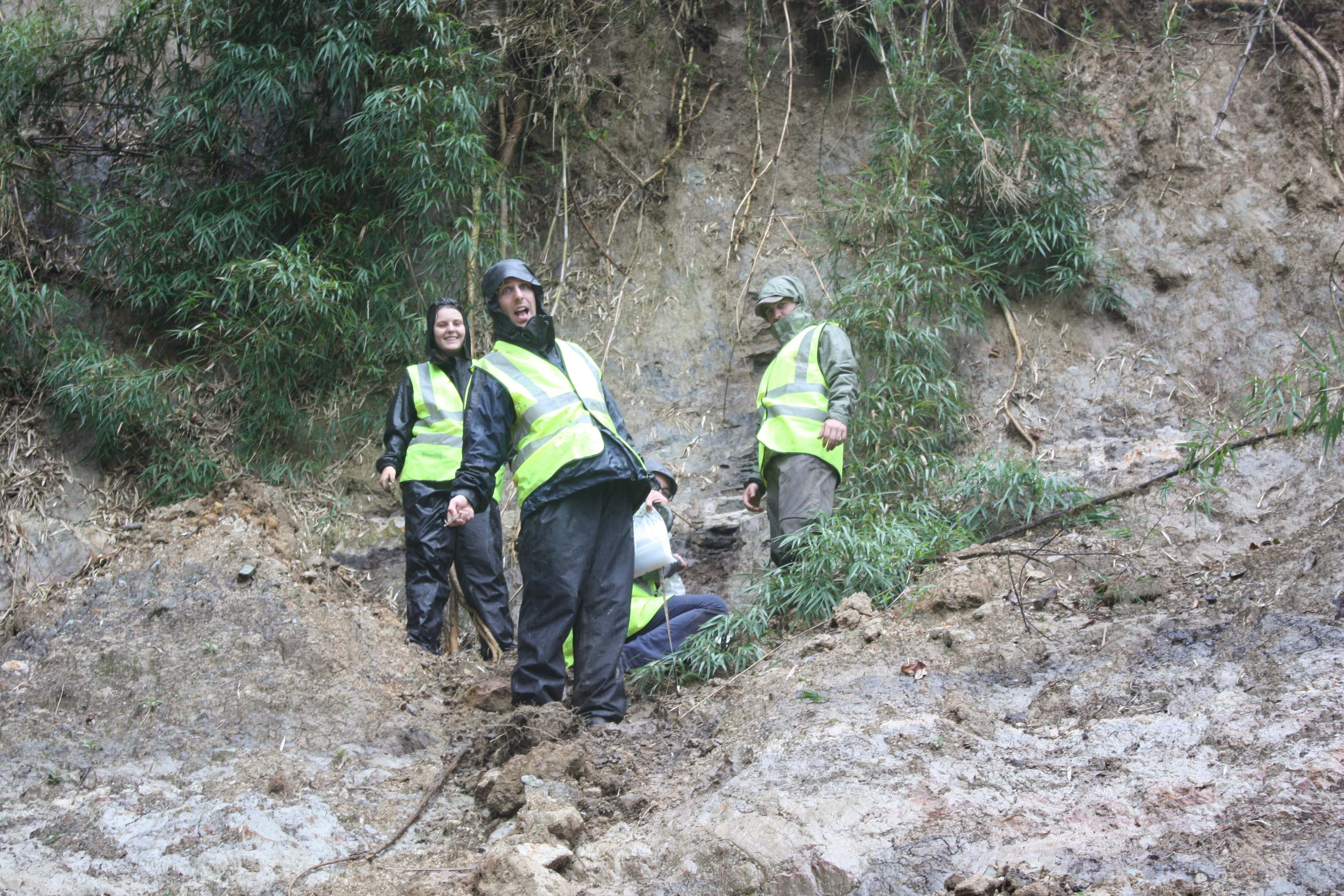
Sampling the sedimentary section at Vinillos was hampered by a tropical downpour. Sediments recovered from here include volcanic ash, mud slide deposits including large wood macrofossils and fine grained organic sediments probably deposited in still water environments.
Preparing to recover a short core from a pond near the antenas at Cujuca. Short cores will be used for Chironomid analysis.
Tomorrow we will attempt to recover short cores from two more lakes. Then our final few days here in Ecuador will be spent visiting partners and packing up.
Laboratory activity has continued through February with progress on pollen counts (Lottie and Hayley) and chironomid (non-biting midges) picking (Frazer). Hayley also managed to escape the microscope lab for a short period: 1) to commence work on selecting samples from tephras for Ar-Ar dating, and 2) to counduct loss-on-ignition analysis of organic samples to identify the constituents of her sediment. I did not make it on to the microscope 😦
I was however very pleased to welcome Macarena Cardenas back into the lab as a visiting Research Fellow. Maca will be working on the pollen reference collection, assisting with PhD student analysis and continuing to write papers during her renewed association.
Frazer, Hayley and I have also begun planning for field work in Ecuador for April-May. We will be working in collaboration with the Instituto Geophisico in Quito and the plan is to visit the Mera site which Hayley is working on, and to collect lake surface samples for Frazer to examine the midges. In preparation for the collection of midges samples expert, and project co-supervisor, Steve Brooks (Natural History Museum) visited for a day to brief us on how best to do this.
Away from research I have been working on writing exam questions and tutor marked assignments for the level 3 module The geological record of environmental change (S369, to those familliar with OU codes!). Hopefully, I have managed to set some interesting and challenging tasks for our students. . .
COMMENT ON THE USE OF NITROGEN ISOTOPES IN PALAEOLIMOLOGICAL STUDIES As a component of my doctoral research, I am examining nitrogen (N) isotopes within sediments obtained from Lake Bosumtwi (West Africa). Below I review and comment on the key uses and limitations of using N isotopes to interpret past environmental change with particular reference to lake sediments. Discussion is based on the key text by Talbot (2001).
REFERENCE
Talbot, M.R. 2001. Nitrogen isotopes in palaeolimnology. Tracking environmental change using lake sediments. Volume 2. Physical and geochemical methods (ed. by W.M. Last and J.P. Smol), pp. 401-439. Kluwer Academic Press, Dordrecht.
January 2012 has been a busy one for the Palaeoenvironmental Change Research Group members we have been getting out and about (attending three research meetings), there has been activity in the labs (pollen, chironomids and geochemical analysis all being undertaken) and developments with the publication of our research (book chapter published and two papers moved along in the publication process).
JUST PUBLISHED
Bush, M.B. & Gosling, W.D. (2012) Environmental change in the humid tropics and monsoonal regions. The SAGE handbook of environmental change: Volume 2. Human Impacts and Response (ed. by J.A. Matthews, P.J. Bartlein, K.R. Briffa, A.G. Dawson, A. De Vernal, T. Denham, S.C. Fritz and F. Oldfield), pp. 113-140. SAGE, London. ISBN: 978-0-857-02360-5
Quaternary – the last 2.6 million years of Earth history (click here for more detailed definition) Hindsight – knowing what to do after the event
The 2012 Annual Discussion Meeting of the Quaternary Research Association, entitled Quaternary Science & Society, focused upon:
The way in which observations of past environmental change can serve as “hindsight” with regard to the consequences of ongoing and predicted environmental and climatic change, and
How scientists might best communicate scientific method and research findings effectively beyond academia, e.g. for policy makers, geoscience professionals and the general public.
Given the nature of this meeting it seems like an ideal subject for the first report on this blog. I will not cover details of all the talks here; however I hope to capture the key themes and highlight a range of interesting examples from this wide ranging and high quality scientific meeting. I will also try and provide links to external sites with further information on projects/researchers where appropriate.



 Ecology of the past