Human impact on forest cover in Europe during the last glaciation

February 27, 2019
riannevduinen

This is the first is a series of blog posts based on papers discussed at our “Amsterdam Palaeoecology Club” meetings. The APC meetings are organized to promote palaeoecological discussion and to help the scientific development of our MSc and BSc research students. At each meeting we discuss a paper and the progress of individual projects. Short summaries of the papers and discussions are then made by the student introducing the paper. First up is MSc researcher Rianne van Duinen with her thoughts on Kaplan et al. (2016).

Monkey on a stick

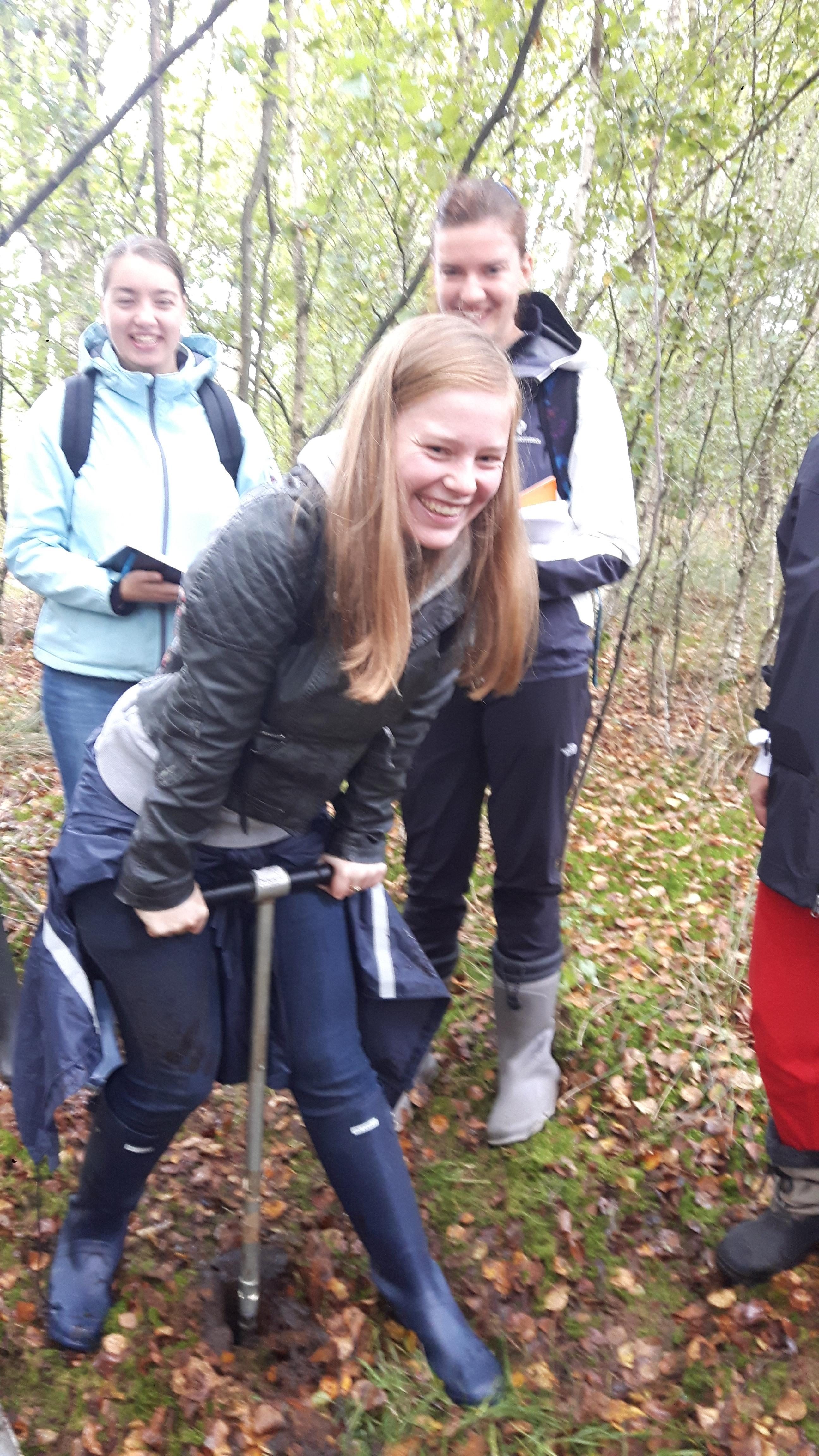
Rianne on field work in Twente during the 2017 edition of the BSc Palaeoecology course at University of Amsterdam

Human impact on forest cover in Europe during the last glaciation
By Rianne van Duinen
(currently studying for MSc Biological Sciences, Ecology & Evolution track at the University of Amsterdam)

We discussed the paper Large scale anthropogenic reduction of forest cover in Last Glacial Maximum Europe by Kaplan et al. (2016) which was found by the group to be super interesting and it incited a lot of discussion. The paper was mostly concerned with the anthropogenic influences and past vegetation of Europe. The main conclusion was that humans had a very big impact on forests during the last glacial period through the use of fire. The authors suggest that human actions are the explaining factor for the low amount of forests cover suggested by pollen records during the last glacial maximum (c. 21,000 years ago). The suggestion from Kaplan et al. that human modification of forest cover through fire during the glacial links with a recent study from Sevink et al. (2018) that suggests, based on pollen and charcoal data from the Netherlands, that human use of fire altered forest cover into the Holocene. In our discussion it was also noted that animals (mega-herbivores) were not really taken into account or discussed, even though animals probably had a big impact on the vegetation (e.g. see Bakker et al., 2016). Furthermore, another discussion point was the charcoal records that were used in the Kaplan et al. study, more specifically the number of cores. Kaplan et al. only used three cores to map out the effect of charcoal. It would be interesting to see what happens when more data from more cores is used. The Global Charcoal Database has a lot of data on European cores (c. 38% of the cores are from Europe) so there is a lot of potential for this.  All in all, the article by Kaplan et al. raised a lot of questions and opened up a nice discussion.

Reference

Continue Reading

Reconstructing past fire temperatures from ancient charcoal material

February 10, 2019
WDG

Gosling, W.D., Cornelissen, H. & McMichael, C.N.H. (2019) Reconstructing past fire temperatures from ancient charcoal material. Palaeogeography, Palaeoclimatology, Palaeoecology 520, 128-137. DOI: 10.1016/j.palaeo.2019.01.029

Click here for open access until 01/04/2019

Note: This article is developed directly from work conducted by Henk Cornelissen during his BSc Future Planet Studies thesis project at the Institute for Biodiversity & Ecosystem Dynamics, University of Amsterdam.

Job: MacGillavry Fellowship

December 20, 2018
WDG

The Faculty of Science of the University of Amsterdam has just announced the third round of MacGillavry Fellowships. These are tenure track positions (6 years) for talented female researchers. Applicants can apply in six different fields including “Biodiversity & Earth Sciences” this field encompasses all activity within the Institute for Biodiversity & Ecosystem Dynamics.

Email me for informal discussions of applications related to Ecosystem & Landscape Dynamics.

To find out more and how to apply click here.

Job: Theoretical Ecology

November 29, 2018
WDG

The Institute for Biodiversity & Ecosystem Dynamics (University of Amsterdam) is currently looking for an theoretical ecologist. The position will be based in the Department of Theoretical & Computational Ecology and will be at the Assistant or Associate Professor level.

Closing date: 3 January 2019
For further details on the position and how to apply click here.

Advances in tropical research symposium

November 2, 2018
WDG

Treub Maatschappij – Society for the Advancement of Research in the Tropics &
The Institute for Biodiversity and Ecosystem Dynamics (IBED), University of Amsterdam…
…invites you to join this symposium.

Date: 15 November 2018
Location: Amsterdam Science Park

Programme

13.30-13.45: Welcome

13.45-14.15: Dr Robert-Jan Wille
History Department, Utrecht University
Dutch colonial science in the age of Melchior Treub: evolution, development and symbiosis as political and scientific themes in the late nineteenth century

Continue Reading

Columbus’ environmental impact in the New World: Land use change in the Yaque River valley, Dominican Republic

August 29, 2018
WDG

Open access:

Hooghiemstra, H., Olijhoek, T., Hoogland, M., Prins, M., van Geel, B., Donders, T., Gosling, W.D. & Hofman, C. (2018) Columbus’ environmental impact in the New World: Land use change in the Yaque River valley, Dominican Republic. The Holocene. Online DOI: 10.1177/0959683618788732
Introducing Yoshi Maezumi

May 14, 2018
S. Yoshi Maezumi

This slideshow requires JavaScript.

Greetings Paleo-Family!

For those of you I have not had the pleasure of meeting yet, please allow me to introduce myself. My name is Yoshi Maezumi. I have recently been awarded a Marie Curie Fellowship for my research proposal FIRE: Fire Intensity in Rainforest Ecotones. I will have the honor of working with an extraordinary team of international, interdisciplinary researchers including Will Gosling, Crystal McMichael, Emiel van Loon, and Boris Jansen from the University of Amsterdam, Boris Vannière from the Université de Franche-Comté, Jose Iriarte from the University of Exeter, and Francisco Cruz from the University of São Paulo. Together we will examine the long-term role of fire in shaping Amazon Rainforest Ecotones.

My research is focused on paleofire (fire in the past) in Neotropical savanna and rainforest ecosystems. My current post-doctoral research at the University of Exeter is investigating the role indigenous fire management practices had on shaping the composition, structure, and flammability of modern Amazonian rainforests.

Recently introduced to a book by Bill Gammage entitled The Biggest Estate on Earth: How the Aborigines Made Australia.  Gammage identifies five uses of indigenous fire: 1) to control wildfire fuel; 2) to maintain diversity; 3) to balance species; 4) to ensure abundance; 5) to locate resources conveniently and predictably. Gammage argues that our current regime is struggling with number one. These stages of fire management provide some really interesting food for thought for my Marie Curie Fellowship as I aim to develop new paleoecological techniques to analyze paleofire that will be used to model natural and anthropogenic drivers of paleofire activity.

I have been thinking a lot about what we do and do not know about paleofire. One of the ways we reconstruct past fire activity is through the use of charcoal preserved in lake sediments. Charcoal can tell us a lot about what past fires were like including what kind of plants were burning, how often fires occurred, and potentially how big a fire was. One of the more elusive components is paleofire intensity, or how hot a particular fire was. The temperature of a fire has important ecological implications, as hotter fires tend to cause more ecological damage. Lots of factors can contribute to fire intensity including droughts, fuel loads, vegetation composition and structure, fuel moisture, etc.  All of this is to say that, fire intensity is complicated. Nevertheless, one of the main objectives of my Marie Curie research will be to compile what we currently know about the effect of modern fire intensity on the charcoal formation to figure out how that information can be used to interpret charcoal from the palaeorecord.

If you would like to join me on this ‘intense’ paleofire journey, (punny, I know, I just couldn’t resist), I am starting a weekly science blog called Her Science that will highlight the trials, tribulations, and triumphs of my Marie Curie research over the next few years.

Until next time,

Live long and Science On,

-yoshi

Introducing Veerle Vink

April 23, 2018
WDG

Hiking though the jungle in Panama (San Lorenzo)

Hiking though the jungle in Panama (San Lorenzo)

Hi All!

My name is Veerle, and I am in my first year of the Master in Biological Sciences, Ecology & Evolution track, at the University of Amsterdam. I also completed my BSc Biology at the University of Amsterdam, specializing in Ecology and Global Change. One of my favorite courses during my BSc was Palaeoecology, which led to a BSc research project with William Gosling and Crystal McMichael on the farming history in the Netherlands. I really enjoyed this project and it made me even more interested in palaeoecology. This year I have gotten the amazing opportunity to do another project with Crystal McMichael…. including a field expedition together with Britte Heijink and Nina Witteveen to Panama and Colombia! This was an amazing experience with a lot of fun, mud, insect repellent and most of all really nice cores! I am super excited to tell you about my field experiences, so soon we will post another blog about that!

Collecting the soil

Collecting the soil

Now that we’re back in Amsterdam, I’m analyzing phytoliths from Gigante (Panama) to reconstruct the fire and vegetation history. I’m especially interested in past agriculture and forest management to see if there were humans present in the area and how they affected the vegetation. Hopefully I can show you some nice results about that in the future!

Cheers,

Veerle

Blog at WordPress.com.