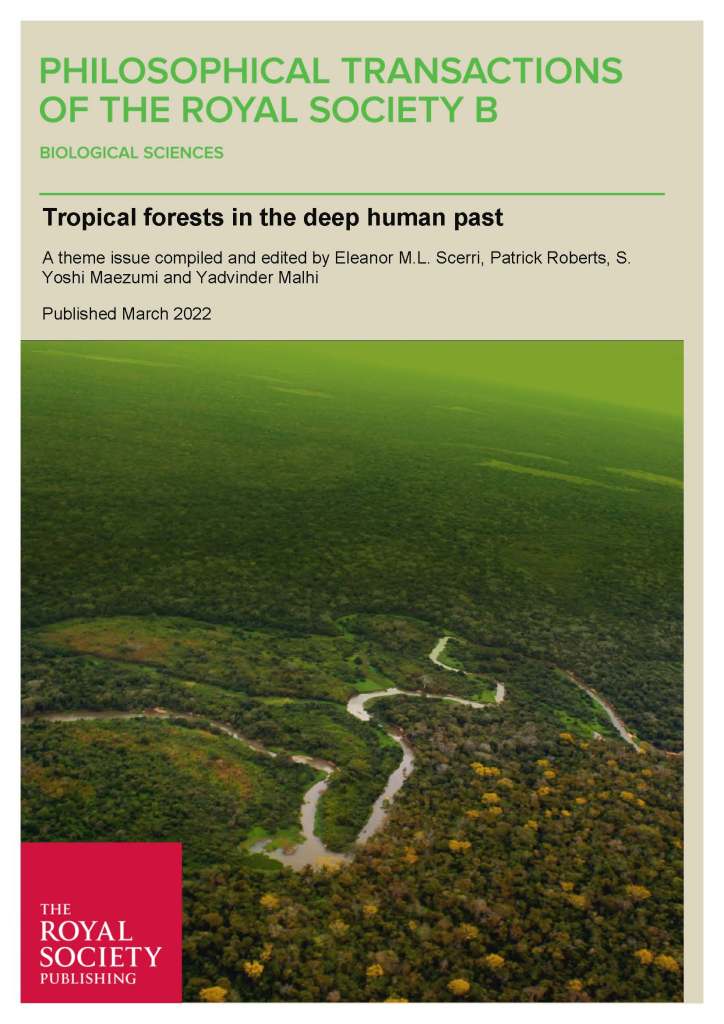
Nascimento, M.N., Heijink, B.M., Bush, M.B., Gosling, W.D. & McMichael, C.N.H. (2022) Early to mid-Holocene human activity exerted gradual influences on Amazonian forest vegetation. Philosophical Transactions of the Royal Society B: Biological Sciences 377, 20200498. https://doi.org/10.1098/rstb.2020.0498
Bush, M.B., Rozas-Davila, A., Raczka, M., Nascimento, M., Valencia, B., Sales, R.K., McMichael, C.N.H. & Gosling, W.D. (2022) A palaeoecological perspective on the transformation of the tropical Andes by early human activity. Philosophical Transactions of the Royal Society B: Biological Sciences 377, 20200497. https://doi.org/10.1098/rstb.2020.0497
Gosling, W.D., Scerri, E.M.L. & Kaboth-Bahr, S. (2022) The climate and vegetation backdrop to hominin evolution in Africa. Philosophical Transactions of the Royal Society B: Biological Sciences 377, 20200483. https://doi.org/10.1098/rstb.2020.0483
I wanted to share the details of Scholars at Risk Network with people today. This is an organisation that the University of Amsterdam is working with to provide support to scholars around the world who find themselves in difficult situations. The university is currently working with Scholars at Risk to see if there are additional possibilities to support people effected by the current crisis in Ukraine.
The fourth of a seminars in the Mapping Ancient African project took place on Tuesday 1 March 2022 and was given by Minchao Wu (Uppsala University). You can watch the seminar now on the Ecology of the Past YouTube channel. Seminar details can be found here.
In June there will be a “European Pollen Database in Neotoma” meeting in Prague. For full details visit the European Pollen Database web site, click here.
The next online seminar day of the Palynologishe Kring will take place on Friday 18 February.
Programma
13:00 Welcome
13:10 – 13:30 Annual General Meeting – finances, activities and board election. New Board member: Nelleke van Asch
13:30 – 14:00 Sander Houben (TNO) – Advances in Palaeozoic stratigraphy in the Netherlands
14:00 – 14:30 Marjolein van der Linden & Lucy Kubiak-Martens (BIAX) – What goes up must come down: The Neolithic human diet based on coprolites from the Swifterbant sites
14:30 – 14:45 Break
14:45 – 15:00 Announcement of Florschütz award winner 2021
15:00 – 15:30 Iris de Wolf and Thomas Giesecke (UU) – Unlocking the wealth of Dutch Pollen data: A new data portal and highlights
15:30 – 16:00 Stefan Uitdehaag (NFI) – Pollen – Silent witness to solving homicides
New sediment coring videos from Lynne Quick and her team at Nelson Mandela University. Find out more about their work on Twitter (@The_Palaeolab) and on their Palaeoecology Lab web pages.
Nelson Mandela University’s Palaeoecology Research Group: Sediment coring fieldwork campaign to the Zuurberg Mountains, Eastern Cape, September 2021. Enjoy…
The third of a seminars in the Mapping Ancient African project took place on Monday 17 January 2022 and was given by Emmanuel Ndiema (National Museums of Kenya). You can watch the seminar now on the Ecology of the Past YouTube channel. Seminar details can be found here.





 Ecology of the past