The Anthropocene Review is a new journal focusing on the impact of humans on planet Earth through time; information on the latest publications can be found on the associated blog.
Given that much of the research we are interested in relates human-environment interactions in the past we decided to take a closer look at the range of articles being covered by this journal. Our thoughts on seven articles published in the first issue of The Anthropocene Review will appear in a series of blog posts soon. To get started here are a list of the papers we will be covering:
Extracting data from tropical pollen records can be difficult, and time consuming, because of the high floristic diversity. Ecology of the past contributor and PhD researcher Bryan Valencia has developed a method for turning your computer into a tally counter. Bryan’s method allows the easy recording of diverse assemblages, and saves time on data entry. The tally counter can be used to count whatever you like…
With the redesign and refocusing of the blog underway, I’m delighted to announce the launch of our very own “Ecology of the past”YouTube channel. Initially this will host videos produced as part of the Lake Bosumtwi pollen chemistry project, which includes a strong emphasis on impact and outreach activities. The videos are being targeted to a secondary school/sixth form audience, and will demonstrate both how we are doing the research and who we are as academics, highlighting the different roles and career pathways within the team. As time goes on this channel will be a platform for videos from other members of the research group, again showing who we are, what we do and how we do it.
For now, here are the first two videos: a diary of the field trip to Ghana that Adele and I went on last Autumn, and an accompanying piece showing how you too can make your own pollen trap. Enjoy!
Over the next few months the “Palaeolimnology et al.” blog will be changing. The first noticeable change will be the title of the blog to “Ecology of the past”. The idea behind changing the name is to have a title that it easily informs the reader about the broad area of our interests.
The changes have been precipitated by three key factors:
My desire to have a blog people within the Paleo and Landscape Ecology Group at the University of Amsterdam (UvA) can feel comfortable contributing to, and
The fact this blog has been running for over 3 years and it is probably time for a refresh.
Changes to the static pages and blog content will happen over the next few weeks.
My first fieldwork from the OU, in 2005, was pollen trapping on the Galapagos. Here I am looking beardy on Bainbridge.
February was an exciting month for me principally because of the finalization of my move to the University of Amsterdam (UvA) where I will become head of Paleo and Landscape Ecology in September. The decision to leave The Open University (OU) has been a difficult one. When I joined the OU as a RCUK Research Fellow in Ecosystem Science in 2005 I would not have believed that I would be in a position to take on a job such as the one in Amsterdam only nine years later. Building the group here during the last nine years has been a lot of fun and I have got to work with some great people. Stand out moments include:
Obtaining my first grant as Principle Investigator (c. US$20,000 from the National Geographic for field work in Bolivia),
Recruiting, and graduating, my first PhD research students (Joe Williams and Macarena Cardenas),
Being invited to participate in large international research efforts (notably the Lake Bosumtwi project),
Co-editing my first book (Bush et al., 2011), having my first student to publish a paper getting it in Science (Cardenas et al., 2011), and helping to write a popular science text co-published by the Natural History Museum (Silvertown et al., 2011)
There have been many more amazing things here but I don’t want to swamp this post with a retrospective of my OU career…
Ongoing excitement within the PCRG is happening on a number of fronts:
I am delighted to announce that later this year I will be moving to the Institute of Biodiversity & Ecosystem Dynamics at the Universiteit van Amsterdam. I will be taking up an Associate Professor position as head of the Paleo & Landscape Ecology group. I am excited, and honoured, by this appointment and look forward to intergrating my ongoing program of research with the world class team in Amsterdam. Over the next few months I am sure further details will appear on the blog about the move as plans evolve towards my start date in September. Exciting times…
In the light of my departure, at that of Emma Sayer (bound for Lancaster), The Open University, Department of Environment, Earth & Ecosystems is now advertising two posts (details below). I have enjoyed my time at the OU and I think there are still good teaching and research opportunities for academics here. If anyone whats to contact me about the posts then I am happy to discuss.
Lectureship Environmental Science (Advert)
Lectureship / Senior Lectureship in Earth or Environmental Science (Advert)
Tardigrade egg found in Ghanaian pollen trap by Adele
Here is a summary of what other people have been up to:
Lottie Miller: submission and approval of thesis corrections (hooray), working on British Ecological Society grant application.
Hayley Keen: is finishing up lab work (macro charcoal – done, XRF – done, wood macrofossils – thin sectioned, awaiting identification, pollen – just 4 more samples!); and dealing with minor review revisions to first submitted paper (hooray).
Frazer Bird: finished the data collection for two Ecuadorian lakes (Banos and Pindo) and will hopefully begin to write up this data soon; attended the NERC stats course (very useful; would advise everyone to try and get on it).
Nick Loughlin: has split and logged the sediment cores recovered from Lake Huila (Ecuador) during recent fieldwork, and begun preparing the samples for pollen.
Adele Julier: has been preparing pollen trap samples from Ghana and learning tropical pollen.
Emily Sear: has mostly been on holiday and we are still waiting for the post card! She has also been working at getting results that make sense from the MS2.
Phil Jardine: has been oxidising spores to see what it does to the chemistry, generating FTIR data with the oxidised samples and starting the numerical analysis, and editing film footage from the 2013 Ghana trip.
Encarni Montoya: has been doing pollen lab and analysing pollen from Baños, and comparing the midges trends from Pindo and Baños with Frazer.
Wes Fraser: Reported back to Royal Society on finding from research grant – paper containing exciting results to follow in next couple of months.
Some pollen from Adele’s pollen traps in Ghana
We have also had 4 papers published with 2014 dates on them:
Cárdenas, M.L., Gosling, W.D., Pennington, R.T., Poole, I., Sherlock, S.C. & Mothes, P. (2014) Forests of the tropical eastern Andean flank during the middle Pleistocene. Palaeogeography, Palaeoclimatology, Palaeoecology, 393: 76-89. doi: 10.1016/j.palaeo.2013.10.009
Fraser, W.T., Watson, J.S., Sephton, M.A., Lomax, B.H., Harrington, G., Gosling, W.D. & Self, S. (2014) Changes in spore chemistry and appearance with increasing maturity. Review of Palaeobotany and Palynology, 201, 41-46. doi:10.1016/j.revpalbo.2013.11.001
Sayer, E.J., Featherstone, H.C. & Gosling, W.D. (2014) Sex & Bugs & Rock n Roll: getting creative about public engagement. Trends in Ecology & Evolution, 29, 65-67. doi: 10.1016/j.tree.2013.12.008
So we’re back from a hot and humid Ecuador to the joys of a British winter. Ecuador is an amazing country and the diversity of the flora and fauna surpasses anything that I have experienced before. Continue Reading
 The Anthropocene Review is a new journal focusing on the impact of humans on planet Earth through time; information on the latest publications can be found on the associated blog.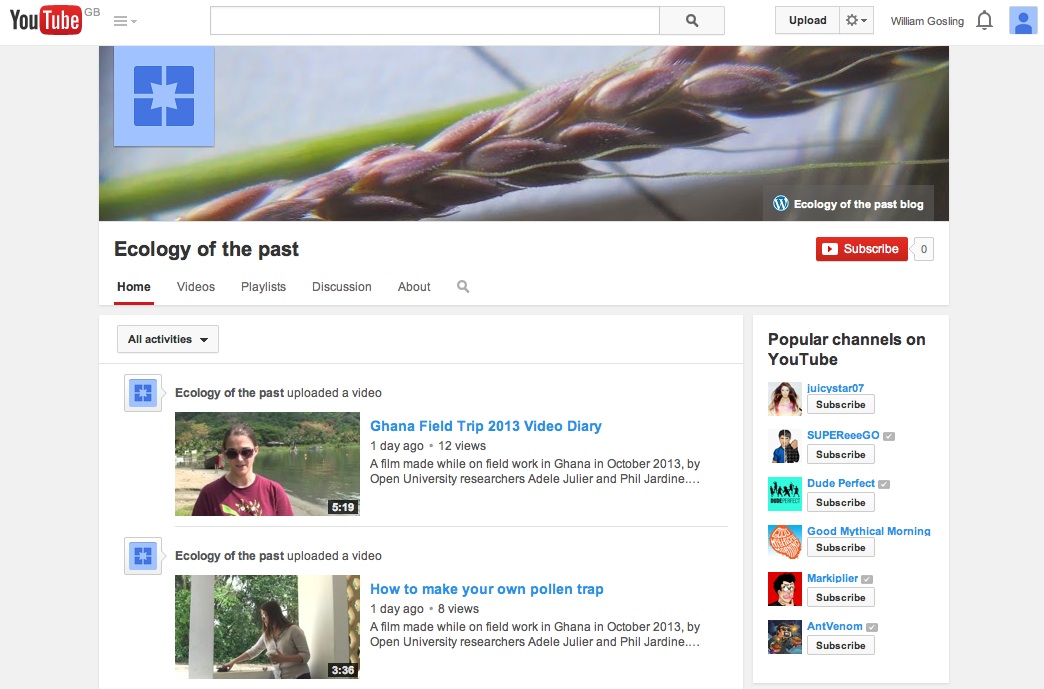


 Ecology of the past