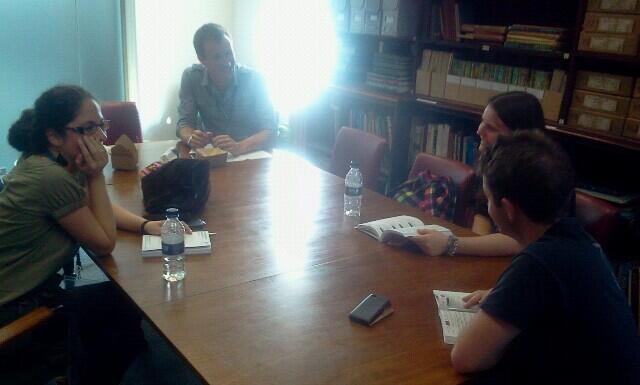
Palaeo-people at the RGS-IBG meeting plotting future papers and grants. Left-right: Encarni Montoya, Joe Williams, Hayley Keen and Frazer Bird.
RGS – IBG Annul International Conference 2013
27th – 30th August, London
Yesterday (29th August) four members of the Palaeoenvironmental Change Research Group (PCRG) went down to London for the third day of the Royal Geographical Society with IBG (RGS – IBG) international conference for a day of informative talks. Two of the morning sessions were of particular interest to us with the sessions entitled ‘Human – environment interactions in the Neotropics: historical impact to current challenges’organised by John Carson, Lizzy Rushton and Sarah Metcalfe.
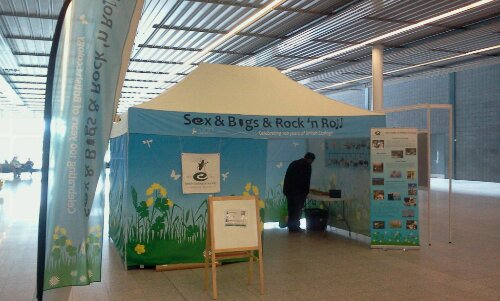
Sex & Bugs & Rock n Roll at INTECOL: The BES sponsored tour of music festivals (http://www.besfest.org) landed at INTECOL. David Price from Science made Simple (http://www.sciencemadesimple.co.uk/) arrived on the Wednesday day afternoon to show what can be achived with professional science busking.
As a palaeoecologist when I came back to the UK from my post doc in Florida I started to get involved with the British Ecological Society (BES) so I could meet neoecologists. Eight years later I am still involved in the society and delighted that the theme of the society’s centenary celebration meeting focuses on change through time: Into the next 100 years. With 11 plenary lectures, dozens of parallel session, hundreds of posters and other activities including Pecha Kucha talks, workshops, field trips and trade stalls I will restrict my post to my thinking about the theme of timescales and the broader messages I got from the meeting.
Last week I attended the annual meeting of the British Ecological Society Macroecology Special Interest Group (or BES Macroecology SIG for something a bit more manageable) at the University of Sheffield. Macroecology deals with ecological patterns and processes that occur over large spatial and temporal scales, and so is a natural fit for a lot of palaeoecological data.
The organisers deliberately moved away from the standard conference format of back-to-back talks, and instead built in lots of time for discussions around several themes (‘provacations’) that addressed the current status of macroecology and possible future directions for it. Several areas for progress were identified here, including finding more efficient ways of generating, curating and accessing large (global scale) datasets, increasing dialogue between numerical modellers and empirical ecologists, and more statistical and computational training for undergraduate ecologists and biologists.
Sessions of presentations were also formulated to encourage discussion and debate, with either rapid, five-minute presentations or longer methodological talks forming the starting point for further discourse. I struggled enormously with the five-minute time limit during my talk (conference talks are often built around a 15 minute slot) but hopefully interested a few people in the uses of 60 million year old pollen for addressing macroecological questions.
A workshop on ‘Spatial analysis in R’ followed the two-day meeting. This was taught by Barry Rowlingson, and was co-organised by the Macroecology and Computational Ecology SIGs. Barry started by introducing the programme R and then went on to demonstrate its uses for handling, mapping and analysing spatial data. This type of analysis was largely new to me, and this workshop was a brilliant introduction to what R can do with geographical data.
To join these British Ecological Society SIGs and find out about other groups visit the BES SIG pages by clicking here.
12th International Workshop on Subfossils Chironomids
10-13th June, New Forest, UK
Last month Frazer and Encarni attended the 3-days “dead heads” workshop that was held at the Beaulieu Hotel , in the New Forest National Park (UK). It was perfectly organised by Pete Langdon and Steve Brooks, and was a great opportunity for both of us who are relatively new to the midges’ community. With around 40 participants from Europe, America and Asia, we greatly enjoyed the discussions that came up about the state-of-the-art for this interesting proxy and the implications for palaeoclimatology, palaeolimnology, and different aspects of ecology like conservation, restoration or community assemblages. In addition, useful topics such as current methodological problems with age-depth model uncertainties, the usefulness and limitations of transfer functions, and taxonomy were also debated.
Besides oral and poster presentations, the workshop offered several tutorials during the afternoons, key amoung these were an introduction to R carried out by Richard Telford and Steve Juggins, and taxonomic support for head capsules ID leaded by Steve Brooks and Oliver Heiri.
In our specific case, Frazer contributed with an oral presentation titled “Understanding the modern distributions and ecological tolerances of the Neotropical Chironomidae fauna: The potential as a palaeoecological proxy” base on his PhD research. We were both so glad to make contact with other people working in South America, in particular Julieta Massaferro and Alberto Araneda presented very interesting data from Argentina and Chile.
Although these meetings are normally biannual, next conference location and date is yet to be decided, but we hope to have the chance to join this very friendly and supporting community again. We encourage people with all kind of experience (or lack of) to attend any further events.
I am glad to say that after almost two months out of the office running around with 8 bags of equipment, Frazer and I have finished our tour of the Americas. As the work has been so diverse, we would like to split our comments and impressions into two different posts, we hope you enjoy them!
Prof. H. Hoogiemstra Chair of Palaeoecology & Landscape ecology at IBED
Dutch and Belgian Palynology meeting
University of Amsterdam
13/12/2012
Many thanks to Henry Hooghiemstra for the invitation to present at the recent palynology meeting in Amsterdam hosted by the Institute of Biodiversity and Ecosystems Dynamics (IBED). The program of talks was broad and interesting ranging from the deep time geological history of the Amazon basin (Carina Hoorn) to the use of video game technology in visulizing landscapes (Bodo Schuetze); watch videos of his work, or read the thesis.
View Schuetze’s work on recreating Mauritius in 3D on Vimeo
I contributed some new work on human-landscape interaction in the central Andes, entitled: “Ecosystem service provision sets the pace for pre-Columbian Andean societal development”. It was very exciting to get feedback from such an esteemed audience on this new work. The days talks concluded with the IBED seminar given by Mark Bush (Florida Institute of Technology) which countinued the South American human-environment theme but we moved to the lowlands for “Amazonia in 1491: A paleoecological perspective”. Mark’s talk built on his recent work exmining the extent of human impact on Amazonia (references 1-3 below) which has cautioned against assuming widespread and intensive human impact within Amazonia prior to the arrival of Europeans.
Following the seminars we had drinks at the institute and an excellent meal in Amsterdam. Thanks again to Henry and all those at IBED who hosted a high class and scientifically stimulating meeting.
The PCRG contribution to the meeting was made by Hayley Keen who presented the first paper related to her doctoral research to an exteral audience entitled “Pollen counting for diverse tropical ecosystems”. The paper presented:
A statistical model (developed by co-author Felix Hanke) which simulaltes pollen counting in order to estimate the size of pollen count required to develop a robust ecological insight from the fossil pollen record, and
compared model predictions with empirical data from a diverse tropopical ecosystem (Mera, Ecuador) to assess the reliablity of the model.
It is hoped the application of the model to fossil pollen counting will allow more efficient and effective use of palynologists time. The paper was very well recieved despite the audible intake of breath when Hayley recommened that to characterize pollen richness (diversity) in some settings pollen counts in excess of 2000 grains might be required!
On Tuesday the UK participation in the International Continental scientific Drilling Program (ICDP) was officially launched at the British Geological Survey (Keyworth). The ICDP is designed to help scientists with the aquisition of samples to answer fundemental questions related to geological and enviornmental science. Now that the UK has membership to the ICDP, thanks to investment from the BGS, UK based scientists can take more of a lead in developing projects. Having worked on two projects based on ICDP sediments (Lake’s Titicaca and Bosumtwi) I am delighted by this development and hope over the next few years to be able to get involved in further exciting research.
Particpants on the Numerical Analysis course 2012: Lottie Miller, Guiomar Sanchez, Maria Rubio, John Douglass and Sonia Jaehnig (left-right). Photo courtesy of Manuela Milan.
The course provided an introduction to the methods, guidance as to when to use the techniques and then outlined the assumptions, limitations and strengths of the various methods. The need to fully understand the techniques applied before attempting to critically evaluate the results was also strongly emphasised.
The course consisted of lectures covering measures of dispersion, cluster analysis, dendrograms, regression analysis, tree models, gradient analysis, transfer functions, time series and hypothesis testing. Afternoon practical computer classes involved using R, C2 and CANOCO to implement the various techniques covered in the lectures.
Overall the course was a great introduction to statistical analysis which I would certainly recommend for anybody working with complex and noisy datasets. In the next few days I will be using my newly learnt R skills to run indirect gradient analysis such as PCA, CA, DCA and NMDSCAL to search for environmental gradients within my data.
Numerical Analysis of Biological and Environmental Data training couse is an annual event and was held at UCL, on 14-25th May 2012. For more information about the course see Gavin’s website or read his blog From the bottom of the heap.
This small (about 30 attendees) workshop brought together academic researchers mainly working in the field of past environmental change to discuss the use, and potential use, of data sets in understanding the key environmental challenges facing society. The bulk of the discussion took place with reference to ‘ecosystem services’. Three types of ecosystem service were mentioned early on for which it was thought that the fossil record can provide a unique long term perspective (beyond historical records): 1) provisioning services (e.g. food, timber, biofuels), 2) regulating services (e.g. carbon), and 3) cultural services (e.g. national parks, tourism).
Below I will summarize some of the issues discussed. Please note that this does not cover the full range of discussion or all of the many high quality contributions. For further information click here to visit the workshop web page.



 Ecology of the past