The second part of our Ecuadorian expedition took in lakes and sections close to the towns of Papallacta and Cosanga. The variation in climatic conditions was marked as we experienced first hand the transition from freezing fog and driving rain to burning sun and heat within a few tens of kilometers as we travelled from >4000 m down to around 1000 m elevation.
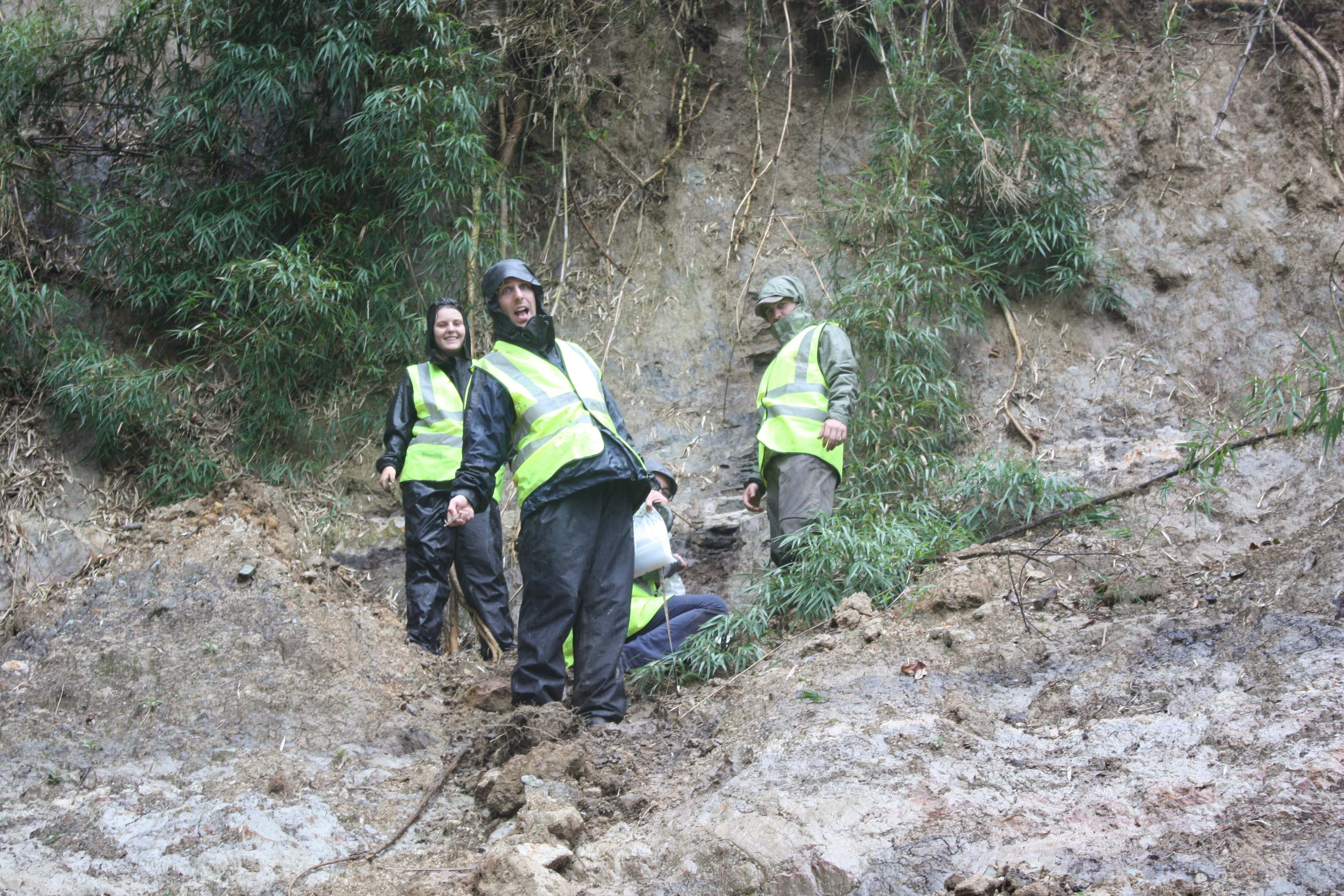
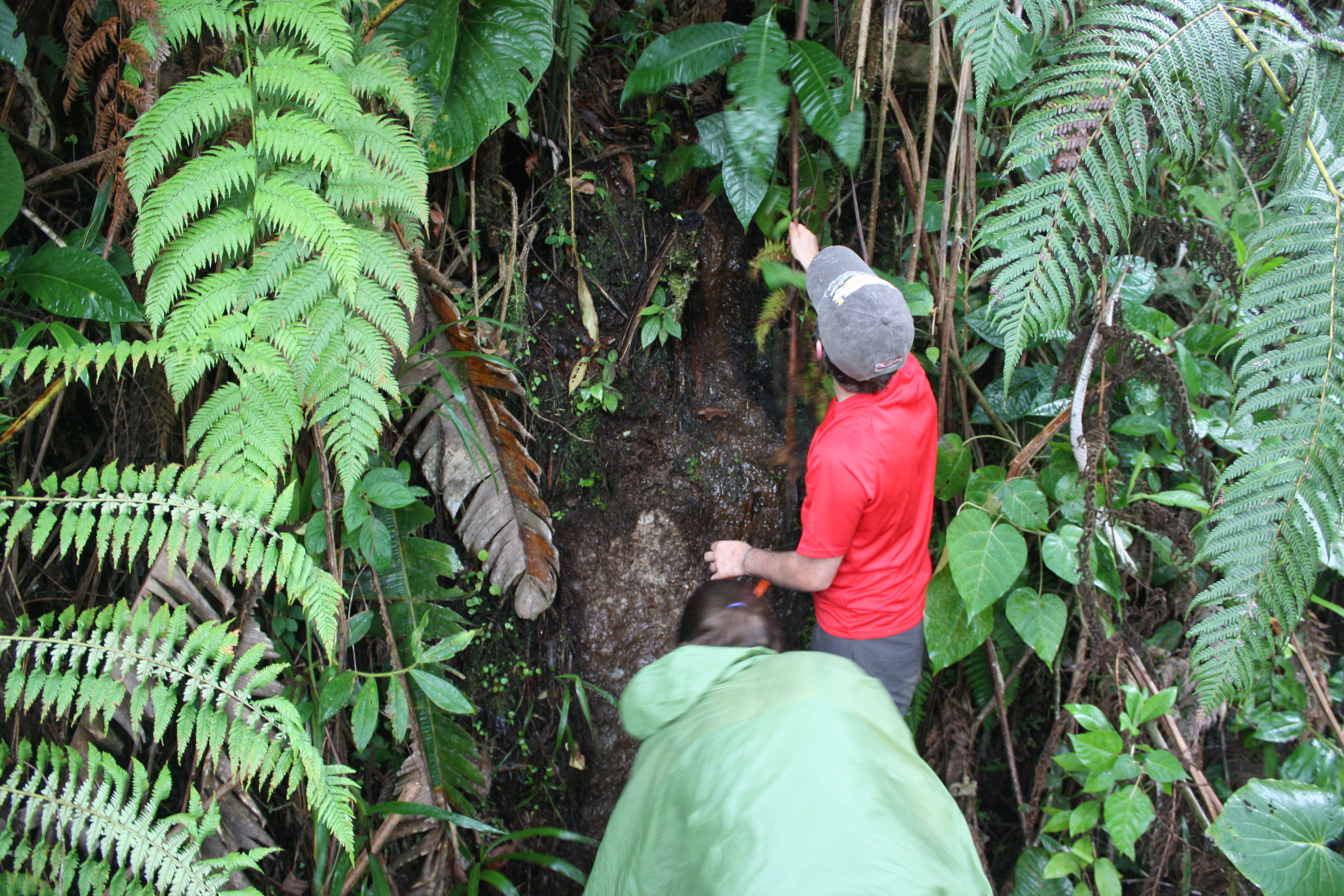
Sampling the sedimentary section at Vinillos was hampered by a tropical downpour. Sediments recovered from here include volcanic ash, mud slide deposits including large wood macrofossils and fine grained organic sediments probably deposited in still water environments.
Preparing to recover a short core from a pond near the antenas at Cujuca. Short cores will be used for Chironomid analysis.
Tomorrow we will attempt to recover short cores from two more lakes. Then our final few days here in Ecuador will be spent visiting partners and packing up.
The first half of our field work expedition to Ecuador has now been completed. We had a very successful visit to Mera collecting samples from three new sections and recovered short cores from four lakes.
The sediment sections have yielded many wood macrofossils and samples for pollen analysis. It is anticipated that these will shed light on the nature of tropical vegetation during the last glacial period and before. Some of these samples will be analyzed by Hayley as part of her PhD research.
The sedimentary section found near Mera contained layers of crushed forest beneath volcanic ash. These “forest beds” provide a snapshot of vegetation in the landscape at the time of eruption. Part of plants growing on the landscape thousands of years ago are clearly preserved in the sediment.
We have now spent two days in sampling sedimentary sections near the Rio Tigre close to Mera in Ecuador. The sections are peat deposits interspersed with volcanic ash and contain many wood macrofossils. It seems likely that the depositional environment was a shallow water swamp or bog. Although we will have to wait for the analysis of the fossil record to know the composition of the vegetation at the site.
I whish I could start with “ Once upon a time…” because that would be the easiest way to begin this paragraph (or a paper). Besides, to some extend, “Once upon a time” can be appropriate because this is a story related to the OLD friends of the Paddington Bear. By that, I mean a story about the mega fauna in South America.
Macrauchenia drawn by Kobrina Olga (Photo credit: Wikipedia)
On Tuesday the UK participation in the International Continental scientific Drilling Program (ICDP) was officially launched at the British Geological Survey (Keyworth). The ICDP is designed to help scientists with the aquisition of samples to answer fundemental questions related to geological and enviornmental science. Now that the UK has membership to the ICDP, thanks to investment from the BGS, UK based scientists can take more of a lead in developing projects. Having worked on two projects based on ICDP sediments (Lake’s Titicaca and Bosumtwi) I am delighted by this development and hope over the next few years to be able to get involved in further exciting research.
Particpants on the Numerical Analysis course 2012: Lottie Miller, Guiomar Sanchez, Maria Rubio, John Douglass and Sonia Jaehnig (left-right). Photo courtesy of Manuela Milan.
The course provided an introduction to the methods, guidance as to when to use the techniques and then outlined the assumptions, limitations and strengths of the various methods. The need to fully understand the techniques applied before attempting to critically evaluate the results was also strongly emphasised.
The course consisted of lectures covering measures of dispersion, cluster analysis, dendrograms, regression analysis, tree models, gradient analysis, transfer functions, time series and hypothesis testing. Afternoon practical computer classes involved using R, C2 and CANOCO to implement the various techniques covered in the lectures.
Overall the course was a great introduction to statistical analysis which I would certainly recommend for anybody working with complex and noisy datasets. In the next few days I will be using my newly learnt R skills to run indirect gradient analysis such as PCA, CA, DCA and NMDSCAL to search for environmental gradients within my data.
Numerical Analysis of Biological and Environmental Data training couse is an annual event and was held at UCL, on 14-25th May 2012. For more information about the course see Gavin’s website or read his blog From the bottom of the heap.
This small (about 30 attendees) workshop brought together academic researchers mainly working in the field of past environmental change to discuss the use, and potential use, of data sets in understanding the key environmental challenges facing society. The bulk of the discussion took place with reference to ‘ecosystem services’. Three types of ecosystem service were mentioned early on for which it was thought that the fossil record can provide a unique long term perspective (beyond historical records): 1) provisioning services (e.g. food, timber, biofuels), 2) regulating services (e.g. carbon), and 3) cultural services (e.g. national parks, tourism).
Below I will summarize some of the issues discussed. Please note that this does not cover the full range of discussion or all of the many high quality contributions. For further information click here to visit the workshop web page.
Quaternary – the last 2.6 million years of Earth history (click here for more detailed definition) Hindsight – knowing what to do after the event
The 2012 Annual Discussion Meeting of the Quaternary Research Association, entitled Quaternary Science & Society, focused upon:
The way in which observations of past environmental change can serve as “hindsight” with regard to the consequences of ongoing and predicted environmental and climatic change, and
How scientists might best communicate scientific method and research findings effectively beyond academia, e.g. for policy makers, geoscience professionals and the general public.
Given the nature of this meeting it seems like an ideal subject for the first report on this blog. I will not cover details of all the talks here; however I hope to capture the key themes and highlight a range of interesting examples from this wide ranging and high quality scientific meeting. I will also try and provide links to external sites with further information on projects/researchers where appropriate.





 Ecology of the past