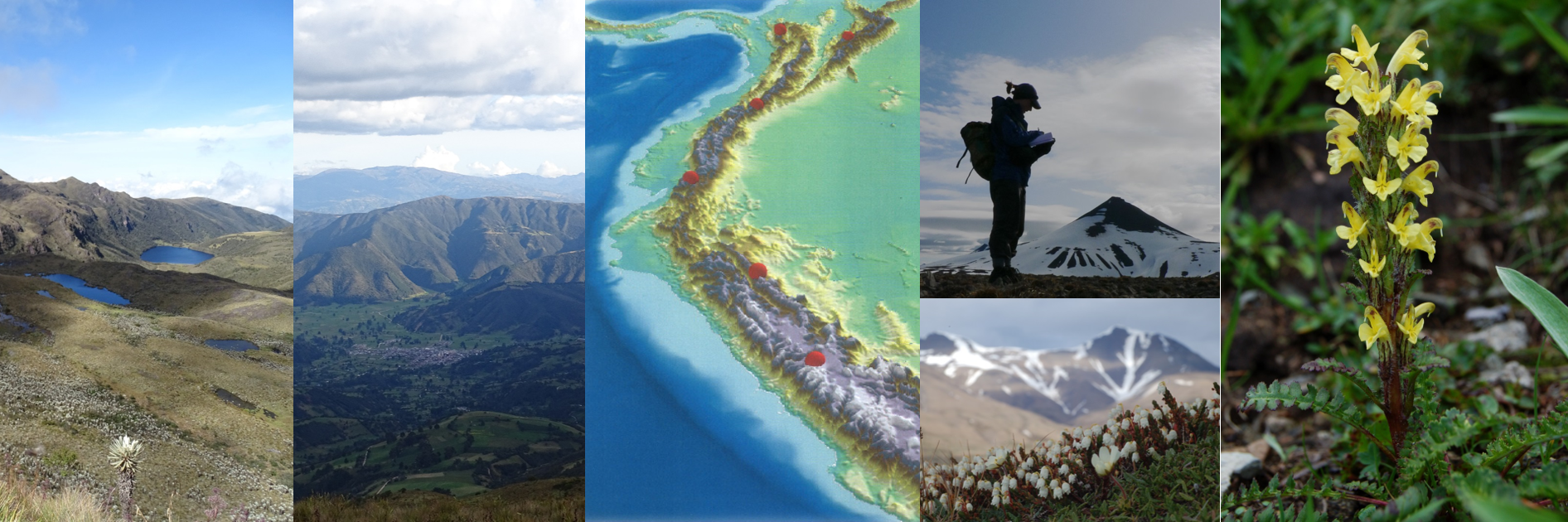
The Institute for Biodiversity & Ecosystem Dynamics is currently seeking two people to enhance our Computational Support team:
Click links for further details and how to apply. The closing date for both posts is 7 October 2018.
September 27, 2018
The Institute for Biodiversity & Ecosystem Dynamics is currently seeking two people to enhance our Computational Support team:
Click links for further details and how to apply. The closing date for both posts is 7 October 2018.
September 12, 2018
There is a vacancy for a 3 or 4-year PhD position at the University of Bergen’s Department of Biological Sciences.
The successful candidate will be primarily responsible for developing tests for evaluating the effect of humans through space and time on species range sizes and developing analyses to compare diversity patterns and range sizes from different data sources in mountainous regions, interpretation of pollen-stratigraphical data for reconstructing range size through time, and applying mapping techniques to assess the patterns over time and space.
Special requirements for the position:
Main PhD Supervisor: Prof. John-Arvid Grytnes. Co-supervised by: Dr. Suzette Flantua
To find out more click here.
August 30, 2018
Nolan, C., Overpeck, J.T., Allen, J.R.M., Anderson, P.M., Betancourt, J.L., Binney, H.A., Brewer, S., Bush, M.B., Chase, B.M., Cheddadi, R., Djamali, M., Dodson, J., Edwards, M.E., Gosling, W.D., Haberle, S., Hotchkiss, S.C., Huntley, B., Ivory, S.J., Kershaw, A.P., Kim, S., Latorre, C., Leydet, M., Lézine, A., Liu, K., Liu, Y., Lozhkin, A.V., McGlone, M.S., Marchant, R.A., Momohara, A., Moreno, P.I., Müller, S., Otto-Bliesner, B.L., Shen, C., Stevenson, J., Takahara, H., Tarasov, P.E., Tipton, J., Vincens, A., Weng, C., Xu, Q., Zheng, Z. & Jackson, S.T. (2018) Past and future global transformation of terrestrial ecosystems under climate change. Science 361, 920-923. DOI: 10.1126/science.aan5360
August 29, 2018
Hooghiemstra, H., Olijhoek, T., Hoogland, M., Prins, M., van Geel, B., Donders, T., Gosling, W.D. & Hofman, C. (2018) Columbus’ environmental impact in the New World: Land use change in the Yaque River valley, Dominican Republic. The Holocene. Online DOI: 10.1177/0959683618788732
July 27, 2018
Video by Thiago Rangel explaining our recent paper (Rangel et al., 2018).
July 26, 2018
20th Congress of the International Union for Quaternary Research (INQUA)
Abstract submission is now open for INQUA 2019 in Dublin Ireland (25-31 July 2019). Please consider submitting to the special session I am co-organizing on landscape change in the tropics. Submissions welcome from the fields of biogeography, palaeoecology, geomorphology, volcanology, and archaeology. Click here to submit your abstract.
TITLE: The changing tropical landscape
ORGANIZERS: William D. Gosling and Crystal N.H. McMichael (University of Amsterdam)
Eighteenth century explorers marveled at the diversity of tropical ecosystems seemingly untouched by human activity. As a result of these observations, the notion of tropical stability, in terms of vegetation and climate, came to underpin theories of evolution, ecology, and biogeography. Gradually, however, it has become apparent that tropical landscapes have changed markedly through time in response to global climate cycles, (a)biotic factors, and human activity. For example, Continue Reading
July 25, 2018
Loughlin, N.J.D. (2017) Changing human impact on the montane forests of the eastern Andean flank, Ecuador. PhD Thesis. School of Environment, Earth and Ecosystem Sciences, The Open University.
Abstract:
The montane cloud forests of South America are some of the most biodiverse habitats in the world, whilst also being especially vulnerable to climate change and human disturbance.
Today much of this landscape has been transformed into a mosaic of secondary forest and agricultural fields. This thesis uses palaeoecological proxies (pollen, non-pollen palynomorphs, charcoal, organic content) to interpret ecosystem dynamics during the late Quaternary, unravelling the vegetation history of the landscape and the relationship between people and the montane cloud forest of the eastern Andean flank of Ecuador. Two new sedimentary records are examined from the montane forest adjacent to the Río Cosanga (Vinillos) and in the Quijos Valley (Huila). These sites characterise the natural dynamics of a pre-human arrival montane forest and reveal how vegetation responded during historical changes in local human populations.
Non-pollen palynomorphs (NPPs) are employed in a novel approach to analyse a forest cover gradient across these sites. The analysis identifies a distinctive NPP assemblage connected to low forest cover and increased regional burning. Investigation into the late Pleistocene Vinillos sediments show volcanic activity to be the primary landscape-scale driver of ecosystem dynamics prior to human arrival, influencing montane forest populations but having little effect on vegetation composition.
Lake sediments at Huila from the last 700 years indicate the presence of pre-Hispanic peoples, managing and cultivating an open landscape. The subsequent colonization of the region by Europeans in the late 1500’s decimated the indigenous population, leading to the abandonment of the region in conjunction with an expansion in forest cover ca. 1588 CE. After approximately 130 years of vegetation recovery, montane cloud forest reached a stage of structural maturity comparable to that seen in the pre-human arrival forest. The following 100 years (1718-1822 CE) of low human population and minimal human impact in the region is proposed as a shifted ecological baseline for future restoration and conservation goals. This ‘cultural ecological baseline’ features a landscape that retains many of the ecosystem service provided by a pristine montane forest, while retaining the cultural history of its indigenous people within the vegetation. Continue Reading
July 23, 2018
Open access:
Woutersen, A., Jardine, P.E., Bogota-Angel, R.G., Zhang, H., Silvestro, D., Antonelli, A., Gogna, E., Erkens, R.H.J., Gosling, W.D., Dupont-Nivet, G. & Hoorn, C. (2018) A novel approach to study the morphology and chemistry of pollen in a phylogenetic context, applied to the halophytic taxon Nitraria L.(Nitrariaceae). PeerJ 6, e5055. DOI: 10.7717/peerj.5055
July 20, 2018

AFQUA: The African Quaternary environments, ecology and humans
2ndInternational Conference and Workshops
14-22 July 2018-07-15 National Museum, Nairobi, Kenya
Day 6
The final day of talks at AFQUA 2018 took a more applied approach in the first session “Applying the Quaternary: The role of the past in supporting the future”. This session focused on how we can focus Quaternary science to produce outputs that directly meet concerns and needs of society. Examples included the quantification of the fossil charcoal record to provide insights into the nature and impact of fires in the past (C. Adolf), how we can use information on past vegetation change and disturbance factors to anticipate how ecosystems on Madagascar might respond to future changes (E. Razanatsoa), and how climate histories can be extended through tree ring data (D. Colombaroli).
July 19, 2018
Rangel, T.F., Edwards, N.R., Holden, P.B., Diniz-Filho, J.A.F., Gosling, W.D., Coelho, M.T.P., Cassemiro, F.A.S., Rahbek, C. & Colwell, R.K. (2018) Modeling the ecology and evolution of biodiversity: Biogeographical cradles, museums, and graves. Science 361, . DOI: 10.1126/science.aar5452