The kick off meeting of the INQUA funded Mapping Ancient Africa project took place on the 14 and 15 October 2021. This hybrid meeting linked up face-to-face meetings in Kenya, South Africa, Germany and the USA online. In total around 35 people participated in the meeting over the two days. It was great to start to get researchers back into rooms together, and to take advantage of the online link ups to connect people within regions who could not travel, and people in different continents. The purpose of the meeting was to introduce the researchers to each other and to start to think about how we can work together to deliver the project goals of collating and synthesising data related to past climate, vegetation and hominin activity from across the continent.
To start discussion during the Mapping Ancient Africa kick off meeting (October 2021) lead author Stefanie Kaboth-Bahr has recorded an introduction to her recent paper proposing a novel tropical based climate mechanism for driving climatic change across Africa.
Kaboth-Bahr S, Gosling WD, Vogelsang R, Bahr A, Scerri EML, Asrat A, Cohen AS, Düsing W, Foerster V, Lamb HF, et al. 2021. Paleo-ENSO influence on African environments and early modern humans. Proceedings of the National Academy of Sciences 118(23):e2018277118. https://doi.org/10.1073/pnas.2018277118
The first meeting of the, INQUA funded, Mapping Ancient Africa project will take place on the 14 and 15 of October 2021 with face-to-face meetings at four locations (Nairobi, Kenya; Port Elisabeth, South Africa; Potsdam, Germany; Portland, Oregon, USA) being linked up online.
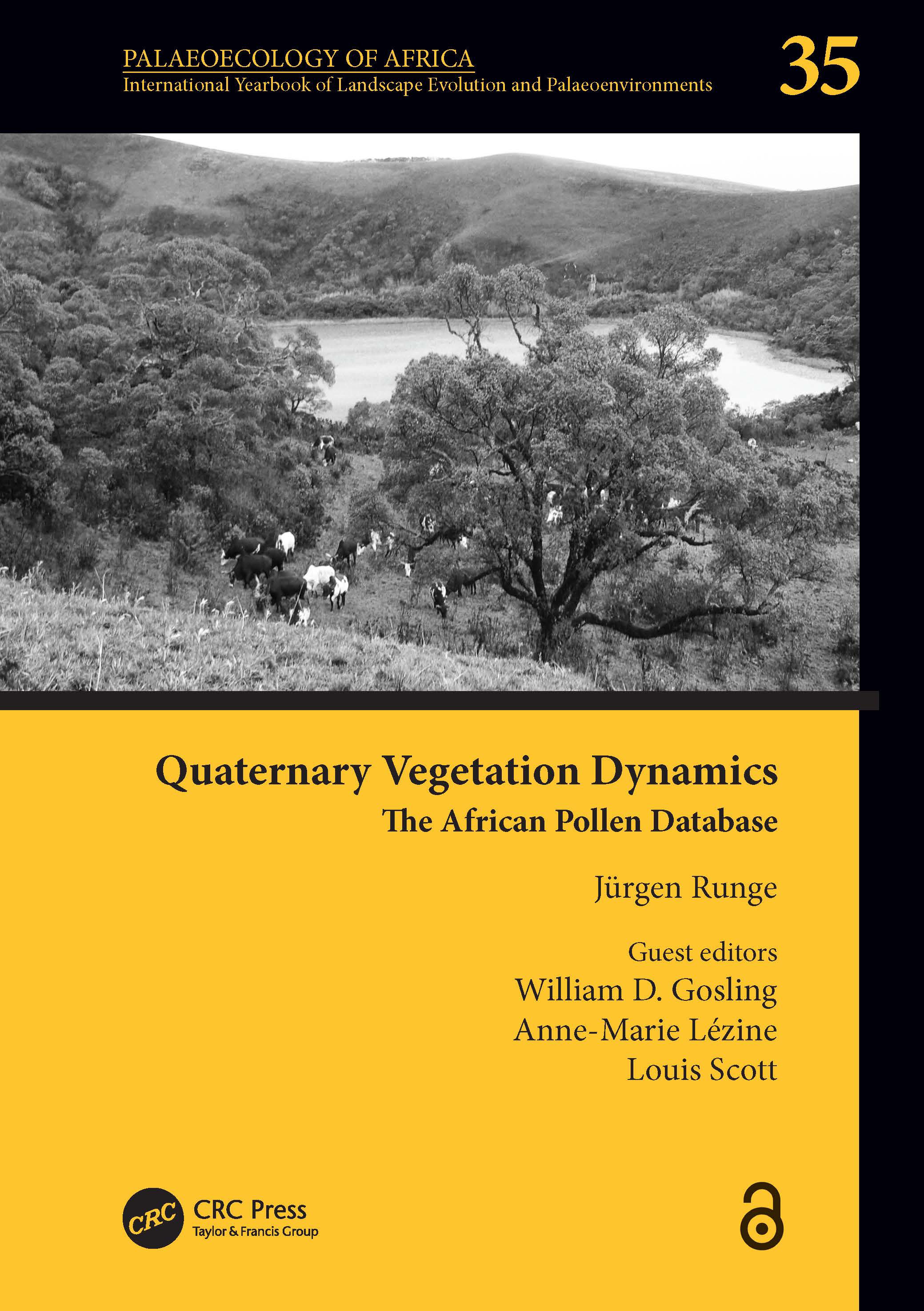
I am pleased to announce that the new, open access, volume of Palaeoecology of Africa (PoA) should be available to download in October. The “Quaternary Vegetation Dynamics” volume comprises 24 chapters, produced by more than 70 authors, and contains extensive review papers, personal perspectives on hot topics, as well as new research and data papers.
To find out more on the volume visit the publishers web site: PoA Vol. 35
Over the next few months I aim to blog about the various specific chapters to showcase some of the key findings. I hope that this book will provide a useful resource to all researchers working on past climate, environmental and vegetation change in Africa, and will provide a springboard for the start of the new “Mapping Ancient Africa” project that will kick off in October.
I am pleased to announce the start of a new project “Mapping Ancient Africa” funded by the International Union for Quaternary Research (INQUA) with support from the Palaeoclimate commission (PALCOM) and the Human & Biospheres commission (HABCOM). This project will bring together Quaternary scientists focused on past climates and environments with those working on human evolution and development in Africa. Through the synthesising data and linking these with modelling approaches we hope to bring together a novel group of researchers to explore the climatic and environmental backdrop to hominin development.
Further information on the project can be found on a new “sub-site” within this blog dedicated to the “Mapping Ancient Africa” project. The project is designed to connect researchers working on these topics so if you are interested to be involved please do get in contact. The first meeting will be held in October 2021 online and at four locations: Nairobi (Kenya), Port Elizabeth (South Africa), Potsdam (Germany) and Portland (Oregon, USA) – for further details click here.
We are looking for a researcher with a geosciences background to explore the physical properties of the sediments recovered from Lake Bosumtwi (Ghana). The Lake Bosumtwi sediments we recovered by the International Continental Scientific Drilling Program in 2004 and have been found to span the last c. 1.07 million years (Koerbel et al., 2005). This project will examine the borehole data and relate this ongoing palaeoenvironmental studies at the site (Miller & Gosling, 2014; Miller et al., 2016).
Kaboth-Bahr S, Gosling WD, Vogelsang R, Bahr A, Scerri EML, Asrat A, Cohen AS, Düsing W, Foerster V, Lamb HF, et al. 2021. Paleo-ENSO influence on African environments and early modern humans. Proceedings of the National Academy of Sciences 118(23):e2018277118. https://doi.org/10.1073/pnas.2018277118
Hi everyone, and welcome to the ALPHA project: Assessing Legacies of Past Human Activities in Amazonia!
This project will increase our understanding of how past disturbances have influenced the biodiversity and structure of Amazonian rainforests. The coming years, we will work on reconstructing past fire and vegetation history of forest plots in Amazonia, and how that history relates to modern biomass and modern carbon dynamics. ALPHA is important for forest conservation, because results can be used to prioritize land for conservation. ALPHA results will also give an estimation of the Amazonian rainforests’ ability to sequester carbon, which is important for global carbon models. dr. C.N.H. McMichael received an ERC grant to research ALPHA in Amazonia together with 2 PhD students, 1 post-doc, 2 technicians and a senior-staff. At the beginning of March, the positions were filled, and our team was complete. But then COVID-19 happened… and our team was spread over continents!
To keep ALPHA going, we started with weekly virtual lab meetings. Because these fruitful discussions are online, other researchers soon joined from the US, UK and Jamaica. It is not your average “vrijmibo”, but very fun and a nice way to stay connected! One of the papers we have discussed is the “Asynchronous carbon sink saturation in African and Amazonian tropical forests” from Hubau et al (2020).
In 2015, Brienen et al. published an article about the growth and mortality of trees in Amazonian rainforests for the period of 1985 to 2015. Their results showed a decline of the carbon sink in Amazonian forests.
Now, Hubau et al. (2020) added results from African forest plots and compared the net carbon sink of the African and Amazonian forests. Instead of a long-term decline, African forests showed a stable carbon sink. The difference in their carbon sink was because more trees died in Amazonia, but not in African forests. But since 2010, a decline is also visible in the carbon sink of African forests. This suggests that the two forests have a different ‘saturation’ point in the carbon they can storage.
A statistical model with CO2, temperature, drought and forest dynamics was created to predict the carbon changes of the forests over time. This model predicts that the carbon sink of African forests will show a gradual decline and the carbon sink of Amazonian forests will decline fast.
Overall, this paper highlights that our rainforests may not be the carbon sink we had thirty years ago. We will need to reduce greenhouse gas emissions sooner, if we want to limit global warming. Also, this paper showed how important forest dynamics are to accurately model and predict the carbon storage of Amazonia. Hopefully, the ALPHA research project will make a contribution to this!
I am delighted to announce that a new volume of the classic book series “Palaeoecology of Africa“ is now under development. This new volume (hopefully number 35) will focus on “Quaternary Vegetation Dynamics” and build on recent initiatives to develop the “African Pollen Database”. The volume will be guest edited by Anne-Marie Lezine (LOCEAN), Louis Scott (University of the Free State) and myself, along side the series editor Jürgen Runge (Johann Wolfgang Goethe University). If you are interested to contribute please get in touch.
Scope
The Quaternary Vegetation Dynamics volume of the long-running Palaeoecology of Africa series will showcase palynological work from across the African continent and surrounding regions, and place this in the context of past climatic, human and evolutionary change. We are keen to use this opportunity to catalyse the archiving of previously published and new datasets into the open access online African Pollen Database. The volume will be published entirely open access online and will contain four types of manuscript: (i) Research papers, (ii) Data papers, (iii) Review papers, and (iv) Perspectives.
Githumbi, E., Marchant, R. & Olago, D. (2020) Using the Past to Inform a Sustainable Future: Palaeoecological Insights from East Africa. Africa and the Sustainable Development Goals (ed. by M. Ramutsindela & D. Mickler), pp. 187-195. Springer Nature, Switzerland AG. DOI: 10.1007/978-3-030-14857-7_18








 Ecology of the past