The annual PhD thesis prize from the Koninklijk Nederlandse Botanische Vereniging (Royal Dutch Botanical Association) is now open. The prize of EURO 5000 will be awarded to the best PhD thesis defended between January and December 2025 at a Dutch university. The subject matter of the thesis is broadly defined within the field of botany, and includs topics such as taxonomy, (palaeo- / macro-) ecology, and cell biology.
The next seminar series of the Palynologische Kring (Dutch palynological society) will take place on 24 January 2025, at the Auditorium of TNO Utrecht. If you would like to attend please register by emailing the society (link).
PROGRAMME
13.00-13.15 Arrival
13.15-13.45 Irene Waajen (TNO): Re-evaluation of Early Weichselian pollen zones with new insights from the North Sea.
The annual PhD thesis prize from the Koninklijk Nederlandse Botanische Vereniging (Royal Dutch Botanical Association) is now open. The prize of EURO 5000 will be awarded to the best PhD thesis defended between January and December 2024 at a Dutch university. The subject matter of the thesis is broadly defined within the field of botany, and includs topics such as taxonomy, (palaeo- / macro-) ecology, and cell biology.
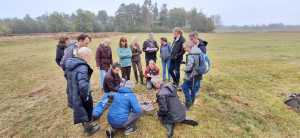
During the seminar afternoon (17 October) we heard four talks. The first from Harm Smeenge and Ariët Kieskamp (both Bosgroep) introduced the sites we were to visit on the excursion the next day. This focused on the landscape ecology and ecological history of the bogs on the eastern slopes of the Veluwe. The second talk, by Roy van Beek (Wageningen University & Research), focused on the Celtic field systems around the Veluwe. He explained the latest archaeological and archaeobotaincal work investigating the age and origins of these field systems. The third presentation was by Jasper Candel (Wageningen University & Research) and focused on the geomorphological features from glacial activity in the Veluwe region and how this has effected the development of mire ecosystems. I (William Gosling) gave the final talk, presenting the outputs of the research theses of Sanna Wessel, Chiara Raino and Roos Dik who all completed projects at the University of Amsterdam and worked together to investigate how different mega-herbivore populations in the Dutch landscape were represented by the dung fungal spores preserved in the soil.
13.00-13.30: Ontvangst met koffie / Arrival with coffee
13.30-14.00: Harm Smeenge & Ariet Kieskamp (Bosgroepen): Landscape ecological/historical ecological characteristics of bogs in the eastern slopes of the Veluwe
14.00-14.30: Roy van Beek (WUR): Archeological, archeobotanical and morphological aspects of the Celtic Field complex of Vaassen (Veluwe)
14.30-15.00: Koffiepauze / Coffee break
15.00-15.30 Jasper Candel (WUR): Geophysical research in the push moraine of the Veluwe and relation with peat development in valley mires
15.30-16.00: William Gosling (UvA): On the use of spores of coprophilous fungi in characterizing herbivory past and present in Dutch landscapes
Voor mensen die slecht ter been zijn, is er beperkte mogelijkheid om met eigen auto deel te nemen aan de excursie (max. 2 auto’s kunnen parkeren bij de excursiepunten). / For people with walking or cycling difficulties there is a limited opportunity to come in a car on the trip (maximum 2 cars can park at the excursion points).
For further information and costs please email Nelleke van Asch (secretary of the Palynologische Kring). Contact details can be found at: https://www.palynologischekring.nl/contact/
Attention Dutch biologists: The deadline for submission of nominations for the Hugo de Vries Prijs is closing soon (31 January 2024). The prize is awarded to the best biology PhD thesis defended at a Dutch university in 2023. The types of thesis considered by the panel within the category on “biology” is broad, and – for readers of this blog – includes (palaeo)ecology.
A new funding stream is about to open up (1 December 2023) to support African scientists to carry out PhD research at Dutch universities. The GROW research programme (Graduate Research on Worldwide Challenges) will fund 51 PhD positions to be based at one of five Dutch universities, including with the Institute for Biodiversity & Ecosystem Dynamics, at the University of Amsterdam.
The June 2023 meeting of the Dutch palynological society (Palynologische Kring) took place at the offices of the Dutch National Cultural Heritage Agency (Rijksdienst Cultureel Erfgoed) in Amersfoort. The focus of this meeting was the past forest landscape of the Netherlands. The meeting included the annual report of the society, three scientific talks, and a prize giving for the best MSc thesis.
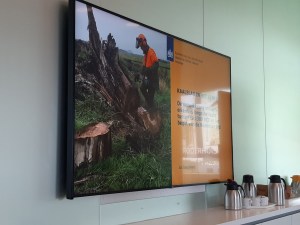
Presentation of Jos Bazelmans showed the huge amount of woody material extracted from Dutch peat bogs.
The scientific part of the meeting was kicked off my Roy van Beek who presented results from his ongoing project on the peatlands of the Netherlands which suggest peatland expansion occurred between 5500 and 3500 years ago (van Beek et al., 2023). The second talk was by our host, Otto Brinkkemper, and traced the history of woodlands across the Netherlands on the basis of macrofossil finds; including huge tree stumps remarkably preserved in peatlands (Bazelmans et al., 2021; Kooistra et al., 2006). The final talk was given by Jos Bazelmans who showed the remarkably high volume of tree stumps that have been recovered from the Netherlands, and how tree rings from these 100s of record are being used to reconstruct forest histories and past climate change. It was interesting to hear that the average age of the tree stumps found was around 250 years, and that some of the trees had lived to around 400 years in exceptional cases.
Kelly with her proud supervisors Stefan Uitdehaag (right), and I (left)
The final section of the meeting was the prize giving. Corrie Barkels, on behalf of the independent judging panel, announced Kelly van Leeuwen as the winner for her thesis entitled “Using soils samples and footwear to improve forensic palynology”. Her thesis was conducted at the University of Amsterdam as part of her MSc Earth Sciences degree and was conducted in collaboration with the Netherlands Forensic Institute. Congratulations Kelly!
de Wolf, I.K., McMichael, C.N.H., Philip, A.L. & Gosling, W.D. (2022) Characterising Dutch forests, wetlands and cultivated lands on the basis of phytolith assemblages. Netherlands Journal of Geosciences 101, e17. DOI: 10.1017/njg.2022.14
This paper started off as a research thesis undertaken by Iris de Wolf at the University of Amsterdam as part of her BSc Biology degree in 2018. The project was supervised by Crystal McMichael and William Gosling and has subsequently been further developed. If you are student or researcher interested in undertaking a similar type of projects please get in touch.
Listen to Iris’s journal podcast speaking about the subject here.
The next online seminar day of the Palynologishe Kring will take place on Friday 18 February.
Programma
13:00 Welcome
13:10 – 13:30 Annual General Meeting – finances, activities and board election. New Board member: Nelleke van Asch
13:30 – 14:00 Sander Houben (TNO) – Advances in Palaeozoic stratigraphy in the Netherlands
14:00 – 14:30 Marjolein van der Linden & Lucy Kubiak-Martens (BIAX) – What goes up must come down: The Neolithic human diet based on coprolites from the Swifterbant sites
14:30 – 14:45 Break
14:45 – 15:00 Announcement of Florschütz award winner 2021
15:00 – 15:30 Iris de Wolf and Thomas Giesecke (UU) – Unlocking the wealth of Dutch Pollen data: A new data portal and highlights
15:30 – 16:00 Stefan Uitdehaag (NFI) – Pollen – Silent witness to solving homicides









 Ecology of the past