
Lake Huila
So we’re back from a hot and humid Ecuador to the joys of a British winter. Ecuador is an amazing country and the diversity of the flora and fauna surpasses anything that I have experienced before. Continue Reading

January 14, 2014
Lake Huila
So we’re back from a hot and humid Ecuador to the joys of a British winter. Ecuador is an amazing country and the diversity of the flora and fauna surpasses anything that I have experienced before. Continue Reading
December 20, 2013
The latter half of 2013 seems to have been incredibly busy and I have not managed to get my monthly update posts completed since October. Rather than a rapid series of backdates here is a quick summary of what I think the main activities through this period have been!
Thesis defence: Congratulations to both Lottie and Natalie for sucessfully defending their PhD theses! Exeptional effort and hard work from both of you. Well done.
Publications: Four articles have gone through the final stages and been published in top journals. Well done to Lottie, Maca, Wes for leading three of those publications covering Lake Bosumtwi, Erazo and pollen/spore chemistry respectively. Personally I am delighted that the revised tropical pollen atlas is now online and open access. The final stages of publication of the atlas with Review of Palaeobotany and Palynology were hard work but great to see it online and avaliable. Thanks to Lottie and Dan Livingstone for their invaluable contributions.
Grant: We have been awarded further 14C dates from NERC radiocarbon facility to improve the chronology on Laguna Khomer Kotcha Upper so that the timing of temperature osscilations revealed by new chironomid analysis (by Frazer Bird) can be related to the last global degalciation (c. 18,000 years ago) and the Younger Dryas cooling event (c. 12,800 – 11,500 years ago). This research builds on that of former PCRG PhD student and current research collaborator Joe Williams (Williams et al., 2011; Williams et al., 2012).
Teaching: I have been working primarily on the Geological record of environmental change (S369) presentation, and writing the landforms section for the new level 2 environmental science module.
Fieldwork: Trips to Ghana (Adele and Phil) and Ecuador (Nick, Encarni and Will) have been super successful; AND all the samples have made it back! See posts elsewhere on the blog for details of field work fun.
I am sure other stuff has happened… more in the New Year… and maybe some more pictures when I can get back on my newly “optimized” (killed) office computer 🙂
December 13, 2013

Nick and Will with Carman (director of the Pindo Mirador biological station)
Three members of the PCRG (William Gosling, Encarni Montoya and Nick Loughlin) visited Ecuador (November-December 2013) to develop collaborations with Ecuadorian institutions, recover more lake sediments, and find new potential sites for projects. Below are some photos from:
Full reports on specific aspects of the fieldwork to follow.
Cárdenas, M.L., Gosling, W.D., Pennington, R.T., Poole, I., Sherlock, S.C. & Mothes, P. (2014) Forests of the tropical eastern Andean flank during the middle Pleistocene. Palaeogeography, Palaeoclimatology, Palaeoecology, 393: 76-89.
October 2, 2013

Section of fossil wood from Ecuador
Having been away for half of the month I asked people to provide a summary of what they have been up to. Here is what they admitted to…
Natalie Ludgate and Lottie Miller have submitted their theses! Well done.
Hayley Keen: “Continual pollen counting, second lot of Argon dating done, and first set of wood macrofossils back and ready for identification!”
Frazer Bird: “At the start of September I began working as a technician as part of Encarni’s project. I am looking at the midges from the core we collected together on our last field trip. Things are going well, although the midges are hard to find in the older sections the preservation in early sequences is great. The resolution of this core looks to be fantastic also so and hopefully we will get some interesting results when we compare all the proxies. Away fromthe lab I presented at INTECOL 2013 in London, The talk seemed to go down well and was noted as highly commended by the judging panel. Great publicity all round for the midges!!!”
Bryan Valencia: Has been on field work in Peru during this time he presented a talk on climate change to the Asociación para la Conservación de la Cuenca Amazónica, and gave interviews to local journalists and two TV stations. He also collected sediments from two locations, and manged to obtain a new US visa. He is now working on the final stages of submitting his thesis.
Phil Jardine: Phil has been busy ordering in microscopes and other equipment for the Lake Bosumtwi project (the first of which arrived today), and setting up the trip to Ghana that he’ll be going on with new PhD student Adele Julier in late October. He’s also been attempting to learn more about geochemistry, which has proved challenging.
William Gosling: “I have been promoted to Senior Lecturer (hooray), started work on the new level 2 environmental science module, been working on a new paper from the Erazo study site, and had a holiday!”
September 4, 2013
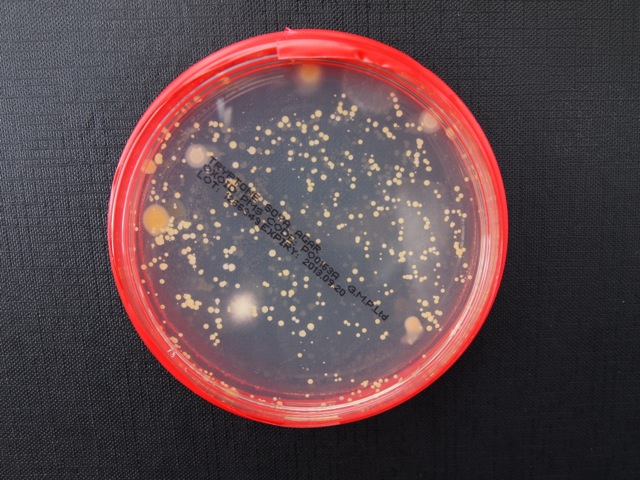
Will’s BES T-shirt logo swabbed at Greenman; for more microbes on festival kit visit the “Hall of shame” on http://www.besfest.org
August was a month for travel with PCRG members heading for Peru (Bryan, and he is still there), Greenman festival (William), INTECOL conference (William and Frazer), and the Royal Geographic Society annual meeting (William, Encarni, Frazer and Hayley). Detailed reports of the UK based travels are already on the blog, and hopefully we will get a post from Bryan on his Peruvian adventure once he is back.
Back in Milton Keynes work progressed with:
March 1, 2013

Four new workstations installed in the Past Environmental Change microscope lab
Excitement in February saw the arrival of a new research grant within the PCRG, to look at pollen and spore chemistry from Lake Bosumtwi (watch this space for new post-doc and PhD studentship positions), and (just in time) the expansion of benches in the microscope lab which will ensure that the new people will have spaces to sit in! In addition, we had a paper published with long time friends and collaborators at the University of Leeds; Roucoux et al. (2013).
Despite the disruption of the lab refit Hayley and Frazer have been cracking on with pollen and chironomid analysis. Encarni and Frazer returned from field work in Ecuador and half the samples have so far made it back to The Open University; we now wait with anticipation for customs to release the other box!

Four shiny new workstations from the other side – woo
Meanwhile I have been working on exam questions for the Geological Record of Environmental Change module (S369), interviewing prospective PhD candidates for the October 2013 start projects and have been on a training course to learn about the Vitae support for research student training.
February 26, 2013
PCRG COMPLETE AGAIN

I am glad to say that after almost two months out of the office running around with 8 bags of equipment, Frazer and I have finished our tour of the Americas. As the work has been so diverse, we would like to split our comments and impressions into two different posts, we hope you enjoy them!
January 31, 2013

We are taking the BES festival of ecology to music festivals in 2013! “Tell me when”… you’d better read the blog!
January seems to have flown past and has been another active month. With group members variously involved in:
January 10, 2013
The last two months of 2012 were exceptionally busy!
On the research front
On the teaching and administration front
Two tasks dominated the non-research activity: 1) teaching the Geological Record of Environmental Change (S369) exams assessment and assigment, and 2) as Post Graduate Tutor keeping up with NERC developments for the new Doctoral Training Partnerships.

PCRG members on field work in Cayabe-Coca National Park (2012). Left to right: Hayley, Encarni, William and Frazer.
Encarni and Frazer have returned to Ecuador Jan-Feb 2013 to collect further sedimentary cores. More on the blog soon…
Finally all that remains is to say “Happy New Year” from the PCRG and on with 2013… 🙂
 Ecology of the past