Published open access:

Julier, A.C.M., Jardine, P.E., Coe, A.L., Gosling, W.D., Lomax, B.H. & Fraser, W.T. (2016) Chemotaxonomy as a tool for interpreting the cryptic diversity of Poaceae pollen. Review of Palaeobotany and Palynology 235, 140-147. DOI: 10.1016/j.revpalbo.2016.08.004

Linnean Society Palynology Specialist Group

November 17, 2015
WDG


Posted on behalf of Barry Lomax
Linnean Society Palynology Specialist Group meeting

Linnean Society of London
Tuesday 24 November 2015

Provisional program

10:30 – 11:00 Barry Thomas (Aberystwyth University). Ecological interpretations of Asturian and Cantabrian lycophyte microspore floras of the Variscan Foreland and the Appalachian Province of the Central Coalfields of the U.S.A

11:00 – 11:30 Adele Julier (Open University). Can FTIR spectroscopy be used to identify grass pollen?

Morning Coffee 11:30-12:00

12:00 – 12:30 Katrina Bakker (York University). Spore particles: new materials applications.

Lunch 12:30-14:00

14:00 – 14:30 Viktória Baranyi1 (Oslo Universiy). Morphology and wall-ultrastructure of Froelichsporites traversei, an enigmatic sporomorph from the Late Triassic in North America.

14:30 – 15:00 Hannah Banks (Royal Botanic Gardens Kew). Functional and phylogenetically useful structures in Caesalpinioid legume pollen.

15:00 – 15:30 Sam Slater (Sheffield University). A quantitative analysis of Middle Jurassic vegetation dynamics based on dispersed spore/pollen assemblages from the Ravenscar Group, North Yorkshire, UK.

Afternoon tea 15:30 – 16:00

16:00 – 16:30 Alex Askew (Sheffield University). A palynological investigation of the Middle Devonian of northern Spain: hunting for the Kačák event.

16:30 – 17:00 Phil Jardine (Open University). A new use for old pollen: reconstructing past solar irradiance using pollen chemistry.

Wine reception

To register please contact Barry Lomax (Group secretary)
PCRG August

September 4, 2013
WDG

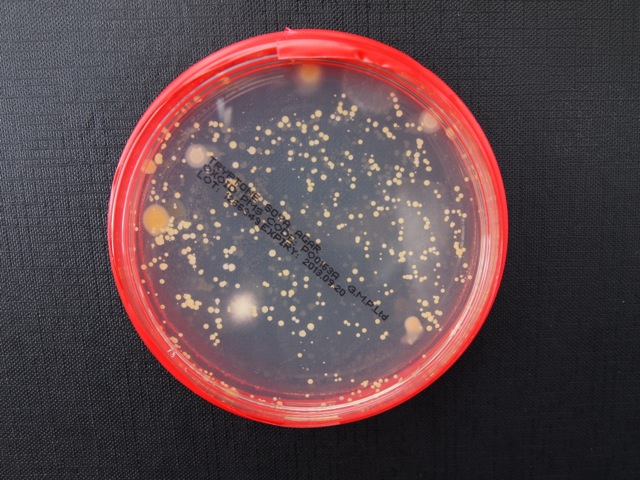
Will's BES T-shirt logo swabbed at Greenman

Will’s BES T-shirt logo swabbed at Greenman; for more microbes on festival kit visit the “Hall of shame” on http://www.besfest.org

August was a month for travel with PCRG members heading for Peru (Bryan, and he is still there), Greenman festival (William), INTECOL conference (William and Frazer), and the Royal Geographic Society annual meeting (William, Encarni, Frazer and Hayley). Detailed reports of the UK based travels are already on the blog, and hopefully we will get a post from Bryan on his Peruvian adventure once he is back.

Back in Milton Keynes work progressed with:

  • Hayley producing a revised full draft of her pollen counting methodology manuscript,
  • Frazer starting with the first tentative attempts to apply his chironomid training data set to fossil chironomid records,
  • Phil trialing inverted microscopes and training on the FTIR,
  • Encarni plotting field work in Ecuador (more travel for November-December),
  • William seeming to spend alot of time working on research strategy for the faculty, and thinking about writing teaching material for the ongoing revison of our level 2 environmental science module, and
  • most excitingly of all, Lottie submitting her PhD thesis! WELL DONE LOTTIE.

PDRA: Past environmental and climate change in West Africa

March 29, 2013
WDG

Full time Post-Doctoral Research Associate, Temporary contract for 36 months, £27,854 – £36,298
Department of Environment, Earth & Ecosystems, Faculty of Science, The Open University

Closing date : 25/04/2013

The PDRA project will descover more about past vegetation and climate change in Lake Bosumtwi (Ghana)

The PDRA project will descover more about past vegetation and climate change in Lake Bosumtwi (Ghana)

We are seeking a PDRA to study past climate and vegetation change in tropical West Africa as part of the NERC-funded “500,000 years of solar irradiance, climate and vegetation changes” project. You will join a multidisciplinary collaborative research team and will work with an international network of project partners. The project will utilise cutting-edge organic geochemical techniques to generate the longest continuous record of fossil pollen chemistry change. The study will build upon previous research into the sediments recovered from Lake Bosumtwi (Ghana). The data generated will shed new light on the role of climate in driving vegetation change in the tropics.

You will already hold a PhD, or be near to completing your PhD, in a relevant scientific discipline with a background in the Earth or Environmental sciences. You must have substantial experience of organic geochemistry or tropical palynology, with well-developed self-management skills and the ability to prioritise effectively.

The PDRA will work with an associated PhD student looking at modern pollen-vegetation relationships in the same region.

The PDRA will work with an associated PhD student looking at modern pollen-vegetation relationships in the same region.

Co-Investigators:
Dr Barry Lomax (University of Nottingham)
Dr Wesley Fraser (Oxford Brookes University)

Project partners:
Prof . Yadvinder Malhi (University of Oxford)
Prof. Mark Sephton (Imperial College London)
Dr Tim Shanahan (University of Texas, Austin)
Dr Stephen Abu-Bredu (Forestry Research Institute of Ghana)

For further particulars click here.
For information on how to apply click here visit The Open University jobs web site.

Associated PhD project.

The PDRA will be part of an international team; partners based at University of Nottingham, Oxford Brooks University, Imperial College London, Oxford University, University of Texas at Austin and the Forestry Research Institute of Ghana

The PDRA will be part of an international team; partners based at University of Nottingham, Oxford Brooks University, Imperial College London, Oxford University, University of Texas at Austin and the Forestry Research Institute of Ghana

Evolutionary stasis of sporopollenin

October 5, 2012
wesfraser

Fraser,WT, Scott, AC, Forbes, AES, Glasspol, IJ, Plotnick, RE, Kenig, F & Lomax, BH (2012) Evolutionary stasis of sporopollenin biochemistry revealed by unaltered Pennsylvanian spores. New Phytologist, doi:10.1111/j.1469-8137.2012.04301.x

Continue Reading

Blog at WordPress.com.