The “Fire in Human Evolution” international Symposium will take place at the University of Leiden (10-11 June 2024). The meeting is being organized by Femke Reidsma and Amanda Henry. The meeting will include talks and discussion on:
The June 2023 meeting of the Dutch palynological society (Palynologische Kring) took place at the offices of the Dutch National Cultural Heritage Agency (Rijksdienst Cultureel Erfgoed) in Amersfoort. The focus of this meeting was the past forest landscape of the Netherlands. The meeting included the annual report of the society, three scientific talks, and a prize giving for the best MSc thesis.
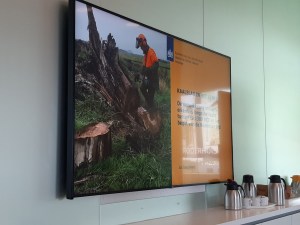
Presentation of Jos Bazelmans showed the huge amount of woody material extracted from Dutch peat bogs.
The scientific part of the meeting was kicked off my Roy van Beek who presented results from his ongoing project on the peatlands of the Netherlands which suggest peatland expansion occurred between 5500 and 3500 years ago (van Beek et al., 2023). The second talk was by our host, Otto Brinkkemper, and traced the history of woodlands across the Netherlands on the basis of macrofossil finds; including huge tree stumps remarkably preserved in peatlands (Bazelmans et al., 2021; Kooistra et al., 2006). The final talk was given by Jos Bazelmans who showed the remarkably high volume of tree stumps that have been recovered from the Netherlands, and how tree rings from these 100s of record are being used to reconstruct forest histories and past climate change. It was interesting to hear that the average age of the tree stumps found was around 250 years, and that some of the trees had lived to around 400 years in exceptional cases.
Kelly with her proud supervisors Stefan Uitdehaag (right), and I (left)
The final section of the meeting was the prize giving. Corrie Barkels, on behalf of the independent judging panel, announced Kelly van Leeuwen as the winner for her thesis entitled “Using soils samples and footwear to improve forensic palynology”. Her thesis was conducted at the University of Amsterdam as part of her MSc Earth Sciences degree and was conducted in collaboration with the Netherlands Forensic Institute. Congratulations Kelly!
Prof. dr. Willem Renema Special Chair in Marine Palaeobiodiversity
Willem Renema, head of the Marine Biodiversity research group at Naturalis, has been appointed as a Special Chair in Marine Palaeobiodiversity within the Department of Ecosystem & Landscape Dynamics at the University of Amsterdam. I am delighted that Willem has joined the team coupling his expertise in marine tropical systems with our existing focus on terrestrial tropical settings will, I am sure, provide many new avenues of scientific endeavour. Catalysing collaboration between Naturalis and UvA will be five PhD researchers, employed on the Marie Skłodowska-Curie Innovative Training Network, who will be jointly supervised by Naturalis and UvA staff.
To find out more about Willem and his appointment click here.
Cuesta, F., Llambi, L.D., Huggel, C., Drenkhan, F., Gosling, W.D., Muriel, P., Jaramillo, R. & Tovar, C. (2019) New land in the Neotropics: a review of biotic community, ecosystem, and landscape transformations in the face of climate and glacier change. Regional Environmental Change. DOI: 10.1007/s10113-019-01499-3
In the 4th edition of our “Amsterdam Paleoecology Club”(APC), we discussed ‘A 6900-year history of landscape modification by humans in lowland Amazonia’ by Bush et al. (2006)1. The high-resolution record presented in this paper shows impressively that what we might perceive as native rainforest today could rather be a since a long time actively modified landscape.
The chronology from Lake Sauce (Peruvian Andes) suggests a continuously forested landscape under significant anthropogenic impact over the last 6900 years. Indicators of human activity are taken to be the varying presence of crop pollen (Zea mays) throughout the record, combined with the continuous occurrence of charcoal. Two extra-large fire events are dated at c. 6700 and between 4500-4230 cal BP, probably enhanced by the relatively drier climate of the mid-Holocene. However, it is not clear yet if human actions formed a response to climate change or were part of social and cultural changes.
van der Sande, M.T., Gosling, W.D., Correa-Metrio, A., Prado-Junior, J., Poorter, L., Oliveira, R.S., Mazzei, L. & Bush, M.B. (2019) A 7000-year history of changing plant trait composition in an Amazonian landscape; the role of humans and climate. Ecology Letters DOI: 10.1111/ele.13251
The paper we discussed was “Columbus’ footprint in Hispaniola: A paleoenvironmental record of indigenous and colonial impacts on the landscape of the central Cibao Valley, northern Dominican Republic” by Castilla-Beltrán et al (2018). The paper provides a multi-proxy paleoecological reconstruction of the Caribbean island nation of the Dominican Republic, spanning the last 1100 years. Personally I found this to be a very interesting paper, packed with information and interpretations on the impact of anthropogenic factors on past Caribbean environments. What this paper nicely demonstrates is the difference in impact between pre-colonial and post-colonial societies on the vegetation of the Dominican republic. Pre-colonial Hispaniola was inhabited by indigenous societies, the Taíno people, and while this paper clearly shows them having had an environmental impact in the form of fire management (e.g. for slash and burn agriculture), small scale deforestation and the introduction of cultivars such as maize and squash, their environmental impact remains modest compared to post-colonial disturbances. Columbus arriving in AD 1492 signified a moment of change in the landscape. The paleorecord suggests that, after an initial collapse of the Taíno population, the colonization of the Dominican Republic by the Spanish brought with it deforestation, crop monoculture and the introduction of European livestock, all of which still characterizes the landscape to this day.
The discussion mainly focused on the chronology used. One of the radiocarbon samples was excluded from the age-depth model for no apparent reason, which led us to discuss the importance of critically evaluating your calibrated radiocarbon dates and which ones to incorporate in your age-depth model. The age-depth model currently used implied a shift in pollen composition c. 30 years before the arrival of the Spanish. We were unsure how to interpret these findings because you would expect the shift to happen afterwards, so my initial thought was that it had to be a fault in the chronology. This chronology however does imply a large charcoal peak followed by a rapid decline that coincides precisely with the arrival of the Spanish, and it turned out that this was the reason the authors settled on this chronology.
Even though this paper by Castilla-Beltrán et al. didn’t spark any heated discussions, its incorporation of ecology, botany, history, archeology and geology still showcases the interdisciplinary nature of paleoecology, something I very much enjoy about this field of research.
Hooghiemstra, H., Olijhoek, T., Hoogland, M., Prins, M., van Geel, B., Donders, T., Gosling, W.D. & Hofman, C. (2018) Columbus’ environmental impact in the New World: Land use change in the Yaque River valley, Dominican Republic. The Holocene. Online DOI: 10.1177/0959683618788732
Yesterday was the second, and final, day of the Netherlands Annunal Ecology Meeting (NAEM) for 2018. Having stayed up rather later than I would normally for a Tuesday night, due to the the gezellig atmosphere, the scrambled eggs and coffee were very welcome for breakfast. We were then on with the conference with parallel sessions starting at 08:30.
First up I opted for the session on “Monitoring biodiversity change: Essential biodiversity variables and beyond” organised by Daniel Kissiling (University of Amsterdam) and Rob Jongman (Wageningen University & Research). In the session new IBED PhD research Zsofia Koma presented a nice talk on the potential of LiDAR for evaluating ecosystem change, and Franziska Schrodt (University of Nottingham) looked at how we can link biodiversity and geodiversity. I found the talk by Franziska highlighting the importance of linking the abiotic and biotic components of the landscape particulalry stimulating as it links very well with much ongoing work within both the Department of Theoretical & Computational Ecology (Biogeography & Macroecology) and Ecosystem & Landscape Dynamics (Biodiversity & Geodiversity in the tropics) here at IBED.
Having fun online at #NAEM2018
To take us to lunch were two plenary lectures on the theme of these were given by Katja Poveda (Cornell University) and Erik Polman (replacing Marchel Dicke; Wageningen University). Both talks illustrated the complexity of natural systems and landscapes.
After lunch I chose the “Animal Ecology” session charied by Chris Smit (University of Groningen) and Patrick Jansen (Wageningen Research & University). I really enjoyed the first two talks in this session which highlighted the complexity that animals add to ecosystems. First up Esther Rodriguez (PWN) showed the differential impact of European bison and wild horses on vegetation (Cromsigt et al., 2017). Then Annelies van Grinkel (University of Groningen) presented her work trying to discover if deer in the Netherlands are still scared of wolves after the absence of wolves from the Netherlands for the last 150 years; this included some nice camera trap footage of deer running away from hand soap!
Overall a fun meeting, I met lots of new people, and saw lots of great talks so will definatly be back next year. Thanks to all the organisers for putting on such as show.
IBEDs Crystal McMichael hard at work sampling sediments in the Andes
Insights into recent field work in Ecuador by a team lead by Crystal McMichael can be found in a recent blog from our collaborators at the Instituto Geofisico, Escuela Politecnica Nacional, Quito (Ecuador).






 Ecology of the past