In June there will be a “European Pollen Database in Neotoma” meeting in Prague. For full details visit the European Pollen Database web site, click here.


February 28, 2022
In June there will be a “European Pollen Database in Neotoma” meeting in Prague. For full details visit the European Pollen Database web site, click here.
February 1, 2022
The next online seminar day of the Palynologishe Kring will take place on Friday 18 February.

Programma
13:00 Welcome
13:10 – 13:30 Annual General Meeting – finances, activities and board election. New Board member: Nelleke van Asch
13:30 – 14:00 Sander Houben (TNO) – Advances in Palaeozoic stratigraphy in the Netherlands
14:00 – 14:30 Marjolein van der Linden & Lucy Kubiak-Martens (BIAX) – What goes up must come down: The Neolithic human diet based on coprolites from the Swifterbant sites
14:30 – 14:45 Break
14:45 – 15:00 Announcement of Florschütz award winner 2021
15:00 – 15:30 Iris de Wolf and Thomas Giesecke (UU) – Unlocking the wealth of Dutch Pollen data: A new data portal and highlights
15:30 – 16:00 Stefan Uitdehaag (NFI) – Pollen – Silent witness to solving homicides
16:00 – 16:15 Discussion and closure
For more information on the society visit: https://www.palynologischekring.nl
November 16, 2020
This note is to acknowledge the passing yesterday of one of the most influential figures in the fields of palynology and palaeoecology, Eric Grimm. While I did not know Eric well he did visit Amsterdam twice in recent years. Firstly, as part of a collaborative initiative to digitise pollen data from the University of Amsterdam archives (March-July 2017), and secondly to train Data Stewards for the African Pollen Database (January 2020). During these visits Eric was generous with his time, masterful with his knowledge, and infectious with his enthusiasm. He will be sadly missed. My deepest condolences to his family and friends. Rest in peace Eric.
Some photos from the meeting in January


April 20, 2020
 I am delighted to announce that a new volume of the classic book series “Palaeoecology of Africa“ is now under development. This new volume (hopefully number 35) will focus on “Quaternary Vegetation Dynamics” and build on recent initiatives to develop the “African Pollen Database”. The volume will be guest edited by Anne-Marie Lezine (LOCEAN), Louis Scott (University of the Free State) and myself, along side the series editor Jürgen Runge (Johann Wolfgang Goethe University). If you are interested to contribute please get in touch.
Scope
The Quaternary Vegetation Dynamics volume of the long-running Palaeoecology of Africa series will showcase palynological work from across the African continent and surrounding regions, and place this in the context of past climatic, human and evolutionary change. We are keen to use this opportunity to catalyse the archiving of previously published and new datasets into the open access online African Pollen Database. The volume will be published entirely open access online and will contain four types of manuscript: (i) Research papers, (ii) Data papers, (iii) Review papers, and (iv) Perspectives.
January 30, 2020
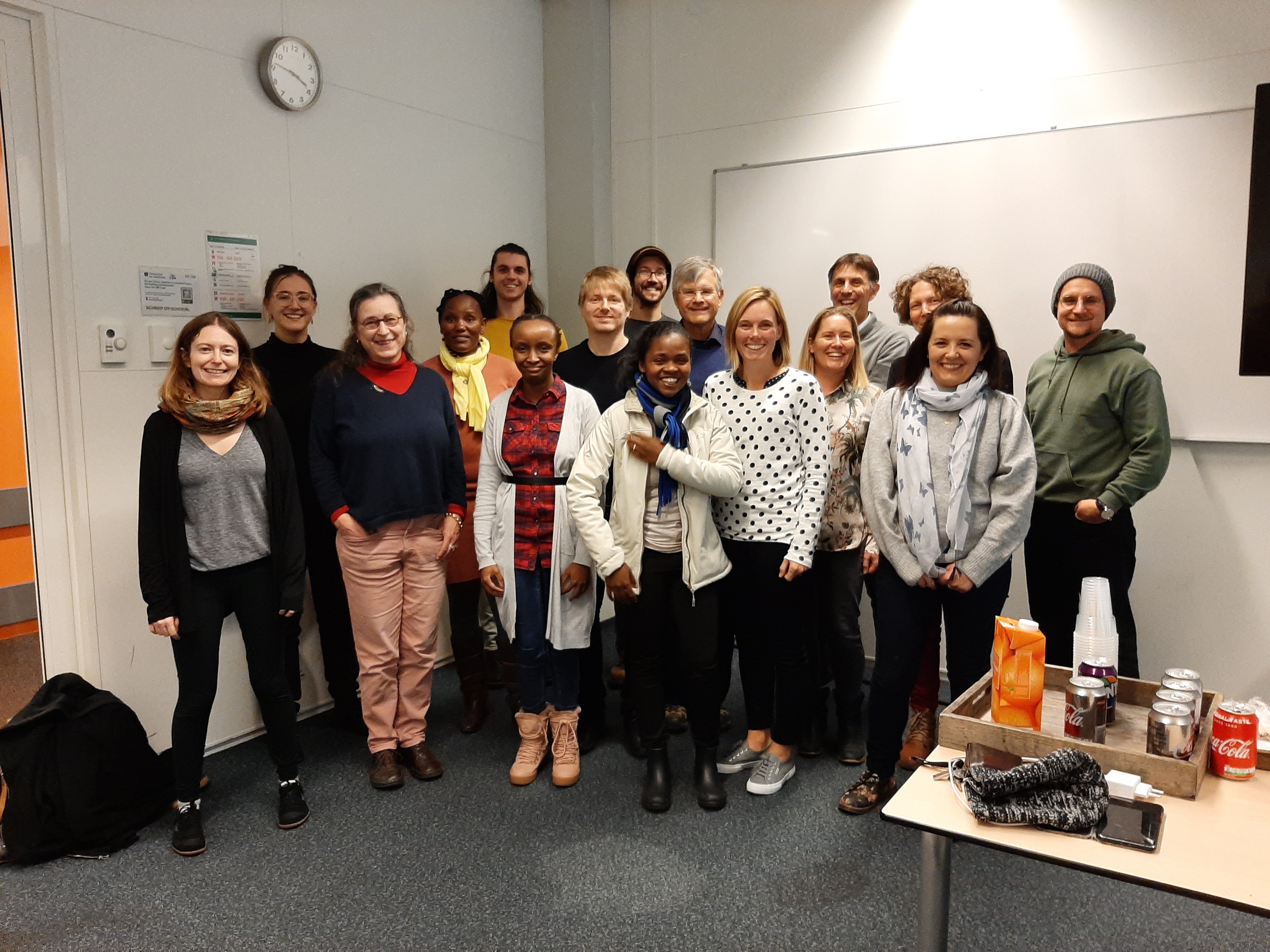
APD data steward event (Amsterdam, January 2020)
January 29, 2020
 An African Pollen Database data steward training event was held at the Institute for Biodiversity & Ecosystem Dyanmics (University of Amsterdam, 27-29 January 2020) where training in the use of the Neotoma database was provided by Eric Grimm. The participants are now enabled curate and archive data within Neotoma. If you have a palaeoecological data set that you would like to contribute to Neotoma, or if you would like training as well, these people can now help you. Contact details below:
January 24, 2020

APD “Awesome” in Paris October 2019 – Vincent Montade, William Gosling, Chris Kiathipes, and Manu Chevalier (l-r)
The African Pollen Database (APD; Vincens et al., 2007) has recently received a new life thanks to the work of Anne-Marie Lezine, Eric Grimm, Sarah Ivory and Jack Williams who have obtained funding to develop the digital infrastructure and link to the Neotoma Palaeoecology Database (Williams et al., 2018) and the Institut Pierre-Simon Laplace (IPSL) Paleoclimate database. The kick off meeting was held at the IRD centre in Bondy (October 2019), and the next step (training the data stewards) will be held in my department within the Institute for Biodiversity & Ecosystems Dynamics (University of Amsterdam) next week (January 2020).
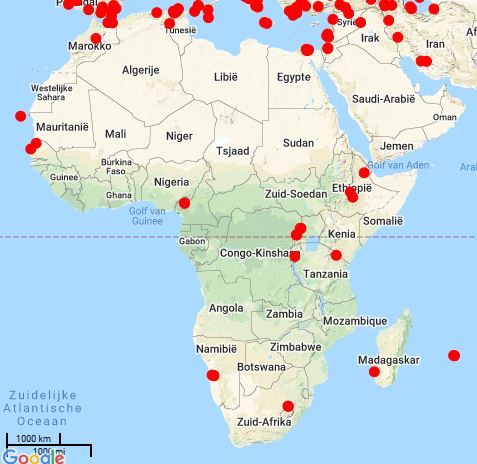
Pollen data recorded in Neotoma for Africa on 24 January 2020. Hopefully after the data steward training event we will have a few more dots on the map, and the potential for many more.
We are delighted to be able to host sixteen researchers of many nationalities conducting research in many different countries. The aim of the training event is to provide researchers with the skills to manage Neotoma and strengthen the African pollen research community. I am excited to be involved, I am confidence that much new research will be brought together, and I hope that we can get good plans in place for further steps and growth of this network.
REFERENCES
Vincens, A., Lézine, A.-., Buchet, G., Lewden, D. & Le Thomas, A. (2007) African pollen database inventory of tree and shrub pollen types. Review of Palaeobotany and Palynology 145, 135-141. DOI: 10.1016/j.revpalbo.2006.09.004
Williams, J.W., Grimm, E.C., Blois, J.L., Charles, D.F., Davis, E.B., Goring, S.J., Graham, R.W., Smith, A.J., Anderson, M., Arroyo-Cabrales, J., Ashworth, A.C., Betancourt, J.L., Bills, B.W., Booth, R.K., Buckland, P.I., Curry, B.B., Giesecke, T., Jackson, S.T., Latorre, C., Nichols, J., Purdum, T., Roth, R.E., Stryker, M. & Takahara, H. (2018) The Neotoma Paleoecology Database, a multiproxy, international, community-curated data resource. Quaternary Research 89, 156-177. DOI: 10.1017/qua.2017.105
March 18, 2019
 Palynologische Kring: Spatial patterns in palaeoecology meeting
Date: Thursday 4 April
Location: Rijksdienst voor het Cultureel Erfgoed (RCE), Amersfoort
Break
Rijksdienst voor het Cultureel Erfgoed
:
November 6, 2018
 The 2018 edition of the University of Amsterdam masters course “Environments Through Time” is now up and running. The course sits at the interface between ecology, physical geography and archaeology and seeks to provide students with a better understanding of how long-term (>100’s years) datasets can provide insights in to past environmental change.
In the first week of the course the students had to present their ‘favourite’ paper in just three (3) minutes! Quite a challenge and lots of fun. This years selection of papers themed around:
For full list of papers presented see below.
In the second and third weeks (now ongoing) students get to deconstruct published chronologies and conduct time series analsis of multi-proxy datasets. Data for these excercises is frequently is extracted from databases such as Neotoma, Pangea, NOAA – paleoclimatology datasets database and the Global Charcoal Database – which shows the importance of these open access databases for developing effective research led eductation, as well as pushing forward to frontiers of research.
Environments Through Time is taught in English, delivered by myself (William Gosling), Crystal McMichael and Milan Tunissen van Manen and currently has 31 registered students from MSc Biological Sciences and MSc Earth Sciences degrees.
Full list of papers presented by students on the Environments Through Time course in 2018 Continue Reading
November 10, 2015
Posted on behalf of Thomas Giesecke:
EUROPEAN POLLEN DATABASE
Meeting and training workshops
1-3/06/2016
Aix-en-Provence, France
We offer exciting keynote lectures, an extensive poster session to showcase your research, and two days of training with experts in software, databases, and modelling.
We want your opinion on how to develop the European Pollen Database (EPD) to make it a better resource for research, education, and data storage.
NO registration fee
Workshop topics include:
Click links below for further information on:
Event supported by:

 Ecology of the past