Phytoliths, starch grains and diatoms

May 29, 2024
WDG

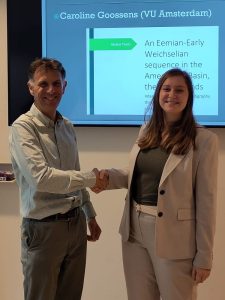
Caroline Goossens receives the Florschütz Award.

On Friday 24 May 2024 the Palynologische Kring (Dutch palynological society) held a seminar series and laboratory workshop at the Institute for Biodiversity & Ecosystem Dynamics (University of Amsterdam). During the afternoon we had the annual meeting of the society, the presentation of our MSc Thesis prize, four seminars and two laboratory demonstrations. The MSc thesis prize “Florschütz Award” was won by Caroline Goossens (VU Amsterdam) for her thesis entitle: “An Eemian-Early Weichselian sequence in the Amersfoort Basin, the Netherlands”; the project was supervised by Natalie Van der Putten, Cees Kasse and Jeroen Schokker. We hope that Caroline will present her thesis at a future Palynologishe Kring meeting.

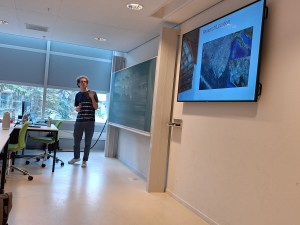
Teye Aukes presenting on the diatoms of ancient Rome

The talk series was kicked off by Nina Witteveen (University of Amsterdam) who presented part of her PhD thesis (currently awaiting defense), entitled: “Long-term forest recovery in Amazonia insights from phytolith analysis”. Nina discussed the impact of past peoples on the vegetation of Suriname based on her work identifying phytoliths in soil samples collected at varying distances from an archaeological site. The second talk was given my Amanda Henry (Leiden University) who demonstrated how the analysis of starch grains extracted from archaeological context can provide insights in to past diets. She used these evidences to suggest that early humans and Neanderthals had a similar diversity of plants in their diets. The third talk was given by University of Amsterdam MSc researcher Teye Aukes and focused upon his identification of diatoms from an swampy lagoon environment near Ostia (Italy). He drew conclusions from these data about the antiquity of salt production in ancient Rome. The final talk was given online by Welmoed Out (Moesgaard Museum) who presented a detailed analysis of inter- and intra-analyst variability in phytolith morphometric analysis.

After the seminars we moved upstairs to the microscope laboratory where Nina Witteveen and Ana Smuk (University of Groningen) showed off phytoliths from their study site in South America and the Netherlands.

Some of the Palynologische Kring members enjoying some refreshment after the event.

Heijink PhD thesis 2024

April 19, 2024
WDG

Heijink, B.M. (2024) Assessing past fire regimes and their effects on modern vegetation in Amazonian forests. PhD Thesis, University of Amsterdam, Amsterdam. ISBN: 9789493260283

Abstract

Amazonian rainforests are incredibly biodiverse and provide global ecosystem services, but are threatened by fires, which completely alter ecosystem function and structure. Fires, especially in western Amazonia, almost always have an anthropogenic origin. However, much is unknown about the long-term recovery and multi-generational successional processes following fire events. Due to the long lifespan of tropical trees, past fires may have left ecological legacies in modern forest composition in Amazonia. The goal of this thesis is to investigate how past fire events impact successional trajectories of past vegetation change and whether these fire events and related human impacts have left ecological legacies in modern Amazonian forests. I specifically focus on western Amazon and changes in palm abundances and composition through time, as palms were an economically important plant family to past peoples. I compared lake charcoal records across the Amazon Basin and found fire was least prevalent in western Amazonia. On a local scale, very limited evidence of past disturbances was present in forest plots in northwestern Amazonia. Palm abundances have been increasing since the mid-Holocene, but this increase is not related to past fire events. Past fire likely have left low to none ecological legacies in these forest plots. Modern trait composition across western Amazonia is associated with past fire events, but more research is necessary to disentangle relationships between past fire, soils, and modern vegetation. Overall, western Amazonia likely contains the least intense ecological legacies in comparison with the rest of Amazonia.

Handel: http://hdl.handle.net/11245.1/c1d12124-0025-44a3-90b9-c5835d9d3c5b

Pre-contact and post-colonial ecological legacies shape Surinamese rainforests

April 10, 2024
WDG

Open access:

Witteveen, N.H., White, C., Sánchez-Martínez, B.A., Philip, A., Boyd, F., Booij, R., Christ, R., Singh, S., Gosling, W.D., Piperno, D.R. & McMichael, C.N.H. (2024) Pre-contact and post-colonial ecological legacies shape Surinamese rainforests. Ecology, e4272. DOI: 10.1002/ecy.4272

What has biogenic silica ever done for us?

April 3, 2024
WDG

Siliceous Microfossils Meeting

  • Date: Friday 24 May 2024
  • Location: Institute for Biodiversity & Ecosystem Dynamics, University of Amsterdam

Program

  • 13:00-14:00 – Palynologische Kring society annual meeting
  • 14:00-14:15 – Coffee
  • 14:15-15:45 – Seminar series
    • Using phytolith analysis to detect palm enrichment in Amazonia Nina Witteveen (University of Amsterdam)
    • Starch grains as indicators of plant food consumption in Neanderthals and Early Modern Humans Amanda Henry (University of Leiden)
    • Paleoenvironmental history of an archaeological lagoon in Central Italy: Insights from diatom analysis Majoi Nacimiento, Teye Aukes & Jan Sevink (University of Amsterdam)
  • 15:45-17:30 – Laboratory activities
    • Advances in topical phytolith identification Nina Witteveen (University of Amsterdam)
    • Finding Suitable Grounds – combining the on/off site approach through phytolith investigation in Flevoland Ana Smuk (Rijksuniversiteit Groningen)

If you are not already a member and would like to attend please contact the society via email or the web portal: https://www.palynologischekring.nl/contact/

To find out more about the Palynologische Kring click here to visit the web site.

Mapping Ancient Africa: Seminar 16

April 2, 2024
WDG

The next Mapping Ancient Africa seminar will take place online at 17:00 CEST on 12 April 2024.

  • Speaker: Stéphanie Bodin (Senckenberg Research Institute and Natural History Museum Frankfurt)
  • Title: Hunter-gatherers and Afromontane vegetation in the Ethiopian highlands since the end of the African Humid Period
  • Related publication:
    • Bodin, S.C., Neumann, K., Hensel, E.A., Vogelsang, R., Demissew, S., Casas-Gallego, M. & Hahn, K. (2024) Afromontane forests and human impact after the African Humid Period: wood charcoal from the Sodicho rock shelter, SW Ethiopian highlands. Vegetation History and Archaeobotany. DOI: 10.1007/s00334-023-00977-3
    • Casas-Gallego, M., Hahn, K., Neumann, K., Demissew, S., Schmidt, M., Bodin, S.C. & Bruch, A.A. (2023) Cooling-induced expansions of Afromontane forests in the Horn of Africa since the Last Glacial Maximum. Scientific Reports 13, 10323. DOI: 10.1038/s41598-023-37135-8

The seminar will be delivered via Zoom. The link for the seminar can be obtained from the MAA Slack channel or by contacting the chair of this seminar (William Gosling). If you want to know more about the Mapping Ancient Africa project visit our web pages and please do not hesitate to get in contact if you want to get involved.

INQUAlogo

Pre-Columbian vegetational and fire history in western Amazonia: Terrestrial soil phytolith and charcoal evidence from three regions

March 6, 2024
WDG

Piperno, D.R., McMichael, C.N.H., Pitman, N.C.A., Paredes, M.R., Torres-Montenegro, L.A. & Bush, M.B. (2024) Pre-Columbian vegetational and fire history in western Amazonia: Terrestrial soil phytolith and charcoal evidence from three regions. Quaternary International. DOI: 10.1016/j.quaint.2024.01.011

Quantifying local-scale changes in Amazonian forest cover using phytoliths

March 1, 2024
WDG

Open access:

Witteveen, N.H., Blaus, A., Raczka, M.F., Herrick, C., Palace, M., Nascimento, M.N., Van Loon, E.E., Gosing, W.D., Bush, M.B. & McMichael, C.N.H. (2024) Quantifying local-scale changes in Amazonian forest cover using phytoliths. Frontiers of Biogeography. DOI: 10.21425/F5FBG62254

Spatial and temporal abilities of proxies used to detect pre-Columbian Indigenous human activity in Amazonian ecosystems

November 2, 2023
WDG

Open access:

McMichael, C.N.H., Levis, C., Gosling, W.D., Junqueira, A.B., Piperno, D.R., Neves, E.G., Mayle, F., Peña-Claros, M. & Bongers, F. (2023) Spatial and temporal abilities of proxies used to detect pre-Columbian Indigenous human activity in Amazonian ecosystems. Quaternary Science Reviews 321, 108354. DOI: 10.1016/j.quascirev.2023.108354

Palaeoecology course 2023

September 6, 2023
WDG

The pollen and phytolith identification quiz! Is that an Asteraceae phytolith I see…???

The University of Amsterdam “Palaeoecology” course commenced this week with lectures getting students up to speed with the fundamental principles and approaches to the subject, and laboratory practicals training students in the identification of micro- and macro-fossils. Once students have gained a basic understanding of pollen and phytolith identification – and demonstrated this by passing the ‘dreaded’ identification quiz – it is time to commence the group project work.

This year the students are trying to identify from which study site their ‘mystery slides’ come from on the basis of the micro-fossil assemblages (pollen and phytoliths) that they contain. The study sites all come from the area around Hilversum (Netherlands) and (could) include: heathland, pine forest, mix-deciduous forest, and birch woodlands. In addition, just to make it more interesting, one group has samples taken from the medieval palaeosol that is found locally.

Next week is field work week and the students will then need to parameterise the vegetation around the Hilversum area in such a way that they: (i) get a representative sample the variation across the landscape, and (ii) can compare the vegetation data with their micro-fossil data. Then, following the number crunching in the third week of the course, we will find out if the different groups can identify the correct study site from which there samples came…

The Palaeoecology course at the University of Amsterdam is part of the BSc Biology program, it is also frequently taken by students on the BSc Future Planet Studies degree. We also welcome students from other programs, such as BSc Béta-Gamma, and international exchange students.

African insights

March 30, 2023
WDG

Plant Ecology & Diversity

Having recently traveled to South Africa as part of the Landscape Dynamics field course run by our graduate school, and to be thinking again about trying to obtain funding to further research in Africa, I thought it might be fun to turn to the journals in which I have an editorial hand (Plant Ecology & Diversity, Vegetation History & Archaeobotany, and The Holocene) and see what new work was coming out on African ecosystem dynamics. From each of these journals I have selected two recent papers to highlight here.

The papers come from across the continent and all have a component of the ecology of the past, but they range in focus from developing methods to extract new insights about past ecological change (Le Moyne et al., 2023) through to the application of our understanding of past ecosystems to the management of conservation areas (Wilkinson et al., 2022).

Vegetation History & Archaeobotany

The study by Le Moyne et al. (2023) examined modern reference material of nine grass species to determine how they might be better identified in the archaeological and palaeoecological record from the phytoliths they produce. Three of the studies use different lines of evidence of past ecological dynamics to explore change over the last few thousands of years.

  • Champion et al. (2023) shed light on past agricultural practices in western Africa (Nigeria) through the examination of macro-botanical evidence from 50 archaeological sites and dating back c. 3500 years, hypothesizing a new route for the spread of pearl millet out of the central Sahara into the central Nigerian savannahs.
  • Prader et al. (2023) present a c. 4000 year geochemical, palynological and and charcoal record from Table Mountain National Park in South Africa, showing changes in the abundance of fynbos and forest plants and how this was modified by people.
  • Hildebrand et al. (2022) collated multiple lines of evidence of past environmental change from eastern Africa to assess changes in human activity during and after the African Humid Period (15,000-5000 years ago), highlighting the complex relationship between changes in human resource acquisition practice (fishing, hunting, gathering, and pastoralism) and environmental change.

The longest timescale perspective is provided by Milton et al. (2022) who investigated plant speciation in the Namib Desert. They combined a phylogenetic, morphometric and experimental genetic approaches to explore the evolutionary history of Senecio flavus and S. engerianus and produce palaeo-distribution models. From these data they suggest that the wider ranged species (S. flavus) is in fact derived from the smaller ranged parent (S. engerianus) and that this separation was caused by aridification during the Pleistocene.

The final paper, Wilkinson et al. (2022), take evidence for past abundances of elephants and compare them with the abundances in national parks today. They argue that modern elephant densities in national parks could be higher than the historical levels and that this could be detrimental to the flora and other fauna in the parks.

References

Continue Reading
Blog at WordPress.com.