Job: Full Professor Earth Surface Science

December 5, 2016
WDG

ibedlogo-lowJob: Full Professor Earth Surface Science
Location: Institute for Biodiversity & Ecosystem Dynamics, University of Amsterdam
Closing data: 04/01/2017

The Institute for Biodiversity & Ecosystem Dynamics (IBED) at the University of Amsterdam currently has a vacancy for a Full Professor in Earth Surface Science. IBED is seeking to appoint a world leading scientist whose research and teaching skills compliment those that already exist within the Research Group of Earth Surface Science (ESS). Key themes within the ESS group are: biotic and abiotic interactions, biogeochemistry, geomorphology, and soil chemistry, biodiveristy and management. The work of the ESS group is closely related to other research groups within IBED, and in particular, the Palaeoecology & Landscape ecology (P&L) group which I lead.

For full details click here.

Scientific methods in archaeology

November 10, 2016
WDG

Preparing my lecture for the new Scientific Methods in Archaeology course for VU Amsterdam and University of Amsterdam students studying a minor in Geoarchaeology. The focus will be on detecting human activity in the past, to illustrate this I will include Easter Island/Rapa Nui as a case study. We will focus on how palaeoecological evidence can be used to gain insights into past human activity. Whilst putting this together I discovered these nice documentaries looking at humans and their environmental impacts on Easter Island/Rapa Nui which I wanted to share, they show how much effort people would have had to put into altering their landscape:

For further information see also:

Rull, V., Cañellas-Boltà, N., Saez, A., Margalef, O., Bao, R., Pla-Rabes, S., Valero-Garcés, B. & Giralt, S. (2013) Challenging Easter Island’s collapse: The need for interdisciplinary synergies. Frontiers in Ecology and Evolution 1, DOI: 10.3389/fevo.2013.00003

Tropical forests in the Anthropocene

November 8, 2016
WDG

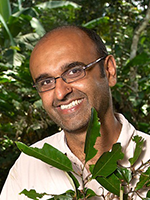
Yadvinder MalhiSeminar
Institute for Biodiversity & Ecosystem Dynamics
University of Amsterdam

Tropical forests in the Anthropocene
by Prof. Yadvinder Malhi (University of Oxford)

16:00-17:00, 24 November 2016
Science Park, Amsterdam
If you want to attend please click here for full details.

ABSTRACT: Continue Reading

Published open access:

Julier, A.C.M., Jardine, P.E., Coe, A.L., Gosling, W.D., Lomax, B.H. & Fraser, W.T. (2016) Chemotaxonomy as a tool for interpreting the cryptic diversity of Poaceae pollen. Review of Palaeobotany and Palynology 235, 140-147. DOI: 10.1016/j.revpalbo.2016.08.004

Environmental change in the Yaque river area, northwestern Dominican Republic

October 14, 2016
WDG

Research Group of Palaeoecology & Landscape Ecology seminar by  Thomas Olijhoek (MSc student at Utrecht University)

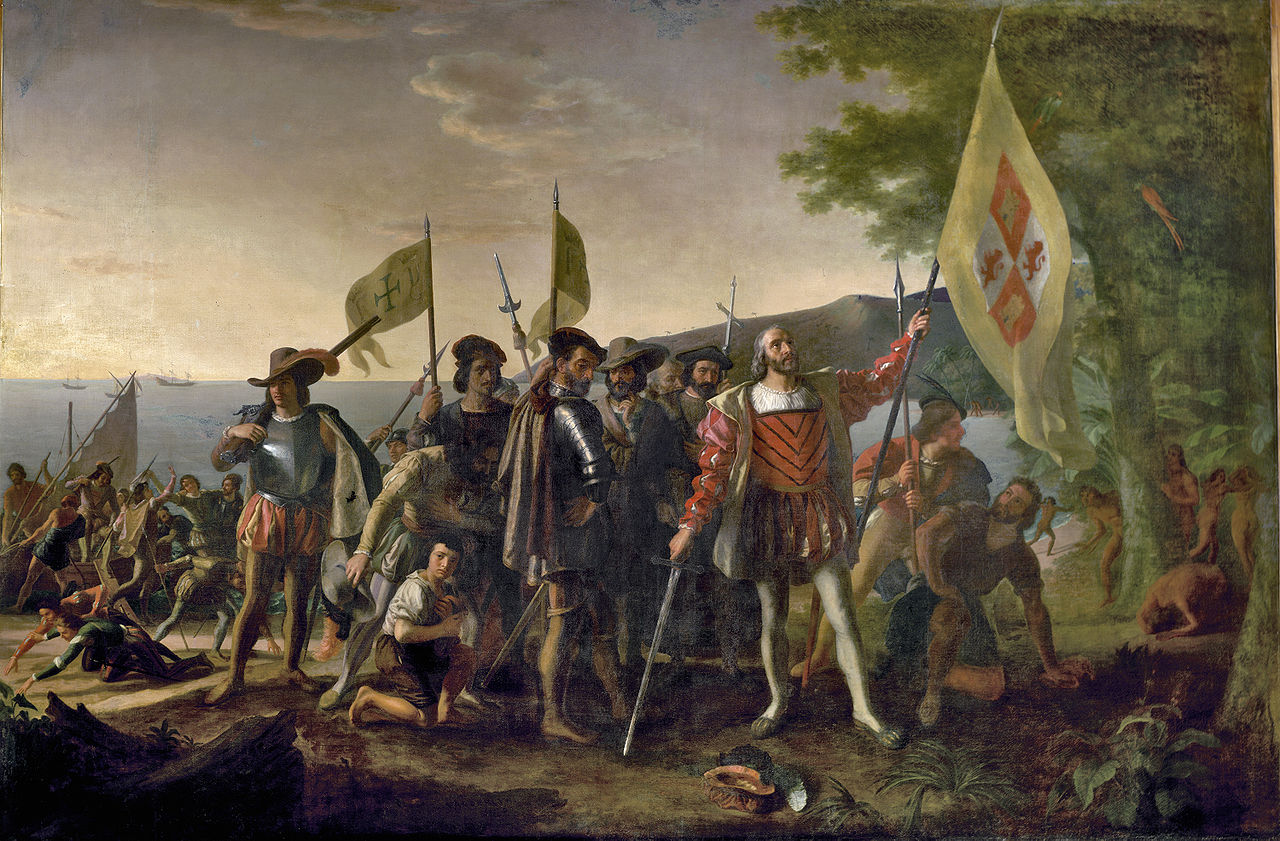
Title: Environmental change in the Yaque river area, northwestern Dominican Republic: Human impact before and after Columbus’ arrival in the New World

Date: Wednesday 26 October, 11:00-12:00

Location: Science Park 904 (please contact Henry Hooghiemstra for details if you want to attend)

Abstract: Multiproxy analysis of the 225-cm long sediment core Los Indios from the Yaque river valley in northwestern Dominican Republic (Hispaniola) shows environmental changes during the last 1150 cal yr BP. The observed changes show a period of little human distubance, followed by increasing human activity and a rapid intensification of these changes after Columbus’ arrival in AD 1492. The fastest changes on the landscape can be observed at 307 cal yr BP, when agricultural development in the Dominican Republic intensified.

Landing of Columbus by John Vanderlyn - Architect of the Capitol, Public Domain, https://commons.wikimedia.org/w/index.php?curid=1380997

Landing of Columbus by John Vanderlyn – Architect of the Capitol, Public Domain, https://commons.wikimedia.org/w/index.php?curid=1380997

Tropical palynology meeting

July 8, 2016
WDG

PalykringThe Palynologische Kring (Palynological Association)
Tropical palynology meeting
14 July 2016

Hosted by: Palaeoecology & Landscape Ecology, Institute for Biodiversity & Ecosystem Dynamics, University of Amsterdam
Located: Science Park 904
Organised: Carina Hoorn (if you want to attend please contact Carina for further details)


Speakers

  • 14.00-14.30 Suzette Flantua (University of Amsterdam) – Thriving palynological research in Latin America: What has been done and what’s next.
  • 14.30-15.00 Dunia Urrego (University of Exeter, UK)- Tropical and subtropical vegetation dynamics over orbital and millennial timescale
  • 15.00-15.30 Coffee break
  • 15.30-16.00 William Gosling (University of Amsterdam) – Long-term solar and ultraviolet-B irradience detected using sporopollenin chemistry
  • 16.00-16.30 Kim Hagemans (Utrecht University) – High Andean vegetation responses to changes in palaeo-ENSO

Climate change and precipitation in past present and future: Mini symposium

June 13, 2016
WDG

Research Group of Palaeoecology & Landscape Ecology
Institute for Biodiversity & Ecosystem Dynamics
University of Amsterdam

Date: 17/06/2016
Time: 13:30-16:00
Location: Amsterdam Science Park 904
For registration & full details please contact: Dr. John van Boxel

When addressing climate change the focus often is on temperature. However precipitation is a climate variable that is at least as important, but much more difficult to assess. This mini symposium will address several aspects of the changes in the precipitation climate. William Gosling shows how climates in the far past can be reconstructed using proxies. One of these proxies, biomarkers, will be discussed by Susanna Mölkänen, who uses them to reconstruct altitudinal gradients. John van Boxel discusses 20th century climate change in the Netherlands focussing on changes in precipitation extremes. The models that are used to study climate change are the topic of the presentation by Geert Lenderink from KNMI. Some of these models were also used by Emma Daniels (WUR) to study the effect of urbanisation on precipitation in the Netherlands. For anyone involved in climate change and precipitation this should be an interesting afternoon.

Outline program below:

Continue Reading

The dodo straightened up

March 30, 2016
Erik de Boer

New publication:
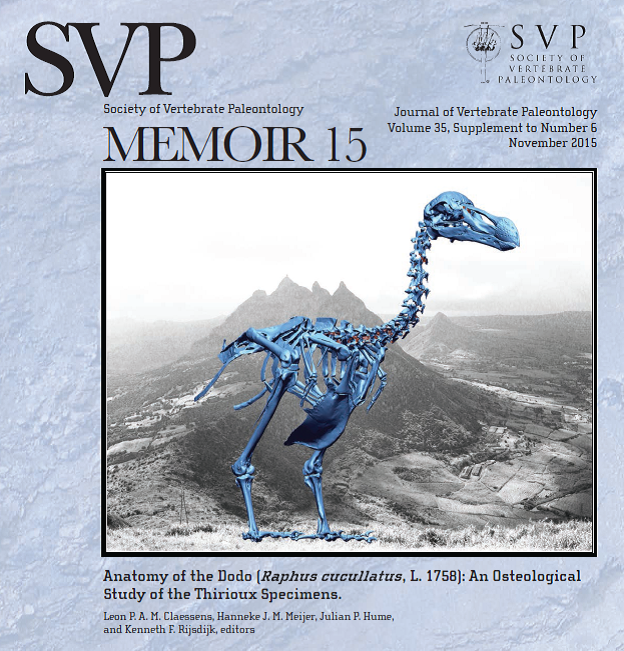
ANATOMY OF THE DODO (RAPHUS CUCULLATUS L., 1758): AN OSTEOLOGICAL STUDY OF THE THIRIOUX SPECIMENS.
Leon P. A. M. Claessens, Hanneke J. M. Meijer, Julian P. Hume, and Kenneth F. Rijsdijk (Editors) Society of Vertebrate Paleontology Memoir 15, Journal of Vertebrate Paleontology Vol. 35, Supplement to No. 6, 187 pages.
Frontpage%20Dodo%20Memoir

Continue Reading

Caspian Sea mini symposium

March 9, 2016
WDG

Research Group of Palaeoecology & Landscape Ecology
Institute for Biodiversity & Ecosystem Dynamics
University of Amsterdam

Date: 01/04/2016
Time: 15:00-18:00
Location: Amsterdam Science Park 904 
Registration: Contact Prof. dr. Henry Hooghiemstra or Dr. Carina Hoorn to book your place and receive location details

15:00-15:30
Frank Wesselingh & the PRIDE team
How high can you get? Mountain uplift driving diversification in Pontocaspian lakes before humans bring down the unique aquatic biota?

15:30-16:00
Christiaan van Baak
Mediterranean-Paratethys connectivity during the late Miocene to recent

– 16:00-16:15 tea/coffee break –

16:15-17:15
Keith Richards
Studies in Caspian palynology: Vegetation, climate and sea level change

17:15-18:00
Questions and discussion

Blog at WordPress.com.