Palaeoecology and past environmental research central to the work at the Institute for Biodiversity & Ecosystem Dynamics (University of Amsterdam); check out the new institute video, spot the palaeoecology researchers, and see what else is going on at IBED:
Prof. dr. Willem Renema Special Chair in Marine Palaeobiodiversity
Willem Renema, head of the Marine Biodiversity research group at Naturalis, has been appointed as a Special Chair in Marine Palaeobiodiversity within the Department of Ecosystem & Landscape Dynamics at the University of Amsterdam. I am delighted that Willem has joined the team coupling his expertise in marine tropical systems with our existing focus on terrestrial tropical settings will, I am sure, provide many new avenues of scientific endeavour. Catalysing collaboration between Naturalis and UvA will be five PhD researchers, employed on the Marie Skłodowska-Curie Innovative Training Network, who will be jointly supervised by Naturalis and UvA staff.
To find out more about Willem and his appointment click here.
Do you have a PhD in Physical Geography, Environmental Sciences, Landscape Ecology or Soil Ecology? Have you got educational and research experience working with digital data to contribute to climate, geographic or biodiversity science? If so please consider applying for the 4-year post-doctoral position “Digital Environmental Sustainability” currently available within the Department of Ecosystem & Landscape Dynamics (Institute for Biodiversity & Ecosystem Dynamics, University of Amsterdam).
Luckily, in spite of these trying times, we are allowed to continue our research in Amsterdam and on the Veluwe to determine the effects of air pollution on airborne pollen grains. Unfortunately for us (but generally perhaps one of the few silver linings of this situation), the COVID-19 lockdown has largely eliminated our main variable of interest; air pollution.
With traffic in the city at a minimum, any chemical differences might not be as pronounced between the city and rural areas. However, this may actually provide us with a unique opportunity to get a baseline of the pollen chemistry in Amsterdam with relatively little pollution. This baseline may also be of interest to projects working on urban air quality and greenifying urban spaces, such as the projects in the Amsterdam Knowledge Mile Park, which is included amongst our sampling locations.
This slideshow requires JavaScript.
For more about our project on pollen and pollution in the Netherlands see other posts:
Figure 1: (a) Illustrative images of sample locations in Amsterdam and the Hoge Veluwe. (b) The newly developed ‘pollen sniffer’ collects airborne pollen from the environment. (c) The FTIR can chemically characterise individual pollen grains.
Does environmental pollution enhance the allergenic nature of pollen? This is the question that drives my NWO Idea Generator grant that has just started. This project links up the pollen chemistry expertise in my group within the Department of Ecosystem & Landscape Dynamics (University of Amsterdam) and the work of Letty de Weger into human health and pollen (Leiden University Medical Centrum). Over the 2020 flowering season we will be monitoring pollen in Amsterdam (urban) and in the Hoge Veluwe (rural) in the space in which people have allergic reactions to see if there is any chemical difference between the pollen in urban and rural settings.
We are delighted that Cas Verbeek has joined the team as a Research Assistant; taking time out from his MSc Biological Sciences degree (University of Amsterdam). Cas is already busy in the field and lab fine tuning our collection and analysis protocols.
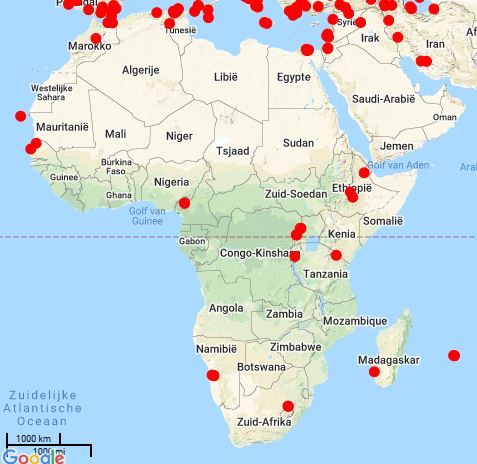
Pollen data recorded in Neotoma for Africa on 24 January 2020. Hopefully after the data steward training event we will have a few more dots on the map, and the potential for many more.
We are delighted to be able to host sixteen researchers of many nationalities conducting research in many different countries. The aim of the training event is to provide researchers with the skills to manage Neotoma and strengthen the African pollen research community. I am excited to be involved, I am confidence that much new research will be brought together, and I hope that we can get good plans in place for further steps and growth of this network.
REFERENCES Vincens, A., Lézine, A.-., Buchet, G., Lewden, D. & Le Thomas, A. (2007) African pollen database inventory of tree and shrub pollen types. Review of Palaeobotany and Palynology 145, 135-141. DOI: 10.1016/j.revpalbo.2006.09.004
Williams, J.W., Grimm, E.C., Blois, J.L., Charles, D.F., Davis, E.B., Goring, S.J., Graham, R.W., Smith, A.J., Anderson, M., Arroyo-Cabrales, J., Ashworth, A.C., Betancourt, J.L., Bills, B.W., Booth, R.K., Buckland, P.I., Curry, B.B., Giesecke, T., Jackson, S.T., Latorre, C., Nichols, J., Purdum, T., Roth, R.E., Stryker, M. & Takahara, H. (2018) The Neotoma Paleoecology Database, a multiproxy, international, community-curated data resource. Quaternary Research 89, 156-177. DOI: 10.1017/qua.2017.105
14:10-14:30: Characterization of phytoliths in mid-elevation Andean forestsSeringe Huisman (University of Amsterdam/Treub grant awardee)
14:30 –14:50: Extinction-driven changes in frugivore communities on tropical islands: worldwide and in MauritiusJulia Heinen (University of Copenhagen, Denmark)
14:50 – 15:10: Are the current Amazonian fires unprecedented?Crystal N.H. McMichael (University of Amsterdam)
15:10 – 15:30: On the relationship between tiger conservation and water managementJasper Griffioen, Hanne Berghuis & Ewa van Kooten (Utrecht University)
15:30-16:00: TEA
16:00 – 16:45: Assembling the diverse rain forest flora of SE Asia by evaluating the fossil and molecular record in relation to plate tectonicsRobert J. Morley (Palynova, and Southeast Asia Research Group, Royal Holloway University of London, UK)
IBED is looking for an Earth scientist/ecologist with expertise and interest in soil carbon cycling, in relation to the role of soil microbial communities therein to support ongoing work within the Department of Ecosystem & Landscape Dynamics (ELD). We are particularly looking for a researcher with an international track record with expertise in one, or more, of the following areas:
Interactions between organic carbon and the mineral soil.
Microbe-organic C interactions.
Molecular and computational approaches for analysing soil microbial communities and their functionality.
Scaling of soil carbon cycling processes from microbe to globe.
Linking global carbon cycle models and laboratory experiments.
This is one of two positions currently open in Earth Systems Science within ELD. The other position is related to Environmental Chemistry and we will be looking at complimentary between the two appointments.
For further details and information on how to apply click here.
IBED is looking for an environmental chemist/environmental scientist experienced in studying sources, transport, transformation and degradation and fate of chemicals in ecosystems to support ongoing work within the Department of Ecosystem & Landscape Dynamics (ELD), and create links with the Department of Freshwater & Marine Ecology. We are particularly looking for a researcher with an international track record with expertise in one, or more, of the following areas:
The fate and effects of organic contaminants of emerging concern in the environment.
The mitigation of environmental pollution.
Environmental policy and circular economy.
Regional and larger-scale systems analysis of human impacts on the environment.
This is one of two positions currently open in Earth Systems Science within ELD. The other position is related to Soil Carbon Cycling and we will be looking at complimentary between the two appointments.
For further details and information on how to apply click here.
There is a 18 month post-doctoral research position within the Department of Theoretical & Computational Ecology at IBED focused on Global Ecology, we are looking for someone with skills and experience the following areas:
PhD in ecology, biodiversity or a related discipline
quantitative skills and statistical analyses
species distribution modelling
analyses of species composition, functional traits and species interactions


 Ecology of the past