Lost forests of the Netherlands

June 13, 2023
WDG

The June 2023 meeting of the Dutch palynological society (Palynologische Kring) took place at the offices of the Dutch National Cultural Heritage Agency (Rijksdienst Cultureel Erfgoed) in Amersfoort. The focus of this meeting was the past forest landscape of the Netherlands. The meeting included the annual report of the society, three scientific talks, and a prize giving for the best MSc thesis.
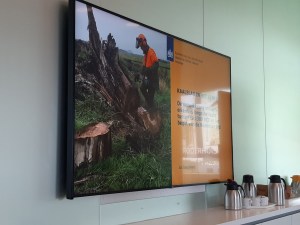
Presentation of Jos Bazelmans showed the huge amount of woody material extracted from Dutch peat bogs.

The annual report of the society showed a healthy finances and membership (>100 members). Two key events from last year were the award of the societies highest award, the Jongmanspenning, to Margaret Collinson for her massive contribution to the field, and the annual excursion; in 2022 this was to Leiden and included visits to Roman archaeological sites.

Kelly van Leeuwen winner of the 2023 Florschütz Award

The scientific part of the meeting was kicked off my Roy van Beek who presented results from his ongoing project on the peatlands of the Netherlands which suggest peatland expansion occurred between 5500 and 3500 years ago (van Beek et al., 2023). The second talk was by our host, Otto Brinkkemper, and traced the history of woodlands across the Netherlands on the basis of macrofossil finds; including huge tree stumps remarkably preserved in peatlands (Bazelmans et al., 2021; Kooistra et al., 2006). The final talk was given by Jos Bazelmans who showed the remarkably high volume of tree stumps that have been recovered from the Netherlands, and how tree rings from these 100s of record are being used to reconstruct forest histories and past climate change. It was interesting to hear that the average age of the tree stumps found was around 250 years, and that some of the trees had lived to around 400 years in exceptional cases.

Kelly with her proud supervisors Stefan Uitdehaag (right), and I (left)

The final section of the meeting was the prize giving. Corrie Barkels, on behalf of the independent judging panel, announced Kelly van Leeuwen as the winner for her thesis entitled “Using soils samples and footwear to improve forensic palynology”. Her thesis was conducted at the University of Amsterdam as part of her MSc Earth Sciences degree and was conducted in collaboration with the Netherlands Forensic Institute. Congratulations Kelly!

Continue Reading

Polylepis woodland dynamics during the last 20,000 years

March 23, 2018
WDG

Valencia, B.G., Bush, M.B., Coe, A.L., Elizabeth, O. & Gosling, W.D. (2018) Polylepis woodland dynamics during the last 20,000 years. Journal of Biogeography online. DOI: 10.1111/jbi.13209

An undergraduate eye-view of an Andean lake-coring expedition

August 23, 2017
WDG

Part 1: Huayabamba
by Molly Kingston (a BSc Biological Sciences student at Florida Institute of Technology, taking part in an expedition lead by Prof. Mark Bush)

When I first heard about this class in Peru, I had no idea that I was going to experience so much in such a short period. Our goal was to visit two lakes in Peru and raise sediment cores for paleoecology. The first lake that we went to was Laguna Huayabamba, which sits at about 3250 m elevation in the La Libertad region of the Peruvian Andes.

However, getting to this lake was no easy task. Before the hike even started, we had to obtain the necessary permits and permission from the local people. After several days of visiting different town officials and waiting for approval, we could set out on our adventure.

Continue Reading

Forests of the tropical eastern Andean flank during the middle Pleistocene: An insight of how highly biodiverse forests lived without us

October 31, 2013
WDG

Photo taken close by the study site. The road that pass through Eastern Andes, and the magnificent Montane forest of western Amazonia behind. (Photo by M. L. Cárdenas)

Photo taken close by the study site. The road that pass through Eastern Andes, and the magnificent Montane forest of western Amazonia behind. (Photo by M. L. Cárdenas)

Who would have thought that building a road in Andes would have allowed us to gain new and unique insight of pristine western- Amazonian forests? (I would have thought completely the opposite). Initially Patricia Mothes, chief of the volcanologist section of the Intituto de Geofisica in Ecuador, was called to look at sediments exposed by road works on the eastern flank of the Ecuadorian Andes. Arriving at the site she found thick (>20 vertical meters) deposits of grayish and dark brown interbedded layers of sediments which looked like they have been recently deposited. At closer inspection Patricia discovered that there were even wood pieces and leaves within the dark sediments (now known to be highly organic) that had the appearance of have been deposited within modern time. She wanted to know more. So a PhD student was recruited (a.k.a. Macarena Cárdenas) to work with the sediments at the Palaeoenvironmental Change Research Group at the Open University under the supervision of Dr William Gosling… And so the study began.

After several years spent dating the sediments, analyzing their composition (physical and elemental) and the fossils (pollen and wood) contained within them preliminary insights into vegetation change on the eastern Andean flank during the middle Pleistocene (c. 200,000-300,000 years ago) were revealed and published (Cárdenas et al., 2011a; Cárdenas et al., 2011b). Further work covering stratigraphically lower sediments (older than those previously published; c. 500,000 year) and more detailed sedimentary and fossil analysis of the entire sequence completed a PhD thesis (Cárdenas, 2011).

I am now pleased to announce that the extended work included in my PhD thesis has now been published in a new article in Palaeogeography, Palaeoclimatology, Palaeoecology (Cárdenas et al., online). The new paper is an extended version from previous publications from the same research and provides further evidence of the unique insights that can be gained from palaeoenvironmental studies in this region. These are some of the oldest Quaternary sediments ever discovered and studied from the mid-elevation eastern Andean flank / western Amazon and upon their analyses we were able to get for the first time an insight of how human-untouched Amazonian forests were back in time (up to 500,000 years ago!), how was their diversity and how they responded to intense volcanic activity and climatic change.

By Dr Macarena L. Cárdenas

REFERENCES

Cárdenas, M.L. (2011) The response of western Amazonian vegetation to fire and climate change: A palaeoecological study. In: Department of Earth & Environmental Sciences, p. 242. The Open University, Milton Keynes

Cárdenas, M.L., Gosling, W.D., Pennington, R.T., Poole, I., Sherlock, S.C. & Mothes, P. (online) Forests of the tropical eastern andean flank during the middle pleistocene. Palaeogeography, Palaeoclimatology, Palaeoecology. DOI: 10.1016/j.palaeo.2013.10.009

Cárdenas, M.L., Gosling, W.D., Sherlock, S.C., Poole, I., Pennington, R.T. & Mothes, P. (2011a) The response of vegetation on the Andean flank in western Amazonia to Pleistocene climate change. Science, 331, 1055-1058. DOI: 10.1126/science.1197947

Cárdenas, M.L., Gosling, W.D., Sherlock, S.C., Poole, I., Pennington, R.T. & Mothes, P. (2011b) Response to comment on “the response of vegetation on the Andean flank in western Amazonia to Pleistocene climate change”. Science, 333, 1825. DOI: 10.1126/science.1207888


Ecosystem service provision sets the pace for pre-Hispanic societal development in the central Andes

July 31, 2013
WDG

Water resources in the Vacas region (near Cochabamba, Bolivia) deminished around the time of the founding of the urban centre at Tiawanaku

Water resources in the Vacas region (near Cochabamba, Bolivia) deminished around the time of the founding of the urban centre at Tiawanaku

Gosling, W.D. & Williams, J.J. (2013) Ecosystem service provision sets the pace for pre-Hispanic societal development in the central Andes. The Holocene, 23(11): 1617-1622. doi: 10.1177/0959683613496296

Click here to download an open access version of this manuscript via The Open University Open Reseach Online repository.

PCRG publications 2009

February 15, 2013
WDG

Gosling, W.D., Hanselman, J.A., Knox, C., Valencia, B.G. & Bush, M.B. (2009) Long term drivers of change in Polylepis woodland distribution in the central Andes. Journal of Vegetation Science, 20, 1041-1052

Gosling, W.D., Mayle, F.E., Tate, N.J. & Killeen, T.J. (2009) Differentiation between Neotropical rainforest, dry forest, and savannah ecosystems by their modern pollen spectra and implications for the fossil pollen record. Review of Palaeobotany and Palynology, 153, 70-85

Marchant, R., Cleef, A., Harrison, S.P., Hooghiemstra, H., Markgraf, V., Van Boxel, J., Ager, T., Almeida, L., Anderson, R., Baied, C., Behling, H., Berrio, J.C., Burbridge, R., Björck, S., Byrne, R., Bush, M., Duivenvoorden, J., Flenley, J., De Oliveira, P., Van Gee, B., Graf, K., Gosling, W.D., Harbele, S., Van Der Hammen, T., Hansen, B., Horn, S., Kuhry, P., Ledru, M.P., Mayle, F., Leyden, B., Lozano-García, S., Melief, A.M., Moreno, P., Moar, N.T., Prieto, A., Van Reenen, G., Salgado-Labouriau, M., Schäbitz, F., Schreve-Brinkman, E.J. & Wille, M. (2009) Pollen-based biome reconstructions for Latin America at 0, 6000 and 18 000 radiocarbon years ago. Climate of the Past, 5, 725-767

Blog at WordPress.com.