The pollen and phytolith identification quiz! Is that an Asteraceae phytolith I see…???
The University of Amsterdam “Palaeoecology” course commenced this week with lectures getting students up to speed with the fundamental principles and approaches to the subject, and laboratory practicals training students in the identification of micro- and macro-fossils. Once students have gained a basic understanding of pollen and phytolith identification – and demonstrated this by passing the ‘dreaded’ identification quiz – it is time to commence the group project work.
This year the students are trying to identify from which study site their ‘mystery slides’ come from on the basis of the micro-fossil assemblages (pollen and phytoliths) that they contain. The study sites all come from the area around Hilversum (Netherlands) and (could) include: heathland, pine forest, mix-deciduous forest, and birch woodlands. In addition, just to make it more interesting, one group has samples taken from the medieval palaeosol that is found locally.
Next week is field work week and the students will then need to parameterise the vegetation around the Hilversum area in such a way that they: (i) get a representative sample the variation across the landscape, and (ii) can compare the vegetation data with their micro-fossil data. Then, following the number crunching in the third week of the course, we will find out if the different groups can identify the correct study site from which there samples came…
The Palaeoecology course at the University of Amsterdam is part of the BSc Biology program, it is also frequently taken by students on the BSc Future Planet Studies degree. We also welcome students from other programs, such as BSc Béta-Gamma, and international exchange students.
The third instalment of interviews with Mapping Ancient Africa scientists is now available. Watch ‘the final four’ below, and check out the other videos by clicking on the names below:
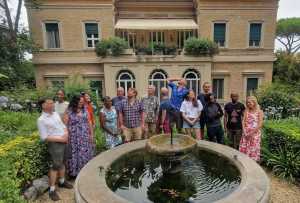
Mapping Ancient Africa participants on the Rome workshop (2023)
The Mapping Ancient Africa (MAA) project has an open call for contributions to a Special Issue of Quaternary International; the journal of our funder the International Union for Quaternary Research (INQUA). The concept for the special issue is agreed in principle with the journals editor-in-chief so now it is our task to collate a collection of manuscripts suitable to published in this international peer reviewed journal. The special issue will be based around papers discussed and presented at the MAA workshop in Rome and session at the INQUA congress in Rome in July 2023, but we are also happy to consider other manuscripts that fit within the MAA project area.
To find out if your manuscript idea might fit either explore the MAA web pages or contact a member of the editorial team:
The Society for Tropical Ecology‘s 7th European Conference of Tropical Ecology will be hosted by the University of Lisbon in 2024. Entitled “Tropical ecosystems in a fast-changing planet” the conference will take place fromMonday 12 to Friday 16 February 2024. The call for sessions is now open (deadline 7 September 2023). So add the date of the congress to your diary and submit your exciting ideas for a session now…
For more details visit the conference web pages here.
The Palaeoecology Research Group within the Department of Archaeology at the Max Planck Institute of Geoanthropology, Jena, Germany is pleased to announce a new vacancy for a Doctoral student exploring long-term human-environment interactions in the Caribbean. The position will be for a period of 3 years with the option for extensions based in Jena, Germany and supervised by Dr. Yoshi Maezumi. The position will be linked with the Department of Ecosystem & Landscape Dynamics at the University of Amsterdam. Deadline: 30 August 2023
The next four interviews with scientists who participated in the Mapping Ancient Africa workshop in Rome (2023) are now online (see below). You can find more interviews with scientists by clicking the names below:
During the Mapping Ancient Africa workshop in Rome I conducted short interviews with the scientists involved. The first of these, Alfred Houngnon can be viewed here, below are four more, and more will follow as I get them uploaded. I hope they provide interesting insights into the diverse range of skills and backgrounds our scientists have.
Interview 2: Busisiwe Hlophe (University of the Witwatersrand)
Interview 3: Angela Effion (University of the Witwatersrand)
Interview 4: Bahru Zinaye Asegahegn (University of Cologne)
Interview 5: Michela Leonardi (University of Cambridge)
To find out more about the Mapping Ancient Africa project click here.




 Ecology of the past