Vegetation responses to late Holocene climate changes in an Andean forest By Klaas Land (currently studying MSc Biological Sciences (Ecology & Evolution) at the University of Amsterdam.
The discussion during the APC meeting on the 19th of March was on the paper by Schiferl et al. (2018), a very recent study on the climatic shifts in the late Holocene and their effects on the South American tropics. The study had analysed a core going back about 3800 years from Lake Palotoa, which was in the Andean foothills (1370m elevation). They found that subtle changes to the fossil pollen record could be identified around the estimated periods for the Little Ice Age (LIA) and Medieval Climate Anomaly (MCA). The focus in the paper Continue Reading
Dobrochna wondering what kind of pollen and phytoliths are hidden it that piece of dirt (Krakenven, 2018)
Looking at a time capsule from Twente
By Dobrochna Delsen (currently studying for BSc Biology at the University of Amsterdam)
An unusual early morning.
It is 8:15. My train arrives at Science Park. After a ten-minute walk accompanied by other students I arrive at the university. After a short contemplation about whether I should take the elevator, I decide to take the stairs. The stairs are a bit exhausting, especially since the microscope room is at the top floor, but it gives me the necessary ‘exercise’ for the day. As I walk to the room at the end of the corridor I can see that the coat rack is still empty, except of the one lab coat that hangs there since the day my bachelors project started. I take out my student card and hold it against the door handle. The sound of the unlocking door gives me feeling of satisfaction and power. I step into the empty room with a feeling of superiority and go to my microscope where I will sit for the rest of the day.
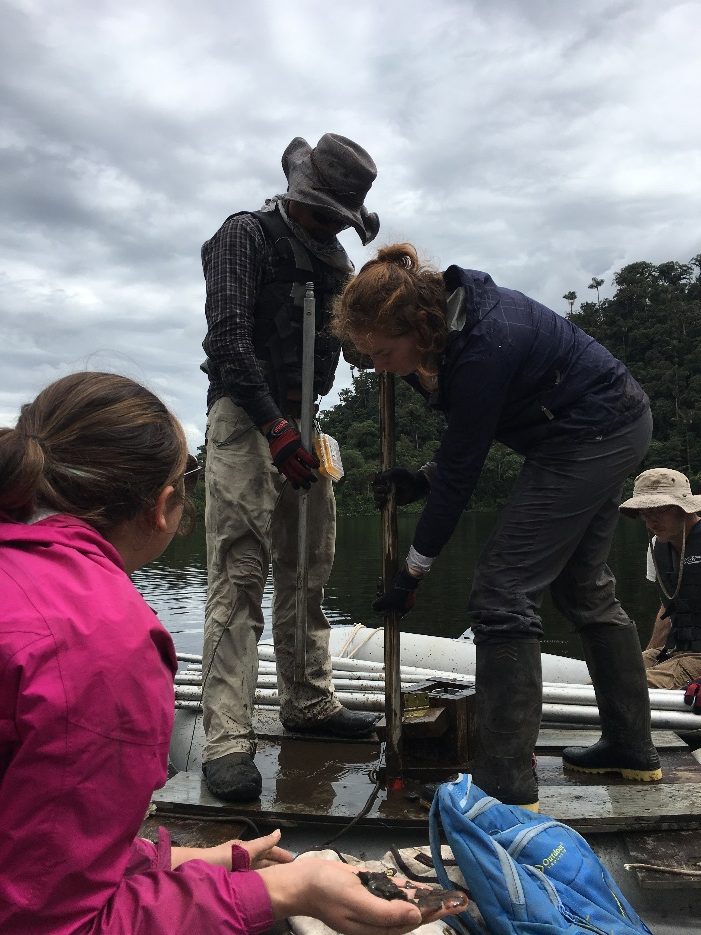
Rachel Sales, Bryan Valencia, and Majoi de Novaes Nascimento coring a different lake. In this picture, we have just pulled a core of mud up from the bottom of the lake. Photo credit: Seringe Huisman
I am sitting on the shore of Lago Condorcillo in Southern Ecuador, after a long day of travel, trying to control my shivering. At roughly 10,500 ft. above sea level, the lake is very cold, with wind that howls over the barren hills dotted with giant boulders. The lake is also almost always blanketed by thick fog and pelted by driving rain. When you’re surrounded by the thick fog punctuated by lightning bolts, it’s easy to believe that some lost civilization lurks just out of sight. Tonight we are experiencing lightning storms, which is adding to the feeling that some angry, ancient life form must live at Lago Condorcillo.
Tomorrow, I will be out in the cold and rain, balancing on an inflatable boat and fighting frostbite. Mark Bush, who is my Ph.D. advisor, Courtney Shadik, who is my lab partner and tent buddy, and I will be collecting cores of mud from the bottom of Condorcillo. We will create our rig for coring by tying two inflatable boats together, and placing a wooden platform between them. Mark, Courtney, and I will then collect our mud cores from this platform.
As I’m contemplating the hazards of camping in a lightning storm, Mark says, “Tell me everything that went wrong today.” Courtney pulls a sleeping bag closer to her. I begin to describe how Google Maps can’t seem to understand distance in the Andes, and so traveling to Lago Condorcillo took much longer than we anticipated. Courtney laughs beside me and adds, “We don’t have any matches to start a fire.” Despite our troubles, I am grinning from ear to ear, no doubt spoiling the grim mood Mark is attempting to cultivate and Lago Condorcillo is doing its best to enforce.
We are currently looking for a new representative to join the British Ecological Society (BES) Education and Careers Committee (ECC) of which I am currently the chair. I have been involved with the BES for may years first attending a conference in 2000 (Warwick University), running the Tropical Ecology special interest group (2006-2009), as an ordinary member of council (2010-2014), and chairing the ECC (2014-2020). Throughout my envolvement with the BES I have had positive experiences and enjoyed contributing to a society that can get things done. Since I have been involved with ECC we have launced under-graduate and A-level summer schools, introduced a mentoring scheme for acadmices, and helped to encourage academics to engage the public with science. If you are interested in helping us to develop the activity of the society please consider joining us!
For full details visit the advert on the BES web page by clicking here. Closing date: 22 March 2019
On Wednesday I visited Dr. Letty de Weger at the Leiden University Medical Centrum to discuss pollen and see her facilities for monitoring pollen in the environment. Super exciting discussions and a beautiful day to be up on the roof!
I recently joined the editorial board of Plant Ecology & Diversity at the invitation of editor-in-chief Laszlo Nagy (University of Campinas, Brazil). The journal focuses on ecological and evolutionary issues within plant biology with broad themes covering biodiversity, conservation and global change. Furthermore, I think this is a particularly interesting journal to be involved with because of its option for double-blind peer reviews, commitment to providing a platform for ‘negative results’ and ‘repeat experiments’, and its open access Grubb Review series (Nagy & Resco de Dios, 2016); which already includes many significant articles, including: Ashton (2017), Barbeta & Peñuelas (2016), Grubb (2016), Körner (2018), Valladares et al. (2016), and Wilkinson & Sherratt (2016). In addition to the invited Grubb Reviews the journal publishes: research articles, short communications, reviews, and scientific correspondence. My role on the editorial board will be to cover submissions related to tropical palaeoecology and biogeography. So please consider submitting to Plant Ecology & Diversity if you have some exciting new research or ideas that you think would be appropriate.
“TERRA NOVA is a new Research Fellowship Programme funded by the European Commission that learns from landscapes with past energy regimes to design new landscapes in the low carbon society. Are you interested in TERRA NOVA and you feel qualified to apply, take a look at one of the 15 positions that are available, and apply before – April 15th 2019.”
I am pleased to announce the opening up of a new DPhil position at the University of Oxford Department of Earth Sciences that I will be involved with. The main supervisor for the project is Prof. Tamsin Mather and the position is part of her recently funded European Research Council project. The project is entitled “Sniffing out global volcanic fingerprints using mercury in Quaternary sedimentary records”.
For full details of the project click here and how to apply click here.
Session abstract: This session deals with studies focused on tropical ecosystems, including terrestrial as well as marine systems. We particularly welcome talks focused on explaining the extraordinary high biodiversity, or on understanding anthropogenic impacts on this diversity.
To submit your paper please send us the following information:
Your full name and those of co-authors to be listed in the programme
Your affiliation (institute + group/department)
The title of the presentation
A short abstract of the presentation that you propose to give (MAX. 200 WORDS)

 Vegetation responses to late Holocene climate changes in an Andean forest





 Ecology of the past