Ecology of the past 2014

January 4, 2015
WDG

William shortly after a haircut

William shortly after first Dutch haircut

2014 has seen more people visit this blog and more “clicks” through to articles than in any previous year (see Annual Report 2014). So thanks for reading! I hope that the information provided is useful. For me 2014 has been a big year of change; with the largest work related change being taking up my new post at the University of Amsterdam in September.

2015 promises to be an exciting year with a number of key projects generating exciting findings (including chironomid climate for the Neotropics, Andean flank evolution, and ‘deep time’ palynomorphs) , the start of the XPERT network, and new proposals and collaborations being developed here in the Netherlands (including new proposal to work in Europe!).

Any comments, thoughts or contributions on the blog welcome.

William

Assistant Professor Palaeoecology

November 18, 2014
WDG

02_05_2007_AsteraceaeVacancy: Assistant Professor Palaeoecology
(5-year tenure track)

Palaeoecology & Landscape Ecology
Institute of Biodiversity & Ecosystem Dynamics
University of Amsterdam

Closing data: 14 December 2014
Interviews: January 2015

We are looking for an ecologist with experience and interest in long timescales specifically related to one, or more, of the following research areas:

  • the Quaternary (last 2.6 million years);
  • sedimentary archives;
  • application and interpretation of proxy indicators (physical, biological and/or geochemical);
  • novel proxy development;
  • numerical/statistical methods in ecology.

For full details on the position and how to apply click here.
For informal discussion of the position please contact William Gosling.

Current research within the P&L group focuses on examining past environmental change in lake sediments (Yanacocha, Peru)

Current research within the P&L group focuses on examining past environmental change in lake sediments (Photo: Yanacocha, Peru)

The Palynology Specialist Group Meeting

November 6, 2014
WDG

Linnean Society of LondonThe Palynology Specialist Group Meeting
13th November 2014
Burlington House, Piccadilly, London W1J 0BF, UK

Program

Phillip Jardine 10:30 – 10:55
Recovering sporopollenin chemical information from processed palynological samples

Luke Mander 10:55 – 11:20
On the taxonomic resolution of pollen and spore records of Earth’s vegetation.

Hugh Dickinson 11:20 – 11:45
Asymmetry in pollen mitosis 1; how does it work and is it important

Mark Grosvenor 11:45 – 12:10
Human-landscape interactions during the Mesolithic-Neolithic Transition in Cumbria

Guy Harrington 12:10 – 12:35
The fate of pollen in soils in the Paleocene-Eocene Thermal Maximum (PETM): The terrestrial response to global warming

– Lunch (not provided) at various locations around Burlington House –

Barry Lomax 14:00 — 14:25
Episodic perturbations of end Permian atmosphere recorded in plant spore chemistry

Matthew Pound 14:25 – 14:50
Global vegetation record indicates no atmospheric pCO2 decline at the Eocene-Oligocene transition

Peter Mark 14:50 – 15:15
The effect of heat stress on wheat pollen development: a multi-faceted approach to a better understanding of a potentially serious issue

Sam Salter 15:15 – 1540
Micro vs. Mega: A quantitative comparison of dispersed spores/pollen and plant megafossil assemblages from a Middle Jurassic plant bed from Yorkshire, UK.

– Tea in Linnean Society Library –

Carina Hoorn 16:00 — 16:25
Evidence of past marine conditions in Amazonia

Wes Fraser 16:25 – 16:50
Towards a unified cross-taxa sporopollenin composition

Organisms and environments: Frontiers in palaeoecological technique development

October 16, 2014
WDG

inquaXIX INQUA Congress
NAGOYA, JAPAN 27 July-2 August, 2015

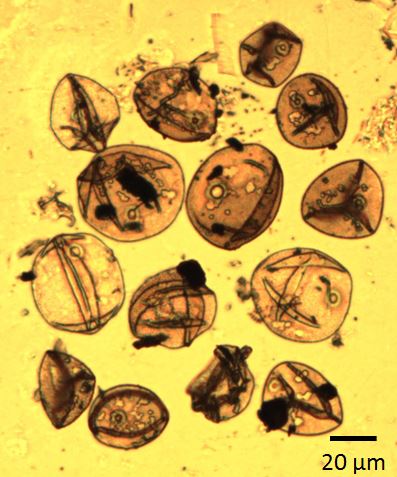
Grass pollen from Lake Bosumwti picked for individual chemical analysis

Grass pollen from Lake Bosumwti picked for individual chemical analysis

Abstract submission is now open for the XIX International Union for Quaternary Research (INQUA) Congress. “Ecology of the past” researchers will be there and are hosting a special session, entitled Organisms and environments: Frontiers in palaeoecological technique development, at which we hope to bring together a wide range of palaeoecologists working on novel proxy development. Members of the “Ecology of the past” group will be showcasing recent findings on the environmental significance of pollen chemistry change through time; linked to the 500,000 years of solar irradiance, climate and vegetation change in tropical West Africa project (Fraser et al., 2014). Please take a look at our session and consider submitting YOUR abstract today!

For information on abstract submission click here. Closing date for abstract submission 20 December 2014.

For further information on our session click here, or “Continue reading” below…

Continue Reading

NERC-PlanetEarth

Insects, sediment and climate change

Frazer Bird and William Gosling talk about how to conduct palaeoecological research in the tropics for NERC’s Planet Earth pod-cast. Click here to here to listen to the conversation.

For other similar stories online visit the Planet Earth website.

African ecology in context

May 14, 2014
WDG

afqua-logo-header-copy

I am delighted to be organizing a focus session at the first AfQUA meeting. The session seeks to bring together ecologists and palaeoecologists working in Africa. If you are interested in getting involved please contact me (William Gosling) directly. For further information on the conference visit the AfQUA website or twitter feed.

Focus session 1: African ecology in context
The African continent spans over 80 degrees of latitude, nearly 6000 m of altitude and around 30 million km2 consequently it contains a vast array of unique ecosystems. Many of the African ecosystems are under direct pressure from human activity and are threatened by on-going and projected climate change. However, management and conservation of the modern African ecosystems is hampered by a paucity of data on their natural history. Studies of observations of ecosystems spanning >30 years are rare so we are heavily reliant on examination of the fossil record to place modern ecology in a long-term (>50 year) context. Information on past ecosystems can be extracted through the examination of a range of biological indicators (e.g. pollen, carbon isotopes, charcoal) found within marine and lake sediments. However, interpretation of the sediments and the proxies they contain with the ecosystems observed today is challenging because of timescale and interpretation issues. The aim of this session is to bring together modern ecologists and paleo-ecologists working in Africa to present the state-of-the-art understanding of ecosystems past and present, and explore how we can improve understanding of timescales and proxy interpretation to place these threatened ecosystems in context.

BES Tropical Ecology Meeting

April 23, 2014
WDG

The 7th Early Career Research meeting 2014

The University of York, August 14th and 15th 2014

Tropical ecosystems – from process to policy

SIG_TropEcol_final-300x214Keynote speakers:

After six successful meetings, the legendary BES-TEG Early Career Research Meeting returns. Day one will focus on Ecology and Ecosystem Processes, while day two will focus on Practical Applications and links to Policy such as conservation, livelihood, policy and development.

All early-career researchers, both PhD and Post-Docs, are welcome to present their tropical ecology related research with a poster and/or oral presentation. There shall be a competition for both with prizes. This event will take place at Derwent College (D/L//047) and the accommodation at Alcuin College (see map link below).

Continue Reading

“Ecology of the past” YouTube channel

March 19, 2014
philjardine

"Ecology of the past" YouTube channel launched

“Ecology of the past” YouTube channel launched

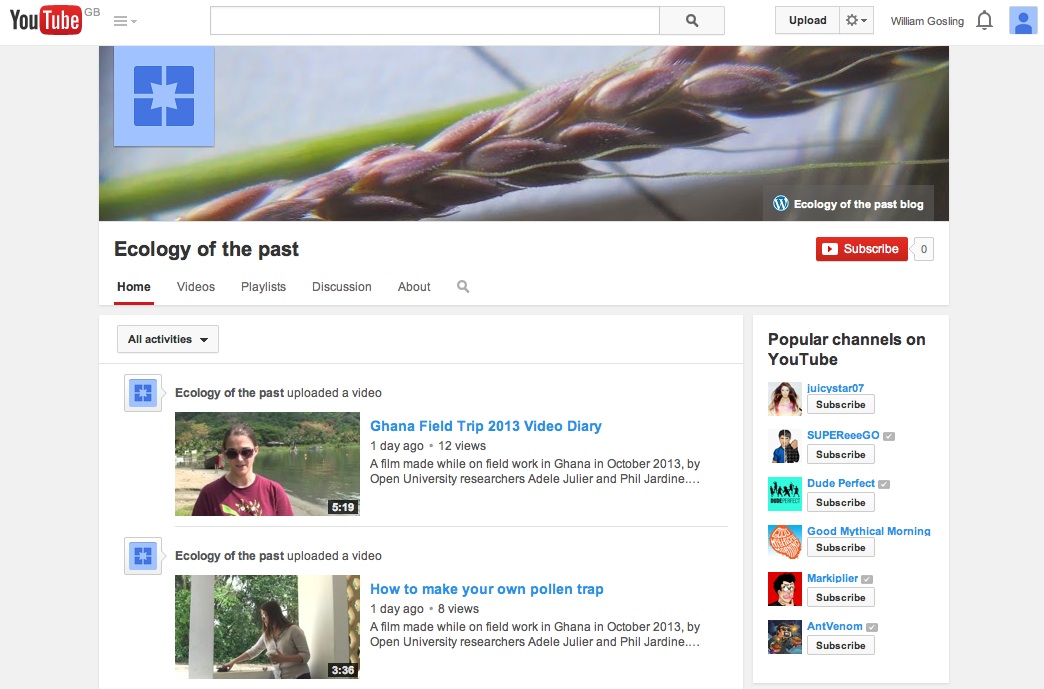
With the redesign and refocusing of the blog underway, I’m delighted to announce the launch of our very own “Ecology of the past” YouTube channel. Initially this will host videos produced as part of the Lake Bosumtwi pollen chemistry project, which includes a strong emphasis on impact and outreach activities. The videos are being targeted to a secondary school/sixth form audience, and will demonstrate both how we are doing the research and who we are as academics, highlighting the different roles and career pathways within the team. As time goes on this channel will be a platform for videos from other members of the research group, again showing who we are, what we do and how we do it.

For now, here are the first two videos: a diary of the field trip to Ghana that Adele and I went on last Autumn, and an accompanying piece showing how you too can make your own pollen trap. Enjoy!

Blog evolution

March 18, 2014
WDG

@PalaeolimOver the next few months the “Palaeolimnology et al.” blog will be changing. The first noticeable change will be the title of the blog to “Ecology of the past”. The idea behind changing the name is to have a title that it easily informs the reader about the broad area of our interests.

The changes have been precipitated by three key factors:

  1. A re-definition of the “Palaeoenvironmental Change Research Group” at The Open University (OU), in part as a response to my impending departure,
  2. My desire to have a blog people within the Paleo and Landscape Ecology Group at the University of Amsterdam (UvA) can feel comfortable contributing to, and
  3. The fact this blog has been running for over 3 years and it is probably time for a refresh.

Changes to the static pages and blog content will happen over the next few weeks.

Continue Reading

Blog at WordPress.com.