Cuesta, F., Llambi, L.D., Huggel, C., Drenkhan, F., Gosling, W.D., Muriel, P., Jaramillo, R. & Tovar, C. (2019) New land in the Neotropics: a review of biotic community, ecosystem, and landscape transformations in the face of climate and glacier change. Regional Environmental Change. DOI: 10.1007/s10113-019-01499-3
Rachel Sales, Bryan Valencia, and Majoi de Novaes Nascimento coring a different lake. In this picture, we have just pulled a core of mud up from the bottom of the lake. Photo credit: Seringe Huisman
I am sitting on the shore of Lago Condorcillo in Southern Ecuador, after a long day of travel, trying to control my shivering. At roughly 10,500 ft. above sea level, the lake is very cold, with wind that howls over the barren hills dotted with giant boulders. The lake is also almost always blanketed by thick fog and pelted by driving rain. When you’re surrounded by the thick fog punctuated by lightning bolts, it’s easy to believe that some lost civilization lurks just out of sight. Tonight we are experiencing lightning storms, which is adding to the feeling that some angry, ancient life form must live at Lago Condorcillo.
Tomorrow, I will be out in the cold and rain, balancing on an inflatable boat and fighting frostbite. Mark Bush, who is my Ph.D. advisor, Courtney Shadik, who is my lab partner and tent buddy, and I will be collecting cores of mud from the bottom of Condorcillo. We will create our rig for coring by tying two inflatable boats together, and placing a wooden platform between them. Mark, Courtney, and I will then collect our mud cores from this platform.
As I’m contemplating the hazards of camping in a lightning storm, Mark says, “Tell me everything that went wrong today.” Courtney pulls a sleeping bag closer to her. I begin to describe how Google Maps can’t seem to understand distance in the Andes, and so traveling to Lago Condorcillo took much longer than we anticipated. Courtney laughs beside me and adds, “We don’t have any matches to start a fire.” Despite our troubles, I am grinning from ear to ear, no doubt spoiling the grim mood Mark is attempting to cultivate and Lago Condorcillo is doing its best to enforce.
In the 4th edition of our “Amsterdam Paleoecology Club”(APC), we discussed ‘A 6900-year history of landscape modification by humans in lowland Amazonia’ by Bush et al. (2006)1. The high-resolution record presented in this paper shows impressively that what we might perceive as native rainforest today could rather be a since a long time actively modified landscape.
The chronology from Lake Sauce (Peruvian Andes) suggests a continuously forested landscape under significant anthropogenic impact over the last 6900 years. Indicators of human activity are taken to be the varying presence of crop pollen (Zea mays) throughout the record, combined with the continuous occurrence of charcoal. Two extra-large fire events are dated at c. 6700 and between 4500-4230 cal BP, probably enhanced by the relatively drier climate of the mid-Holocene. However, it is not clear yet if human actions formed a response to climate change or were part of social and cultural changes.
For this “Amsterdam Palaeoecology Club” (APC) meeting we did not discuss a paper, instead I presented my progress on my second research internship of my master’s on the geolocation of pollen samples under the supervision of dr. C. N. H. McMichael. The other students were asked to read the paper ‘Forensic palynology: Why do it and how it works’ by Mildenhall et al. (2006). This paper gives a review of the use of palynological analysis for criminal investigation, which ties in with my research.
We are currently looking for a new representative to join the British Ecological Society (BES) Education and Careers Committee (ECC) of which I am currently the chair. I have been involved with the BES for may years first attending a conference in 2000 (Warwick University), running the Tropical Ecology special interest group (2006-2009), as an ordinary member of council (2010-2014), and chairing the ECC (2014-2020). Throughout my envolvement with the BES I have had positive experiences and enjoyed contributing to a society that can get things done. Since I have been involved with ECC we have launced under-graduate and A-level summer schools, introduced a mentoring scheme for acadmices, and helped to encourage academics to engage the public with science. If you are interested in helping us to develop the activity of the society please consider joining us!
For full details visit the advert on the BES web page by clicking here. Closing date: 22 March 2019
van der Sande, M.T., Gosling, W.D., Correa-Metrio, A., Prado-Junior, J., Poorter, L., Oliveira, R.S., Mazzei, L. & Bush, M.B. (2019) A 7000-year history of changing plant trait composition in an Amazonian landscape; the role of humans and climate. Ecology Letters DOI: 10.1111/ele.13251
Hagemans, K., Tóth, C.-D., Ormaza, M., Gosling, W.D., Urrego, D.H., León-Yánez, S., Wagner-Cremer, F. & Donders, T.H. (2019) Modern pollen-vegetation relationships along a steep temperature gradient in the Tropical Andes of Ecuador. Quaternary Research online. DOI: 10.1017/qua.2019.4
The International Conference on Past Plant Diversity, Climate Change, and Mountain Conservation was aimed to address this question, with a focus on mountain (montane) species. As climate warms, there are several outcomes for montane species. They can migrate upslope, go extinct, or adapt to the warming conditions. Given these options, we got together to discuss our most recent datasets, and the best strategies for the conservation of montane species. Effective conservation strategies are crucial for the survival of many rare and endemic montane species, because climate is indeed warming, regardless of what Trump or Fox News tries to tell people.
The paper we discussed was “Columbus’ footprint in Hispaniola: A paleoenvironmental record of indigenous and colonial impacts on the landscape of the central Cibao Valley, northern Dominican Republic” by Castilla-Beltrán et al (2018). The paper provides a multi-proxy paleoecological reconstruction of the Caribbean island nation of the Dominican Republic, spanning the last 1100 years. Personally I found this to be a very interesting paper, packed with information and interpretations on the impact of anthropogenic factors on past Caribbean environments. What this paper nicely demonstrates is the difference in impact between pre-colonial and post-colonial societies on the vegetation of the Dominican republic. Pre-colonial Hispaniola was inhabited by indigenous societies, the Taíno people, and while this paper clearly shows them having had an environmental impact in the form of fire management (e.g. for slash and burn agriculture), small scale deforestation and the introduction of cultivars such as maize and squash, their environmental impact remains modest compared to post-colonial disturbances. Columbus arriving in AD 1492 signified a moment of change in the landscape. The paleorecord suggests that, after an initial collapse of the Taíno population, the colonization of the Dominican Republic by the Spanish brought with it deforestation, crop monoculture and the introduction of European livestock, all of which still characterizes the landscape to this day.
The discussion mainly focused on the chronology used. One of the radiocarbon samples was excluded from the age-depth model for no apparent reason, which led us to discuss the importance of critically evaluating your calibrated radiocarbon dates and which ones to incorporate in your age-depth model. The age-depth model currently used implied a shift in pollen composition c. 30 years before the arrival of the Spanish. We were unsure how to interpret these findings because you would expect the shift to happen afterwards, so my initial thought was that it had to be a fault in the chronology. This chronology however does imply a large charcoal peak followed by a rapid decline that coincides precisely with the arrival of the Spanish, and it turned out that this was the reason the authors settled on this chronology.
Even though this paper by Castilla-Beltrán et al. didn’t spark any heated discussions, its incorporation of ecology, botany, history, archeology and geology still showcases the interdisciplinary nature of paleoecology, something I very much enjoy about this field of research.
 Cuesta, F., Llambi, L.D., Huggel, C., Drenkhan, F., Gosling, W.D., Muriel, P., Jaramillo, R. & Tovar, C. (2019) New land in the Neotropics: a review of biotic community, ecosystem, and landscape transformations in the face of climate and glacier change. Regional Environmental Change. DOI: 10.1007/s10113-019-01499-3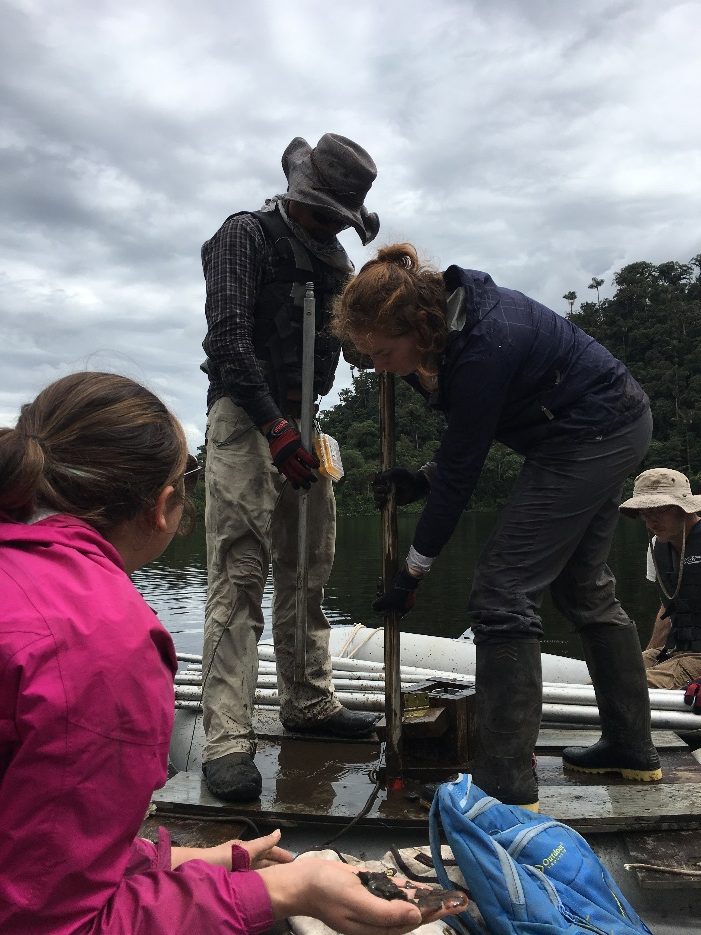




 Ecology of the past