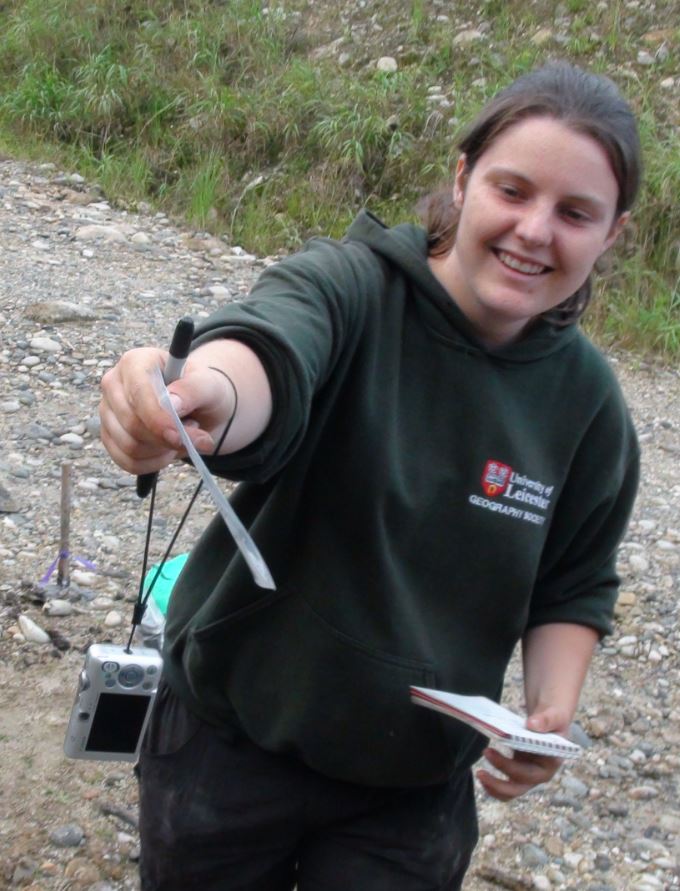
Hayley Keen getting excited about sediments during fieldwork in Ecuador (2012). Photo: J. Malley
Keen, H.F. (2015) Past environmental change on the eastern Andean flank, Ecuador. PhD Thesis, Department of Environment, Earth & Ecosystems, The Open University.
Abstract The eastern Andean flank of Ecuador (EAF) contains some of the world’s most biodiverse ecosystems. Andean montane forests are threatened due to anthropogenic pressures and both current and projected climate change. This thesis examines the palaeoecological history of two stratigraphic sequences (Mera Tigre West [MTW] and Mera Tigre East [MTE]) obtained from the Ecuadorian modern lower montane forest. The sediments preserved were analysed using eight analytical techniques, allowing an insight into the ecosystem’s potential response to projected changes derived from their past responses. Palaeoecological studies on the EAF are rare, and those that do exist are debated relating to: i) the inference of robust ecological data from pollen records in floristically diverse locations, and ii) the past source area of sediments preserved in fluvially exposed sequences, potentially leading to contamination with older material.
A statistical sub-sampling tool was developed (debate i), capable of producing statistically robust count sizes for each pollen sample; MTW and MTE count sizes ranged from 196-982 showing the diversity within sequences. The depositional environment of MTE was analysed, investigating sediment provenance throughout (debate ii). Results found that large scale volcanic events were critical in the preservation of the sediments, whereas fluvial influence caused a regional sediment source area in the upper stratigraphy, impacting on the palynological interpretation of MTE. Pollen records demonstrated the presence of a diverse vegetation community with no modern analogue at MTE (abundant taxa (>15 %): Hedyosmum, Wettinia, Ilex) and upper montane forest at MTW (Alnus, Hedyosmum, Podocarpus). Fire was not the main driver for the vegetation reassortment at either site (MTW correlation coefficient: -0.37, MTE: 0.16). The two sites have demonstrated the EAF plays host to floristically dynamic ecosystems, susceptible to drivers of change (fire and landscape) and should be considered when predicting the montane forests’ future response to environmental change.
The month-long palaeoecology module at UvA is coming to an end. We have had two weeks of lectures and microscope work, an introduction to quantitative palaeoecology, and we just finished a week of fieldwork in Twente, which is in the easternmost part of the Netherlands.
Students working in the field (photo: M. Groot)
Will Gosling and I tried something new for the field excursion this year. We split the class into eight groups, and gave each group a set of pollen and phytolith samples from an ‘unknown location’. Unknown in this context means being from one of the eight primary sites that we would visit during the field excursion. The students were required to perform vegetation surveys and characterize soils at each of the primary sites that we visited. The goal of each group was to figure out which location their set of ‘unknown’ samples came from. Basically, we had them doing forensic palynology, with idea that they could then better visualize the different vegetation assemblages seen in the palaeoecological records. Continue Reading
The final working day of the XPERT summer school focused on projects, grants and careers.
Encarni, Carmen and Will
First thing in the morning Encarni Montoya reported the key findings from her NERC funded fellowship project, entitled: Evaluation of tropical forests sensitivity to past climate changes. Her presentation focused on new multi-proxy palaeoecological data from two lakes in Ecuador (high elevation Laguna Banos, and low elevation Laguna Pindo). Based on the palaeoecological proxies Encarni demonstrated the buffering capacity of different ecosystem structures in preventing/mitigating the environmental impacts of volcanic eruptions. Following Encarni, Carmen Luzuriaga (Director of the Pindo Mirador Research Station [PMRS], Universidad Tecnológica Equinoccial) presented modern ecological information and conservation efforts in the region of Laguna Pindo. Two key impacts were identified from the dialogue with the PMRS and the project team:
Today was proxy meta analysis day! Emiel van Loon took the participants through a number of exercises related to the statistical analysis of palaeoecological data. Much of the day was spent learning about, and experiencing, the challenges of correctly coding data for analysis. It seems to me that the key challenge with the statistical analysis of the data is not the statistical analysis, but working out the method for implementing the statistical analysis.
Erik organising field work (not a BBQ)
After a day of coding in R everyone was ready for a beer, so thankfully tonight was BBQ night! I was dispatched in the afternoon, with Prof. dr. Hooghiemstra, to gather non-meat provisions for the evening, meanwhile Dr. Erik de Boer had organised a grill and meat from a local butcher. By the time I reached the BBQ beer, meat and cucumber…
The second day of the summer school was focused on understanding individual proxies. The day started with introductory talks to five proxies that can be used in palaeo-environmental research:
Students then broke up into four groups each of which focused on an individual proxy. Working collaboratively and in discussion with staff members each group was faced with a ‘raw’ data set for their proxy which they had to process. Once they had ‘played’ with the data for a while they then had to report back to the entire group.
Where available the groups worked with Lake Erazo data generated from the sediment cores recovered during the field school. After reporting back each groups was asked to make…
Most of the XPERT 2015 summer school participants who were coming from abroad arrived in Amsterdam on Saturday and all seem to have found the hotel, and each other, with little problem. Convening in the hotel as a group they arrived together at Science Park 904 just before 09:00 to be met by local students Tom Peters and Valerie van den Bos who guided them to the study room.
The first part of the first day was focused on getting to know each other. Introductions from all students and staff emphasised the diverse range of interests and expertise required to conduct palaeo-environmental research. In particular the introduction talks revealed the importance and range of time scales in palaeo-environemental change; e.g. from evolutionary change over geological time (Jordan Bishop), through high resolution past climate change during the Holocene (Nick Primmer/Elizabet Safont)…
XPERT are delight to announce that we will be incorporating an Open Science meeting, communicating the results of an international research project, as part of our Summer School. The meeting is open to all so if you are not a member of XPERT but would like to attend please contact William Gosling and further details can be provided.
The FORSENS project is a research project focused on understanding past environmental change in different locations within Ecuador (Andean and High Amazon). At the Open Science meeting, hosted by the University…
Characterization of Neotropical ecosystems by their modern pollen spectra and organic chemical composition
Develop skills in pollen identification, pollen chemical characterization, and the analysis of organic biomarkers.
Examine ecological variation across an altitudinal gradient of nearly 4000 meters on the tropical western Andean flank.
Improve understanding of how ecosystems function in a biodiversity hotspot, and how they might be identified in the fossil record.
The considerable biodiversity of Neotropical ecosystems is under pressure from projected climate change and human activity. Modern ecosystems can be characterized by their pollen rain and organic chemistry, which can in turn provide information about ecosystem health and functioning. However, little is known about how pollen assemblage and chemical composition (of pollen and plants) vary along environmental gradients. Altitudinal transects provide an opportunity to study a range of environments and ecosystems with a relatively small geographic area. By improving our understanding of modern ecosystems we can improve our interpretation of fossil records, and consequently better understand how modern ecosystems came into being.
The main objectives of this PhD project are to:
Generate the first modern pollen assemblage and chemical data set for the Neotropics,
Characterize the landscape-scale variation in pollen assemblage and chemistry composition, and
Identify the key environmental drivers that determines pollen assemblage and chemistry composition variation.
Publication date: 27 July 2015 Closing date: 18 September 2015
Level of education: University (Masters)
Hours: 38 hours per week
Salary indication: €2,125 to €2,717 gross per month
Vacancy number: 15-286
Applications should be emailed to application-science@uva.nl, with in the subject line the position you are applying for and vacancy number (15-286). Please make sure all your material is attached in only one pdf. Applications should include a detailed CV including educational experiences, a list of research projects and/or publications, a letter of motivation, relevant work experience, and the names and contact addresses of two academic referees from whom a reference for the candidate can be obtained.
For more details, including information on how to apply, click here (UvA), or here (via academic transfer).





 Ecology of the past