Ghana 2014 – Day 08

October 24, 2014
WDG

wfraser2013's avatarghana2014fieldwork

Yesterdays visit to Kogyae was a long day, but we made it back to FORIG in the evening so today is somewhat of a ‘spare’ day. The day has mostly been spent collating data from yesterday, rehydrating and resting after a long and tiring day.
Passing through some of local villages was really interesting; a mix of traditional living with a modern lifestyle. Many villages consisted only of houses that were constructed in a traditional manner, but most had a Chinese-made motorcycle or TATA pickup truck parked outside and the latest Samsung mobile phones dotted around. Also, I don’t think I have seen so many goats just strolling freely around as I have in these rural villages.

image

View original post

Ghana 2014 – Day 07

October 24, 2014
WDG

Awesome work and trap recovery guys – keep up the good work.

wfraser2013's avatarghana2014fieldwork

An early start at 06:00 this morning to get to Kogyae with sufficient time to collect and deploy all traps across three sites (30 traps in total) and return to FORIG within a single day. We arrived on site at around 10:30, and after some deliberations as to which guide knew exactly where the plots we needed to reach, we were on our way to the first site.

The first site was the savannah plot, with a wide open canopy and grasses above head height. Immediately the difference to the forest at Bobiri was striking (image below). All 10 traps deployed here last year were successfully located, retreived and replaced with fresh traps.

image

The next stop was the transition plot at Kogyae, representing a mid-point between savannah and forest habitat. Again, all 10 traps were easily located, retreived, and redployed (Image below). The grass here was noticeably shorter in height…

View original post 80 more words

Ghana 2014 – Day 06

October 24, 2014
WDG

wfraser2013's avatarghana2014fieldwork

A fairly quiet day today back at base in FORIG. Collating field data collected during yesterdays trip to Bobiri, tidying up the collected pollen traps, and preparing kit and equipment for tomorrows trip to Kogyae. We also need to pack some supplies and clothing etc because we may need to stay overnight somewhere nearby to the field site – it is an 3 hour drive from FORIG in Fumesua, so may not be able to travel there and back in a single day. The option of staying at the field station at Kogyae is not available because a group from Oxford University who are also out here are running a 10 day campaign at Kogyae this week, so the camp is full to the brim.

View original post

Ghana 2014 – Day 05

October 24, 2014
WDG

wfraser2013's avatarghana2014fieldwork

Today we visited the field sites at Bobiri butterfly and nature reserve. In total we collected and redeployed 20 pollen traps; 10 at each of two separate sites (SNR and 50-year logged).

It was great to get a feel for the first of the sites on this project, and helps put the analytical results into context. These forests really are an exciting habitat to explore.

image

View original post

Ghana 2014 – Day 03

October 24, 2014
WDG

wfraser2013's avatarghana2014fieldwork

Day three of the fieldwork campaign saw us form a production line of pollen trap making: Lottie = chief sealant operator and cotton stuffer; Adele = Cap trimmed and fitter; Wes = Noose cuter and net trimmer. In total ro traps were manufactured in just one day.We rewarded ourselves with dinner out at the local hotel, watched a game of football on TV, and a beer – all in all, a pretty good day!

View original post

Ghana Fieldwork 2014; Day 02

October 17, 2014
wesfraser

The second day of our fieldwork saw us; transfer from Accra to Fumesua where FORIG is located (approximately 20 km south of Kumasi); meet up with FORIGs deputy director Dr Stephen Adu-Bredu to discuss fieldwork and outreach plans; and settle in to FORIG for the next two weeks.

The next two days will involve building pollen traps ready for deployment next and finalising the detailed day-to-day plan of work.

Ghana Fieldwork 2014; Day 01

October 17, 2014
wesfraser

The latest round of fieldwork in Ghana is underway. Adele and myself are travelling out to collect pollen traps deployed last year as part of Adeles PhD research. We will be revisiting the sites in Ankasa, Bobiri and Kogyae that Adele and Phil visited last year. This time we are also accompanied by Lottie who will be delivering workshops on outreach activity engagement and the palaeoecology represented in the sediment record of Lake Bosumtwi.

Flying into land at Accra in the twilight we passed over a storm cell, with some fantastic convective clouds illuminated by flashes of lightning within. Once out of the airport, we were taken through the hustle and bustle of Accra streets, alive with evening activity. Finally reaching our destination for the night, the FORIG guesthouse. All three members of our party readily made for bed to get a good nights sleep before tomorrows journey to Kumasi.

Organisms and environments: Frontiers in palaeoecological technique development

October 16, 2014
WDG

inquaXIX INQUA Congress
NAGOYA, JAPAN 27 July-2 August, 2015

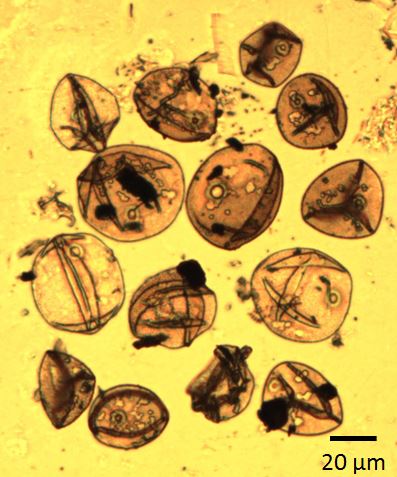
Grass pollen from Lake Bosumwti picked for individual chemical analysis

Grass pollen from Lake Bosumwti picked for individual chemical analysis

Abstract submission is now open for the XIX International Union for Quaternary Research (INQUA) Congress. “Ecology of the past” researchers will be there and are hosting a special session, entitled Organisms and environments: Frontiers in palaeoecological technique development, at which we hope to bring together a wide range of palaeoecologists working on novel proxy development. Members of the “Ecology of the past” group will be showcasing recent findings on the environmental significance of pollen chemistry change through time; linked to the 500,000 years of solar irradiance, climate and vegetation change in tropical West Africa project (Fraser et al., 2014). Please take a look at our session and consider submitting YOUR abstract today!

For information on abstract submission click here. Closing date for abstract submission 20 December 2014.

For further information on our session click here, or “Continue reading” below…

Continue Reading

Predicting the future by understanding the past: Climate change

October 9, 2014
WDG

As part of the 500,000 years of solar irradiance, climate and vegetation changes” Natural Environments Research Council funded (NE/K005294/1) project we have produced a wall chart explaining the type of research we do and how it can help to place on-going, and projected, climate change in context. The wall chart is designed for use in schools and universities. To obtain a copy of this, and other wall charts, please contact the British Ecological Society (direct wall chart link here).

Understanding Climate Changes

Blog at WordPress.com.