Focus on Global Ecology, including: global biodiversity patterns and ecosystem functioning, human impacts on biodiversity, biogeography of species interactions, and/or global changes in ecosystems, biodiversity and ecosystem services.
Exciting new edition of the Past Global Changes (PAGES) magazine focused on the sustainability of Earth’s biodiversity. Includes articles by Ecology of the Past blog contributors Dr. Encarni Montoya and Dr. Macarena Cardenas.
To find out more check out the full issue (free):
Gillson, L., Gell, P. & von Gunten, L. (2017) Past Global Changes Magazine: Sustaining the Earth’s Biodiversity 25(2): 76-130. DOI: 10.22498/pages.25.2
Encarni Montoya
Macarena Cardenas
Online:
Cuesta, F., Muriel, P., Llambí, L.D., Halloy, S., Aguirre, N., Beck, S., Carilla, J., Meneses, R.I., Cuello, S., Grau, A., Gámez, L.E., Irazábal, J., Jácome, J., Jaramillo, R., Ramírez, L., Samaniego, N., Suárez-Duque, D., Thompson, N., Tupayachi, A., Viñas, P., Yager, K., Becerra, M.T., Pauli, H. & Gosling, W.D. (2016) Latitudinal and altitudinal patterns of plant community diversity on mountain summits across the tropical Andes. Ecography. DOI: 10.1111/ecog.02567
The annual Dutch ecology conference is being held over two days at the in “remote” Lunteren and I am pleased to be able to attend all of the conference this year. The conference was kicked off this morning with a recognition that this year is 150 years since the birth of ecology as a science (Haeckel, 1866). The opening two keynotes focused on aspects of ecology which have sometimes been overlooked firstly, parasitism (Peter Hudson, Penn State University) and secondly, immunology (Irene Tieleman, University of Groningen). Following these I focused on just two sessions in the morning “linking diversity to function”, and in the afternoon “ecosystem cascades”. From the range of excellent talks in the sessions I have picked one from each as my favourite:
Masha van der Sande (Wageningen University) The role of biodiversity and environment on productivity in tropical forests; evidence across scales By examining long-term tropical forest monitoring data van der Sande demonstrated that through time ecosystem traits changed significantly. She hypothesised that the lack of stability in ecosystem traits was due to past disturbance; although it is unclear what caused this disturbance (climate or humans), or when it occurred.
Dries Kuijper (Mammal Research Institute, Poland) Landscapes of fear in Europe: Wolves and humans shaping ungulate top-down effects By tracking Wolf pack distributions in the Bialowieza forest (Poland) Kuijpershowed that ungulates avoided Wolf pack “core areas” for fear of predation, that the exclusion of ungulates lead to reduced browsing of the vegetation, and so consequently forests regenerated faster in Wolf pack core areas.
The evening lecture was given by Bart Knols (in2care) who gave an impassioned talk on the importance of communicating science beyond the academic sphere. Arguing that now is the time for ecologists to have an influence on policy making, politics and business, as well as showing us how he has done this.
Mackenzie, G., Boa, A.N., Taboada, A.D., Atkin, S.L. & Sathyapalan, T. (2015) Sporopollenin, the least known yet toughest natural biopolymer. Frontiers in Materials 2. DOI: 10.3389/fmats.2015.00066
Nelson, B.W., Ferreira, C.A.C., da Silva, M.F. & Kawasaki, M.L. (1990) Endemism centers, refugia and botanial collection density in Brazilian Amazonia. Nature 345, 714-716. DOI: 10.1038/345714a0
Souto, C.P., Kitzberger, T., Arbetman, M.P. & Premoli, A.C. (2015) How do cold-sensitive species endure ice ages? Phylogeographic and paleodistribution models of postglacial range expansion of the mesothermic drought-tolerant conifer Austrocedrus chilensis. New Phytologist 208, 960-972. DOI: 10.1111/nph.13508 COMMENT: Variation in genetic diversity used to infer the location of glacial refugia.
Journal articles
Clement, C.R., Denevan, W.M., Heckenberger, M.J., Junqueira, A.B., Neves, E.G., Teixeira, W.G. & Woods, W.I. (2015) The domestication of Amazonia before European conquest. Proceedings of the Royal Society of London B: Biological Sciences 282. DOI: 10.1098/rspb.2015.0813
Oliver, T.H., Heard, M.S., Isaac, N.J.B., Roy, D.B., Procter, D., Eigenbrod, F., Freckleton, R., Hector, A., Orme, C.D., Petchey, O.L., Proenca, V., Raffaelli, D., Suttle, K.B., Mace, G.M., Martin-Lopez, B., Woodcock, B.A. & Bullock, J.M. Biodiversity and Resilience of Ecosystem Functions. Trends in Ecology & Evolution. DOI: 10.1016/j.tree.2015.08.009
Watkins, C. (2015) Oliver Rackham OBE FBA 1939–2015. Landscape History 36, 5-8. DOI: 10.1080/01433768.2015.1044280
COMMENT: One of the books that inspired me to enter this field of research was Rackham’s Trees and woodlands in the British landscape; published the year I was born…
Bush, M.B. (1995) Neotropical plant reproductive strategies and fossil pollen representation. American Naturalist 145, 594-609. Stable URL: http://www.jstor.org/stable/2462970
Cárdenas, M.L., Gosling, W.D., Sherlock, S.C., Poole, I., Pennington, R.T. & Mothes, P. (2011) The response of vegetation on the Andean flank in western Amazonia to Pleistocene climate change. Science 331, 1055-1058. DOI: 10.1126/science.1197947
Logan, A.L. & D’Andrea, A.C. (2012) Oil palm, arboriculture, and changing subsistence practices during Kintampo times (3600–3200 BP, Ghana). Quaternary International 249, 63-71. DOI: 10.1016/j.quaint.2010.12.004
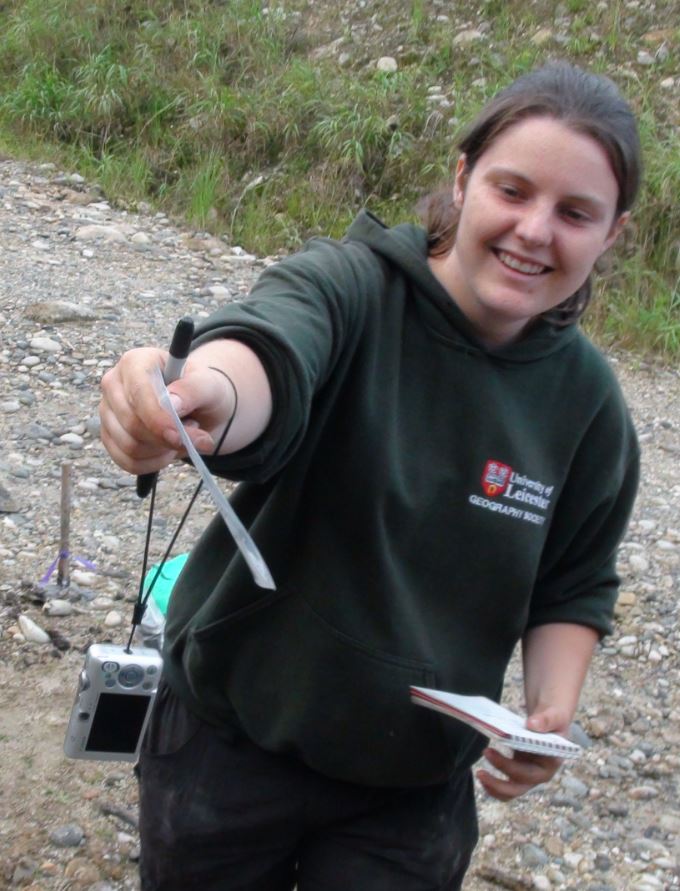
Hayley Keen getting excited about sediments during fieldwork in Ecuador (2012). Photo: J. Malley
Keen, H.F. (2015) Past environmental change on the eastern Andean flank, Ecuador. PhD Thesis, Department of Environment, Earth & Ecosystems, The Open University.
Abstract The eastern Andean flank of Ecuador (EAF) contains some of the world’s most biodiverse ecosystems. Andean montane forests are threatened due to anthropogenic pressures and both current and projected climate change. This thesis examines the palaeoecological history of two stratigraphic sequences (Mera Tigre West [MTW] and Mera Tigre East [MTE]) obtained from the Ecuadorian modern lower montane forest. The sediments preserved were analysed using eight analytical techniques, allowing an insight into the ecosystem’s potential response to projected changes derived from their past responses. Palaeoecological studies on the EAF are rare, and those that do exist are debated relating to: i) the inference of robust ecological data from pollen records in floristically diverse locations, and ii) the past source area of sediments preserved in fluvially exposed sequences, potentially leading to contamination with older material.
A statistical sub-sampling tool was developed (debate i), capable of producing statistically robust count sizes for each pollen sample; MTW and MTE count sizes ranged from 196-982 showing the diversity within sequences. The depositional environment of MTE was analysed, investigating sediment provenance throughout (debate ii). Results found that large scale volcanic events were critical in the preservation of the sediments, whereas fluvial influence caused a regional sediment source area in the upper stratigraphy, impacting on the palynological interpretation of MTE. Pollen records demonstrated the presence of a diverse vegetation community with no modern analogue at MTE (abundant taxa (>15 %): Hedyosmum, Wettinia, Ilex) and upper montane forest at MTW (Alnus, Hedyosmum, Podocarpus). Fire was not the main driver for the vegetation reassortment at either site (MTW correlation coefficient: -0.37, MTE: 0.16). The two sites have demonstrated the EAF plays host to floristically dynamic ecosystems, susceptible to drivers of change (fire and landscape) and should be considered when predicting the montane forests’ future response to environmental change.

 Job: Post-doctoral researcher


 Ecology of the past