The long history of people in the rainforest of Suriname 

July 25, 2024
ninahylkjewitteveen

In this article I summarize and describe the scientific research that was performed near Botopasi in Suriname, which was published in Ecology as ‘Pre-contact and post-colonial ecological legacies shape Surinamese rainforests’ (https://doi.org/10.1002/ecy.4272). 

Figure 1: Our research team in the field

Background

In October 2021, between COVID-19 restrictions, I joined archaeologist dr. Cheryl White and her team to excavate the remnants of a ‘lost village’ of Saamaka Maroons in the Surinamese rainforest. Maroons are the descendants of enslaved Africans, who, in the late 1600s, fled plantations to live in freedom in the Surinamese rainforests. Dr. White has been investigating the first villages and the movements of Suriname’s Maroon communities for decades and is an expert in this topic. 

Our wonderful research team consisted of Farisha Kartosemito B.Sc., Sushmeeta Ganesh B.Sc., Jõvan Samson B.Sc., Agir Axwijk B.Sc., Santosh Singh M.A., Thanya Fonkel MPA, Harrold Sijlbing, Dombi Lö, Gerno Eduards & Farik Eduards. We were welcomed in the village Botopasi, and after a day of hard work in the field, we enjoyed delicious Surinamese food and played troefcall!

As an ecologist, I was interested in the ecological effects of past human activities on the forest ecosystem. In these rainforests, Maroon and Indigenous communities often burn and remove trees near their homes to grow a variety of crops like cassava, tayer, maize and banana. After some years, the cultivation site is abandoned and forests can grow back. But do those forests recover back to their original state? 

What did the forest look like before people arrived and settled in the landscape of Boven Suriname?

To study how Maroon communities have shaped Surinamese forests over time, I made a reconstruction of the landscape of the past (going back thousands of years). The landscape was near an archaeological sites called ‘Beng Tau’, where Maroons lived in the 17th century. We used plant fossils and charcoal remains to reconstruct the forest from the past, to research if people were using fire and growing crops, and how the forests recovered from that.

Results and implications

Figure 2: Phytoliths from the banana plant

The charcoal remains and plant fossils, particularly from maize and banana, confirmed Saamaka Maroons settled in the area since ca. 1700 and practiced slash-and-burn agriculture was near the archaeological site called ‘Beng Tapu’ (Figure 2). The site may have been a cooking area, because remnants of pottery with maize, rice and banana were found. Within 1 km of Beng Tapu, we found large fragments of charcoal, and plant fossils from maize and banana. Smaller charcoal fragments and banana were found within 5 km of the archaeological site. Nowadays, agriculture is practiced within 8 km of the archaeological site and Suriname river. The area used for agriculture likely expanded over time. 

How did the forest recover from these activities? 

Within 1 km of the archaeological site, forests were burnt and used multiple times. Here, forests have a lower biomass than further away from Beng Tapu, meaning fewer or smaller trees have grown back. Also, Attalea and Oenocarpus palm trees increased. Still today, the Saamaka Maroon community uses the maripa palm to make oil. Therefore, the number of maripa palms may have increased due to human activities like cooking and oil production! Attalea and Oenocarpus palms are also adapted to open conditions and fire, showing the influence people had on the environment and how the forest responded to fires.

Further (2-7 km) away from the archaeological site, where disturbances were fewer, the forests recovered much better but Astrocaryum palms grew back in higher numbers in the understory of the forests. What makes these palms so resilient? We are still uncertain. The forests furthest away (>8km) from Beng Tapu showed little signs of disturbances. 
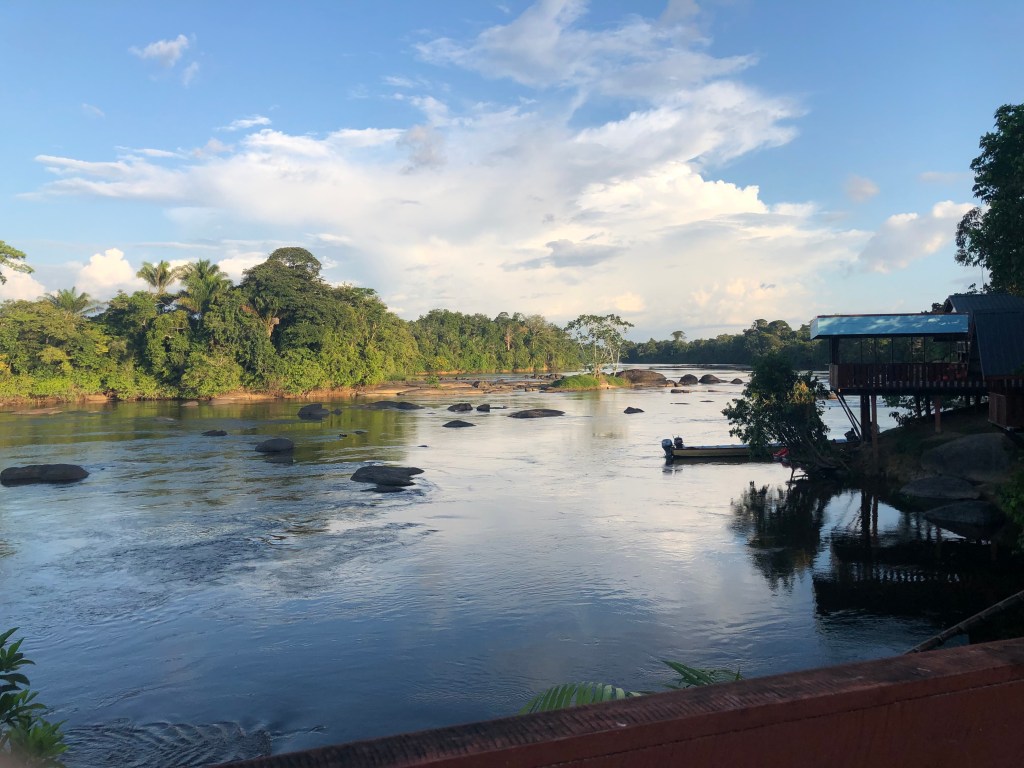
Figure 3: View from the Suriname River

A long human history, and an Indigenous archaeological site?

The Saamaka Maroons were not the first people to have inhabited the forests near Botopasi. Charcoal fragments show that people were in region (the ca. 20 km radius we studied) already 2000 years ago, and fire events occurred ca. 2000, 1700,1500, 1300, 1200 and 800 years ago. We don’t know which Indigenous Cultures may have inhabited this region, because of limited archaeological and historical research here. Large charcoal fragments were found ca. 7 km away from Beng Tapu, across the Suriname River. Could this be an Indigenous archaeological site?  

Conclusion

Our results show the timing, intensity and frequency of past disturbances are very important for good forest recovery and some disturbances from the past can still impact the modern vegetation. 

Unravelling the past not only tells us about the ancestors of Maroons and the lives of Indigenous communities before the 1500s. The past also helps us to understand how forests respond to human impacts. To better guide conservation strategies, we need to do more archaeological and ecological research in Surinamese rainforests. 

Next to the Suriname River, past human activities shaped the forest and increased local palm abundances. The broader forested region showed a healthy recovery. These results indicate that the Saamaka Maroon community preserved most of the forests they inhabited since the 1700s. We can learn from traditional knowledge about which management practices are sustainable to keep forests healthy. 

If you want to know more about the “hows” of this research… dive with me into the methodology! 

Continue Reading

Fire in Human Evolution

June 7, 2024
WDG

The “Fire in Human Evolution” international Symposium will take place at the University of Leiden (10-11 June 2024). The meeting is being organized by Femke Reidsma and Amanda Henry. The meeting will include talks and discussion on:

  • Fire perception, social interaction, and culture
  • Fire as landscape management
  • Fire, cooking and diet
  • Fire technology and cognition 
  • Archaeological signatures of fire

For full details click here.

Introducing: Jelle Kraak

June 5, 2024
WDG

Hello Ecology of the Past readers, my name is Jelle Kraak and I’m currently doing a research project for my MSc Biological Sciences (University of Amsterdam) supervised by William Gosling (University of Amsterdam), Jemma Finch (University of KwaZulu-Natal), and Trevor Hill (University of KwaZulu-Natal). The project is entitled: “Assessing the effect of human induced fire regime changes on vegetation in the Drakensberg mountains”. During the project I will visit South Africa to work at the University of KwaZulu-Natal and visit field site thanks to partial funding from the Amsterdam University Funds.

Research  project outline                                                                                 

As many of you know, humans have been interacting with the environment for millennia in various ways. One of the ways in which humans interact with the environment is through the ignition of fires. By doing so, humans may change fire regimes (fire frequency, severity and/or intensity), which in turn can cause changes in vegetation composition and structure. By using a combination of phytolith (local vegetation) and charcoal (fire) data from two sediment cores obtained from wetland environments in the Drakensberg mountains, we aim to assess the effect of fire regime changes on vegetation over the last 6000 years.

The phytoliths (biogenic silica microfossils) allow for the reconstruction of the past vegetation. Charcoal fragments characterize all aspects of past fire regimes: (i) frequency (time series analysis of charcoal data), (ii) severity (abundance of charcoal in samples reflecting biomass consumed), and (iii) intensity (spectral properties of individual charcoal fragments reflecting combustion temperature). 

The most interesting part of this project (in my humble opinion) is that this study is the first to use micro-Fourier Transformed Infrared Spectroscopy (µFTIR) to reconstruct fire temperatures from field samples ánd combine these accurately reconstructed temperatures with local vegetation data! It is important to accurately estimate fire temperatures, as the temperature of a fire dictates the type of plant materials which are consumed in a fire (the higher the temperature, the greater the proportion of woody material burning up). Similar studies have been conducted previously, however, these studies compared fire severity i.e. total burnt biomass with vegetation data. Although this works decently, total burnt biomass is not an accurate representation of fire intensity or temperature, as at very high temperatures biomass turns to ash, which cannot be detected in sediment cores. Through parameterizing both the vegetation changes and the fire regime we will provide a comprehensive picture of how changing human fire use practices modified the vegetation. We anticipate that: (i) a decrease in fire intensity resulted in woody encroachment of the surrounding vegetation, which was concomitant with the arrival of agropastoralists c. 600 years ago, and (ii) a shift in the proportion of C3 and C4 grass species in reaction to temperature changes in the Drakensberg mountains.

Heijink PhD thesis 2024

April 19, 2024
WDG

Heijink, B.M. (2024) Assessing past fire regimes and their effects on modern vegetation in Amazonian forests. PhD Thesis, University of Amsterdam, Amsterdam. ISBN: 9789493260283

Abstract

Amazonian rainforests are incredibly biodiverse and provide global ecosystem services, but are threatened by fires, which completely alter ecosystem function and structure. Fires, especially in western Amazonia, almost always have an anthropogenic origin. However, much is unknown about the long-term recovery and multi-generational successional processes following fire events. Due to the long lifespan of tropical trees, past fires may have left ecological legacies in modern forest composition in Amazonia. The goal of this thesis is to investigate how past fire events impact successional trajectories of past vegetation change and whether these fire events and related human impacts have left ecological legacies in modern Amazonian forests. I specifically focus on western Amazon and changes in palm abundances and composition through time, as palms were an economically important plant family to past peoples. I compared lake charcoal records across the Amazon Basin and found fire was least prevalent in western Amazonia. On a local scale, very limited evidence of past disturbances was present in forest plots in northwestern Amazonia. Palm abundances have been increasing since the mid-Holocene, but this increase is not related to past fire events. Past fire likely have left low to none ecological legacies in these forest plots. Modern trait composition across western Amazonia is associated with past fire events, but more research is necessary to disentangle relationships between past fire, soils, and modern vegetation. Overall, western Amazonia likely contains the least intense ecological legacies in comparison with the rest of Amazonia.

Handel: http://hdl.handle.net/11245.1/c1d12124-0025-44a3-90b9-c5835d9d3c5b

Mapping Ancient Africa: Video of seminar 16

April 15, 2024
WDG

The 16th Mapping Ancient Africa seminar took place online on Friday 12th April 2024. The seminar was delivered by Stéphanie Bodin (Senckenberg Research Institute and Natural History Museum Frankfurt). In the seminar Stéphanie demonstrated how the examination of ancient charcoals found in caves used for shelter by hunter-gather populations living in Ethiopia at the end of the African Humid Period (4,000-2,000 years ago) can provide insights into vegetation and human selection of woody resources.

Details of this seminar can be found here. You can find more Mapping Ancient Africa seminar videos on the “Ecology of the Past” YouTube channel.

INQUAlogo

Mapping Ancient Africa: Seminar 16

April 2, 2024
WDG

The next Mapping Ancient Africa seminar will take place online at 17:00 CEST on 12 April 2024.

  • Speaker: Stéphanie Bodin (Senckenberg Research Institute and Natural History Museum Frankfurt)
  • Title: Hunter-gatherers and Afromontane vegetation in the Ethiopian highlands since the end of the African Humid Period
  • Related publication:
    • Bodin, S.C., Neumann, K., Hensel, E.A., Vogelsang, R., Demissew, S., Casas-Gallego, M. & Hahn, K. (2024) Afromontane forests and human impact after the African Humid Period: wood charcoal from the Sodicho rock shelter, SW Ethiopian highlands. Vegetation History and Archaeobotany. DOI: 10.1007/s00334-023-00977-3
    • Casas-Gallego, M., Hahn, K., Neumann, K., Demissew, S., Schmidt, M., Bodin, S.C. & Bruch, A.A. (2023) Cooling-induced expansions of Afromontane forests in the Horn of Africa since the Last Glacial Maximum. Scientific Reports 13, 10323. DOI: 10.1038/s41598-023-37135-8

The seminar will be delivered via Zoom. The link for the seminar can be obtained from the MAA Slack channel or by contacting the chair of this seminar (William Gosling). If you want to know more about the Mapping Ancient Africa project visit our web pages and please do not hesitate to get in contact if you want to get involved.

INQUAlogo

Pre-Columbian vegetational and fire history in western Amazonia: Terrestrial soil phytolith and charcoal evidence from three regions

March 6, 2024
WDG

Piperno, D.R., McMichael, C.N.H., Pitman, N.C.A., Paredes, M.R., Torres-Montenegro, L.A. & Bush, M.B. (2024) Pre-Columbian vegetational and fire history in western Amazonia: Terrestrial soil phytolith and charcoal evidence from three regions. Quaternary International. DOI: 10.1016/j.quaint.2024.01.011

Wet and dry events influenced colonization of a mid-elevation Andean forest

March 5, 2024
WDG

Sales, R.A., McMichael, C.N.H., Peterson, L.C., Stanley, A., Bennett, I., Jones, T.E., Walker, A.S., Mulhearn, M., Nelson, A., Moore, C., O’Connor, M., Sinkler, W., Banner, C., Church, W., VanValkenburgh, P. & Bush, M.B. (2024) Wet and dry events influenced colonization of a mid-elevation Andean forest. Quaternary Science Reviews 327, 108518. DOI: 10.1016/j.quascirev.2024.108518

PhD opportunity: Fire Starters – Understanding Human vs Natural Fire Regimes in Britain

January 10, 2024
WDG

Applications are invited for a fully-funded three-year PhD to commence in October 2024 with Adele Julier (University of Portsmouth, UK).

The project will focus on disentangling the history of human ignited and natural fire regimes in Britain. This will be achieved through the analysis of charcoal fragments extracted from sedimentary sequences.

For full details click here.

Deadline: 19 January 2024

INQUA Fellowship Award: Alfred Houngnon

December 20, 2023
WDG

I am delighted to be able to report that Alfred Houngnon (University of Abomey-Calavi, Benin) has beenawarded an INQUA Fellowship for 2024 to develop his research into past environmental change in the Dahomey Gap. This research will link up my laboratory, at the Institute of Biodiversity & Ecosystem Dynamics (University of Amsterdam), and the group of Dr Mireille S.S. Toyi (Laboratory of Applied Ecology, University of Abomey-Calavi). Below, and in the associated video report, Alfred explains the project and what he hopes to achieve during the project.

The Dahomey Gap project is designed to gain new insights on the West African palaeoenvironments using pollen, charcoal and dung fungal spore records to reconstruct past vegetation, fire and animal abundances. These empirical data will then be compared against paleoclimate models. Specifically, we will explore the interactions between fire, animals and vegetation around the Ewe-Adakplame forest in the south east of Benin Republic and highlight the role humans would have previously played in the modification of the landscape for millennia.

Continue Reading
Blog at WordPress.com.