Title: Climate frameworks for the Middle Stone Age and Later Stone Age in Northwest Africa
Related publication: Boisard, S. & Arous, E.B. (2024) A critical inventory and associated chronology of the Middle Stone Age and Later Stone Age in Northwest Africa. Journal of Open Archaeology Data 12, 5. DOI: 10.5334/joad.121
The seminar will be delivered via Zoom. The link for the seminar can be obtained from the MAA Slack channel or by contacting the chair of this seminar (William Gosling). If you want to know more about the Mapping Ancient Africa project visit our web pages and please do not hesitate to get in contact if you want to get involved.
The 14th Mapping Ancient Africa seminar took place on Thursday 28th February 2024. The seminar was delivered by Mathias Vinnepand (Leibniz-Institute for Applied Geophysics Hannover, Germany) and presented recent advances in developing a chronology for the Lake Bosumtwi sediment record over the last c. 1 million years.
The first Mapping Ancient Africa online seminar of 2024 will take place on 28 February (17:00 CET).
Speaker: Mathias Vinnepand (Leibniz-Institute for Applied Geophysics Hannover, Germany)
Title: An age-depth model for Lake Bosumtwi (Ghana) to reconstruct one million years of West African climate and environmental change
Related publication: Vinnepand, M., Zeeden, C., Wonik, T., Gosling, W., Noren, A., Kück, J., Pierdominici, S., Voigt, S., Abadi, M.S., Ulfers, A., Danour, S., Afrifa, K. & Kaboth-Bahr, S. (2024) An age-depth model for Lake Bosumtwi (Ghana) to reconstruct one million years of West African climate and environmental change. Quaternary Science Reviews325, 108478. DOI: 10.1016/j.quascirev.2023.108478
The seminar will be delivered via Zoom. The link for the seminar can be obtained from the MAA Slack channel or by contacting the chair of this seminar (Stefanie Kaboth-Bahr). If you want to know more about the Mapping Ancient Africa project visit our web pages and please do not hesitate to get in contact if you want to get involved.
The paper we discussed was “Columbus’ footprint in Hispaniola: A paleoenvironmental record of indigenous and colonial impacts on the landscape of the central Cibao Valley, northern Dominican Republic” by Castilla-Beltrán et al (2018). The paper provides a multi-proxy paleoecological reconstruction of the Caribbean island nation of the Dominican Republic, spanning the last 1100 years. Personally I found this to be a very interesting paper, packed with information and interpretations on the impact of anthropogenic factors on past Caribbean environments. What this paper nicely demonstrates is the difference in impact between pre-colonial and post-colonial societies on the vegetation of the Dominican republic. Pre-colonial Hispaniola was inhabited by indigenous societies, the Taíno people, and while this paper clearly shows them having had an environmental impact in the form of fire management (e.g. for slash and burn agriculture), small scale deforestation and the introduction of cultivars such as maize and squash, their environmental impact remains modest compared to post-colonial disturbances. Columbus arriving in AD 1492 signified a moment of change in the landscape. The paleorecord suggests that, after an initial collapse of the Taíno population, the colonization of the Dominican Republic by the Spanish brought with it deforestation, crop monoculture and the introduction of European livestock, all of which still characterizes the landscape to this day.
The discussion mainly focused on the chronology used. One of the radiocarbon samples was excluded from the age-depth model for no apparent reason, which led us to discuss the importance of critically evaluating your calibrated radiocarbon dates and which ones to incorporate in your age-depth model. The age-depth model currently used implied a shift in pollen composition c. 30 years before the arrival of the Spanish. We were unsure how to interpret these findings because you would expect the shift to happen afterwards, so my initial thought was that it had to be a fault in the chronology. This chronology however does imply a large charcoal peak followed by a rapid decline that coincides precisely with the arrival of the Spanish, and it turned out that this was the reason the authors settled on this chronology.
Even though this paper by Castilla-Beltrán et al. didn’t spark any heated discussions, its incorporation of ecology, botany, history, archeology and geology still showcases the interdisciplinary nature of paleoecology, something I very much enjoy about this field of research.
The 2018 edition of the University of Amsterdam masters course “Environments Through Time” is now up and running. The course sits at the interface between ecology, physical geography and archaeology and seeks to provide students with a better understanding of how long-term (>100’s years) datasets can provide insights in to past environmental change.
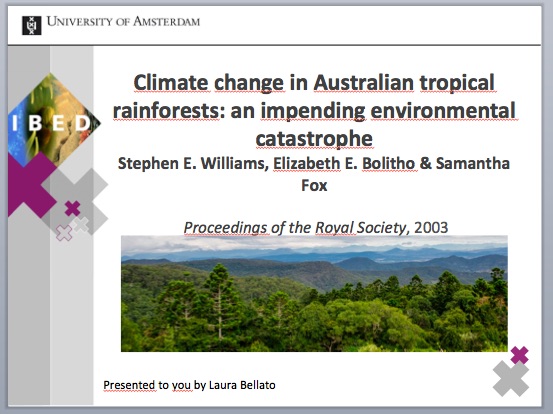
In the first week of the course the students had to present their ‘favourite’ paper in just three (3) minutes! Quite a challenge and lots of fun. This years selection of papers themed around:
mega-fauna extinctions (Bakker et al., 2016; Gill et al., 2009; van der Kaars et al., 2017),
impacts of human land use practices (Bitusik et al., 2018; Carson et al., 2014; Chepstow-Lusty et al., 2009; Gauthier et al., 2010; Tisdall et al., 2018), and
climatic drivers of vegetation change (Haug et al., 2001; Tierney et al., 2017; Tudhope et al., 2001).
For full list of papers presented see below.
In the second and third weeks (now ongoing) students get to deconstruct published chronologies and conduct time series analsis of multi-proxy datasets. Data for these excercises is frequently is extracted from databases such as Neotoma, Pangea, NOAA – paleoclimatology datasets database and the Global Charcoal Database – which shows the importance of these open access databases for developing effective research led eductation, as well as pushing forward to frontiers of research.
The second and third weeks of the Environments Through Time course at the University of Amsterdam has focused on obtaining practical experience of developing chronologies, analyzing multi-variate data-sets, and conducting time series analysis. The focus of the course has been on Quaternary environmental change, however, the skills learnt can be applied to almost any time-scale so long as you have time control points you want to tie together, and multiple things you can track changing through that time.
Over the two week period the students worked on a previously published paper that they had selected that contains: (i) chronological information (at least 3 control points), and (ii) multiple variables that change through the time series (at least 9 variables). In week two they deconstructed the chronologies and generated their own revised versions. For example students have (re-)calibrated radiocarbon dates, made different decisions on dates to include/exclude, and used different approaches to constructing the age vs. depth model, e.g. contrasting linear point-to-point vs. Bayesian methodologies. In week three they have taken the data-set(s) associated with their paper and re-evaluated it in light of the revised chronologies using cluster analysis, ordination techniques, and wavelets.
The joy of wavletes
Through this exercise students have gained experience of how to critically assess scientific literature and gained an appreciation of where re-analysis of data-sets can (and cannot) make a difference. Personally I have be delighted with the high level of engagement and enthusiasm for the material and have been excited to have a chance to delve into literature that I would not otherwise be aware of.




 Ecology of the past