The European Conference of Tropical Ecology will take place in Amsterdam between 24 and 28 February 2025. The call for session ideas is currently open (deadline 19 August). So please visit the conference web pages to find out more and submit your idea that will help shape the program and make this conference a success.
To find out how to submit your session idea click here.
As part of my MSc Biological Sciences (University of Amsterdam) research project entitled “Assessing the effect of human induced fire regime changes on vegetation in the Drakensberg mountains” (for further details click to see previous post). I’ve travelled to Africa, where I’ll be staying a month. During this mini blogpost series I’ll take you with me on my travels!
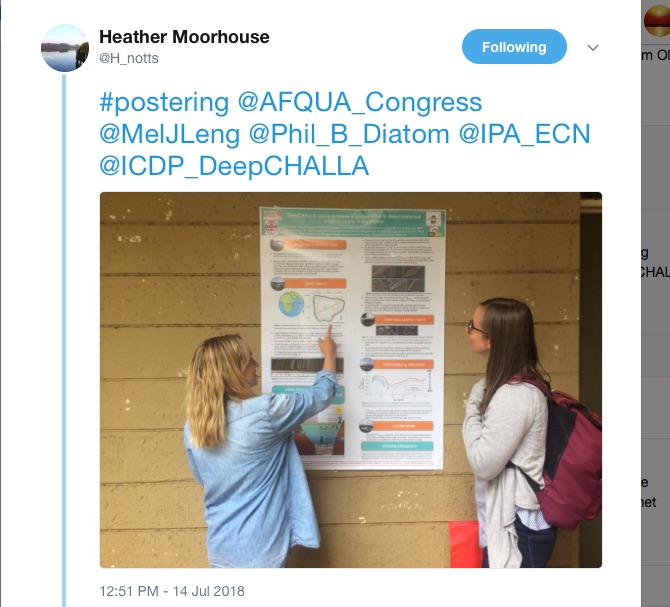
During the first poster session, I presented my poster which went into detail on how we are developing a proxy to reconstruct past fire using micro-Fourier Transformed Infrared Spectroscopy (µFTIR). These reconstructed fire temperatures can then be compared with phytolith or pollen data to assess the effects of different fire temperatures on local vegetation over time. The presentation and poster were well received!
After my poster presentation there were two more congress days which were filled with interesting talks and beautiful posters.
The SASQUA congress will kick off next week (19-24 May 2024) in Cango Valley (South Africa). Sessions cover many aspects of Quaternary science and range from archaeology through palaeoclimate to geological topics. The full program is now available to download.
Quick, L.J & Asithandile, N. (2024) Proceedings of the XXIV Biennial Congress of the Southern African Society for Quaternary Research (SASQUA), Cango Valley, South Africa, 19-24 May 2024. DOI: 10.5281/zenodo.11125697
To find out more about the meeting and other SASQUA activities you can also visit the organizations web pages: https://sasqua.co.za/
The Southern African Society for Quaternary Research (SASQUA) is hosting its 24th congress 19-24 May 2024 in the Cango Valley, South Africa. The congress will bring together scientists working on all aspects of the Quaternary in southern Africa. Poster and oral presentations possible.
Abstract submission and student support application deadline: 31 March 2024
The Mapping Ancient Africa (MAA) project is offering five bursaries to help African based and/or early career researchers^ attend the up coming INQUA Rome congress. Each bursary will around Euro 1000 and should be used towards covering the cost of registration, accommodation and/or travel for the congress.
Application criteria:
Abstract submitted to INQUA Rome congress either to the Mapping Ancient Africa session, or to another session on a related topic (Deadline 1 November 2022).
Commitment to contributing an article for consideration to be published in the proposed MAA special issue of Quaternary International; for frame of references of the MAA project click here.
To apply submit the following information via emails to William Gosling as the corresponding Principle Investigator of the project. Applications should be clearly marked MAA-Application-YourName in the subject line:
Evidence of submission of an abstract to the INQUA Rome congress (copy of confirmation email and abstract).
Letter of motivation, including fit of the proposed article to the MAA aims and goals and statement of commitment to submit an article for consideration to be published in the Mapping Ancient Africa special issue of Quaternary International^^ (not more than 1 page)
Short academic CV, including highlight of up to 5 published articles indicating the scientific importance and your role in the publication (not more than 2 pages).
In the event of more applications being received than funding is available awards will be made by the MAA team (PIs and co-PIs) on the basis of the fit of the research to the MAA aims and goals. To receive funding receipts for all the expenses incurred will need to be provided (following INQUA regulations).
^^ please note that no guarantee of final publication is given or implied by this commitment. All submitted manuscripts will be subject to the usual rigorous peer review procedures for the journal.
My first AFQUA conference really began the day before the conference proper started in the Kenyan immigration queue where I met a number of fellow delegates who were flying in from all over the world. It was great to start to put faces to names of people who’s work I had read for many years. Once out of the airport transfer to the hotel was smooth, and it was with some excitement that the following morning I made the short walk from the hotel to the famous Nairobi National Museum for the start of the conference.
Day 1
Prof. Andy Cohen (one of my fellow delegates in the immigration line) kicked off the AFQUA conference with a plenary giving an overview of African continental drilling projects. He traced the dream of the recovery of long continental records back to Daniel Livingstone and Neil Opdyke’s workshop from 1980 that set out the dream of obtaining long records from the continent. He then went on to give examples of how multi-millennial lake records, including Lake Malawi, can be used to understand the tempo of ecological change.
The first session of the conference, entitled “East Africa”, included: exciting evidence of Deinotherium the largest land mammal of the Quaternary (J.-P. Brugal), the use of d13C in determining homonin ecology (V.M. Iminjili), and evidence from a new c. 200,000 year old site at Natodomeri (Kenya) that contains evidence of homonids, elephids, giant lions and pigmy hippos (F.K. Manthi).
The second session of AFQUA covered “The environmental context for homonin evolution and dispersal”. This started with geochemical data from Chew Bahir that sheds light on potential drivers of climatic shifts (F. Schabitz), and included examination of changes climate between c. 500,000 and 320,000 years ago that coincided with the shift from hominid use of large cutting tools to smaller implements (R. Potts), and discussion of the environment the route which hominids took out of Africa (F. Henselowsky).




 Ecology of the past