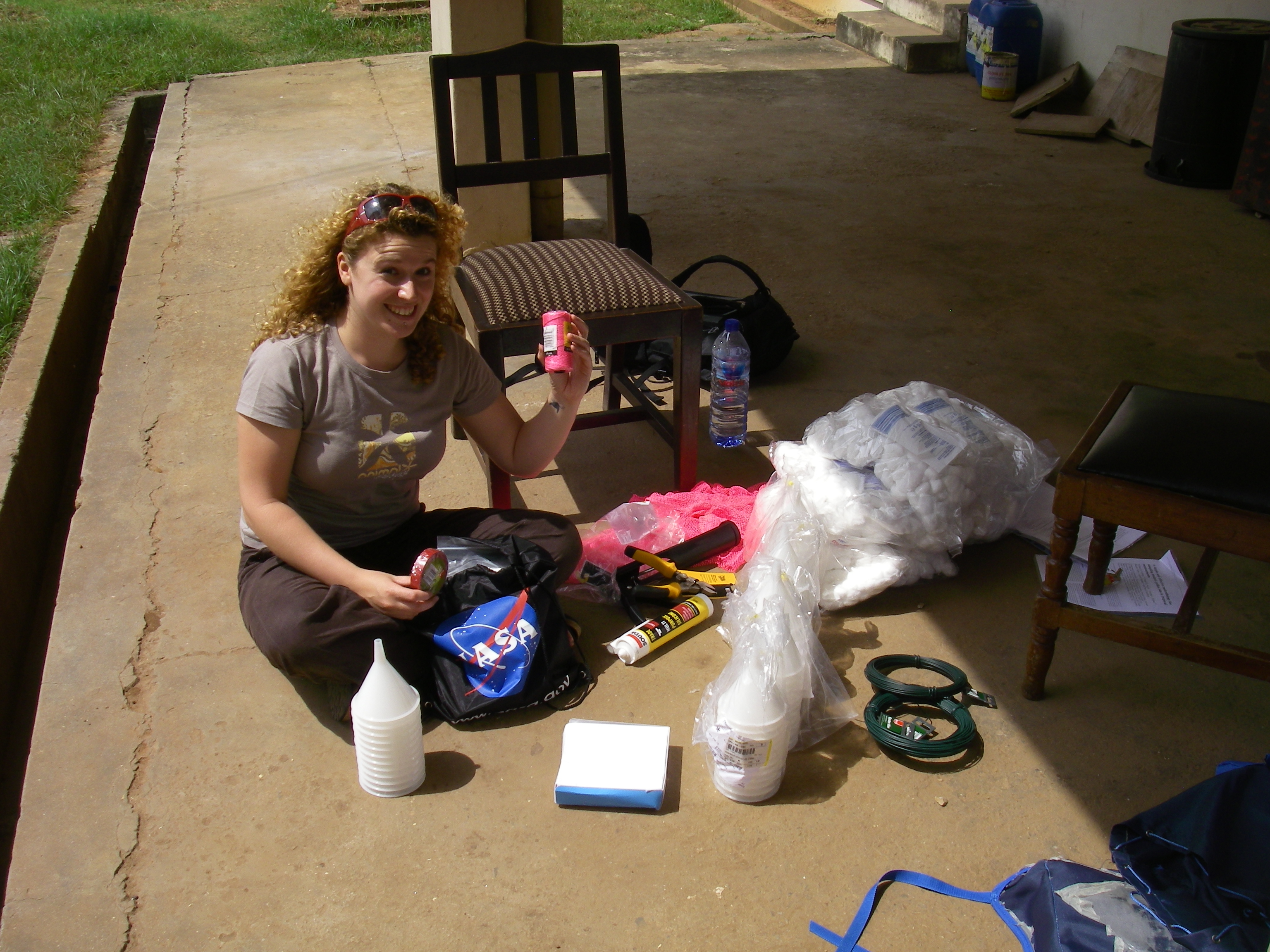
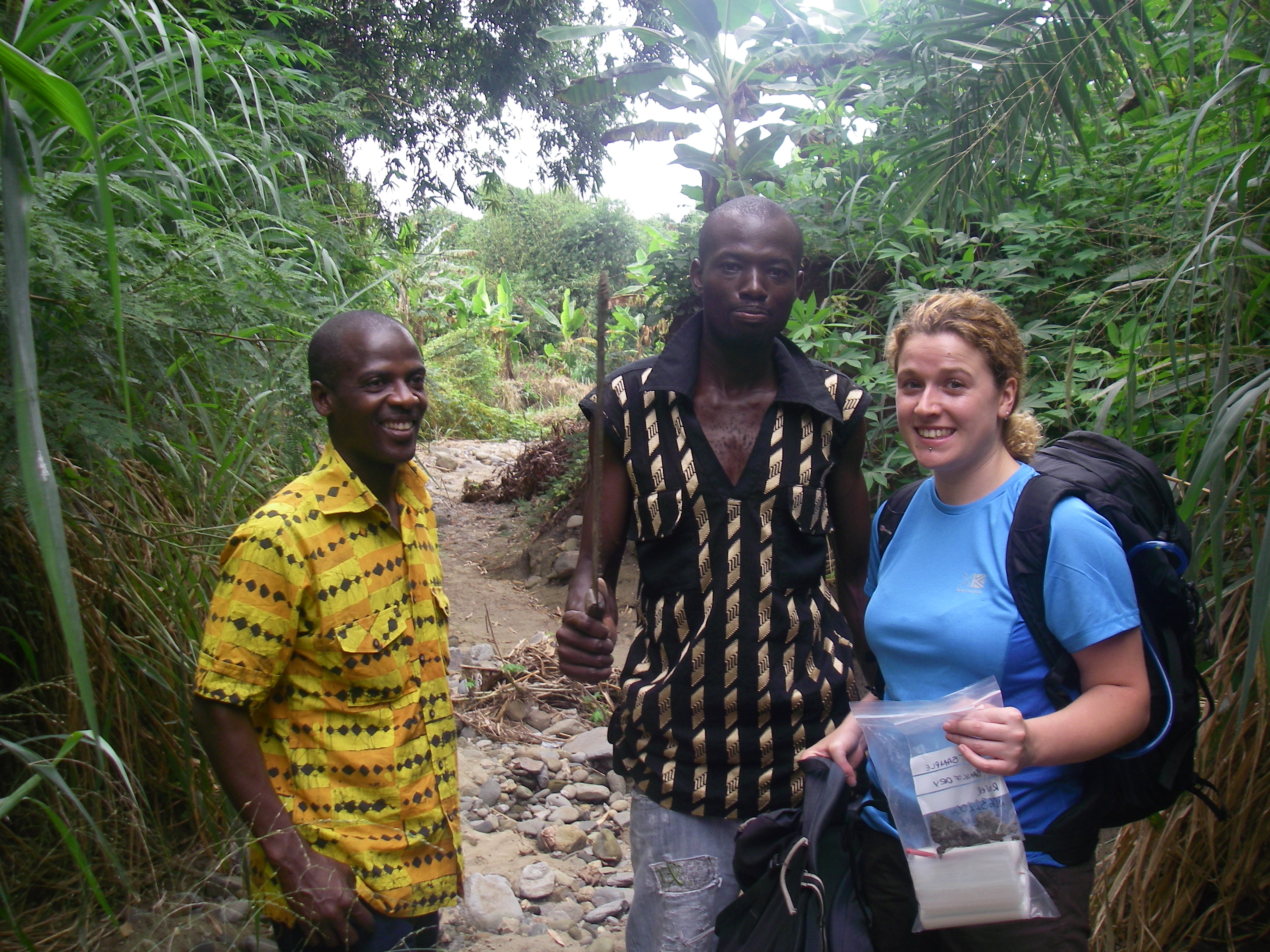
Phil and Adele have survived field work in Ghana collecting pollen traps, looking at the vegetation, visiting Lake Bosumtwi and riding horses (!?) – hooray.
Hello! I’m Adele and I started my PhD about a week ago. It’s been a little intense but I can almost find the lab without a map now, so it is probably time to introduce myself.
I’ll be studying pollen-vegetation relationships in Ghana, as part of the NERC funded project ‘500,000 years of solar irradiance, climate and vegetation changes’. This means I’ll be using pollen traps to figure out how pollen outputs vary between (and sometimes within) different vegetation types in Ghana. I will also be trying my hand at chemotaxonomy and video making. I’m heading out to Ghana (along with Phil Jardine) in just over a week to do my first lot of field work which will involve seeing the plots, collecting existing traps, replacing them with new ones, and setting up some new sites. I’m very excited.
Hayley Keen: “Continual pollen counting, second lot of Argon dating done, and first set of wood macrofossils back and ready for identification!”
Frazer Bird: “At the start of September I began working as a technician as part of Encarni’s project. I am looking at the midges from the core we collected together on our last field trip. Things are going well, although the midges are hard to find in the older sections the preservation in early sequences is great. The resolution of this core looks to be fantastic also so and hopefully we will get some interesting results when we compare all the proxies. Away fromthe lab I presented at INTECOL 2013 in London, The talk seemed to go down well and was noted as highly commended by the judging panel. Great publicity all round for the midges!!!”
Bryan Valencia: Has been on field work in Peru during this time he presented a talk on climate change to the Asociación para la Conservación de la Cuenca Amazónica, and gave interviews to local journalists and two TV stations. He also collected sediments from two locations, and manged to obtain a new US visa. He is now working on the final stages of submitting his thesis.
Phil Jardine: Phil has been busy ordering in microscopes and other equipment for the Lake Bosumtwi project (the first of which arrived today), and setting up the trip to Ghana that he’ll be going on with new PhD student Adele Julier in late October. He’s also been attempting to learn more about geochemistry, which has proved challenging.
Lake Pindo: We have finally the results of 6 samples radiocarbon dated from NRCF through our collaborator Dr Pauline Gulliver, and we have sent 4 more to “range find” the key interval of interests for the FORSENS project. We have started the midges’ analysis although it seems this going to be focused to the upper 4 meters of sediment. We would like to discern possible preservation issues in tropical records for this proxy. Some samples for a preliminary screening looking for diatoms ahve been collected and sent to the new FORSENS collaborator Teresa Vegas-Vilarrúbia. MS samples have been also collected for the first three drives and we hope to run this analysis next month.
Lake Banos: We have started the pollen prep. for the upper section of the record.
Management tasks: We are now ready for the tropical record Lake Marcacocha pollen prep., collaborating with an ongoing project lead by Alex Chepstow-Lusty. On a different topic, I have started the organisation of department seminars, so I would like to highlight if you have any potential speaker, please contact me.
Publications: a co-authorship in a paper published in Perspectives in Plant Ecology, Evolution and Systematics authored by Valentí Rull and his research group in the Botanical Institute of Barcelona is now available on line (click here)
William Gosling: “I have been promoted to Senior Lecturer (hooray),started work on the new level 2 environmental science module, been working on a new paper from the Erazo study site, and had a holiday!”
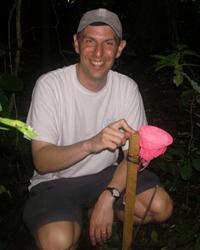
My name’s Phil Jardine, and I’ve recently joined the Palaeoenvironmental Change Research Group as a post-doc, on the NERC-funded ‘500,000 years of solar irradiance, climate and vegetation changes’. For this project I’ll be analysing the chemistry of pollen grains from a 500,000 year long sediment record from Lake Bosumtwi in Ghana, with the aim of generating a long-term historical record of solar irradiance.
Before coming to the Open University I was based at the University of Birmingham, where I did PhD and post-doc research on North American pollen records from the early Palaeogene (~65 – 45 million years ago). For this work I was particularly interested in the role of climate in driving changes in plant communities, especially during a rapid global warming event 55 million years called the Paleocene-Eocene Thermal Maximum (PETM). Having worked for some time now on pretty old material, I’m looking forward to researching something a bit more recent – if you can call the last 500,000 years recent – and going out to Ghana and looking at real, live, tropical plants.
If you would like to get in touch about the Lake Bosumtwi project, or something else pollen related, please feel free to get in touch.
The PDRA project will descover more about past vegetation and climate change in Lake Bosumtwi (Ghana)
We are seeking a PDRA to study past climate and vegetation change in tropical West Africa as part of the NERC-funded “500,000 years of solar irradiance, climate and vegetation changes” project. You will join a multidisciplinary collaborative research team and will work with an international network of project partners. The project will utilise cutting-edge organic geochemical techniques to generate the longest continuous record of fossil pollen chemistry change. The study will build upon previous research into the sediments recovered from Lake Bosumtwi (Ghana). The data generated will shed new light on the role of climate in driving vegetation change in the tropics.
You will already hold a PhD, or be near to completing your PhD, in a relevant scientific discipline with a background in the Earth or Environmental sciences. You must have substantial experience of organic geochemistry or tropical palynology, with well-developed self-management skills and the ability to prioritise effectively.
The PDRA will work with an associated PhD student looking at modern pollen-vegetation relationships in the same region.
The PDRA will be part of an international team; partners based at University of Nottingham, Oxford Brooks University, Imperial College London, Oxford University, University of Texas at Austin and the Forestry Research Institute of Ghana
Understanding how vegetation responded to past climate change requires the development of well constrained relationships between living floras, environment and climate. This project will help constrain the great uncertainty which exists as to how tropical ecosystems are represented in the fossil record by examining the relationship between modern vegetation and the pollen it produces. The project will analyse modern pollen rain using a combination of traditional microscopic analysis [1] and cutting edge geochemical techniques [2]. We anticipate that the findings will provide new insight into past vegetation and climatic change.
For further information on the project and how to apply see the full advert: NERC PhD advert. Prior to applying please check eligibility for NERC funding by clicking here.
Closing date: 25th April, interviews will be held at The Open University during May.
William Gosling pollen trapping in west Africa. A studentship on the new grant will investigate modern pollen-vegeation relationships from tropical West Africa.
I am delighted to be able to report that the PCRG has recently obtained a NERC standard grant to investigate “500,000 years of solar irradiance, climate and vegetation changes” (NE/K005294/1).
COMMENT ON THE USE OF NITROGEN ISOTOPES IN PALAEOLIMOLOGICAL STUDIES As a component of my doctoral research, I am examining nitrogen (N) isotopes within sediments obtained from Lake Bosumtwi (West Africa). Below I review and comment on the key uses and limitations of using N isotopes to interpret past environmental change with particular reference to lake sediments. Discussion is based on the key text by Talbot (2001).
REFERENCE
Talbot, M.R. 2001. Nitrogen isotopes in palaeolimnology. Tracking environmental change using lake sediments. Volume 2. Physical and geochemical methods (ed. by W.M. Last and J.P. Smol), pp. 401-439. Kluwer Academic Press, Dordrecht.





 Ecology of the past