The fifteenth Mapping Ancient Africa seminar will take place on 15 March 2024 (17:00 CET)
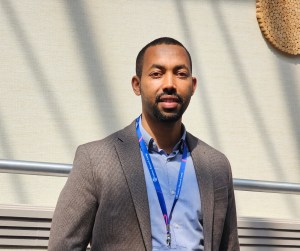
Speaker: Bruk Lemma (Martin Luther University Halle-Wittenberg, Germany; Ethiopian Biodiversity Institute – EBI)
Title: Nature’s Fingerprints: Exploring the Use of Biomarkers and Stable Isotopes in Unraveling Chemotaxonomy and (Paleo-)Climate Dynamics of the Bale Mountains, Ethiopia
The seminar will be delivered via Zoom. The link for the seminar can be obtained from the MAA Slack channel or by contacting the chair of this seminar (Stefanie Kaboth-Bahr). If you want to know more about the Mapping Ancient Africa project visit our web pages and please do not hesitate to get in contact if you want to get involved.
The 14th Mapping Ancient Africa seminar took place on Thursday 28th February 2024. The seminar was delivered by Mathias Vinnepand (Leibniz-Institute for Applied Geophysics Hannover, Germany) and presented recent advances in developing a chronology for the Lake Bosumtwi sediment record over the last c. 1 million years.
The first Mapping Ancient Africa online seminar of 2024 will take place on 28 February (17:00 CET).
Speaker: Mathias Vinnepand (Leibniz-Institute for Applied Geophysics Hannover, Germany)
Title: An age-depth model for Lake Bosumtwi (Ghana) to reconstruct one million years of West African climate and environmental change
Related publication: Vinnepand, M., Zeeden, C., Wonik, T., Gosling, W., Noren, A., Kück, J., Pierdominici, S., Voigt, S., Abadi, M.S., Ulfers, A., Danour, S., Afrifa, K. & Kaboth-Bahr, S. (2024) An age-depth model for Lake Bosumtwi (Ghana) to reconstruct one million years of West African climate and environmental change. Quaternary Science Reviews325, 108478. DOI: 10.1016/j.quascirev.2023.108478
The seminar will be delivered via Zoom. The link for the seminar can be obtained from the MAA Slack channel or by contacting the chair of this seminar (Stefanie Kaboth-Bahr). If you want to know more about the Mapping Ancient Africa project visit our web pages and please do not hesitate to get in contact if you want to get involved.
The 10th Mapping Ancient Africa seminar took place on Tuesday 7th February 2023. The seminar was delivered by Cecile Blanchet (Helmholtz-Zentrum Potsdam) and highlighted recent work linking river sediments from the Nile with change in global climate systems, including El Nino.
Blanchet, C.L., Osborne, A.H., Tjallingii, R., Ehrmann, W., Friedrich, T., Timmermann, A., Brückmann, W. & Frank, M. (2021) Drivers of river reactivation in North Africa during the last glacial cycle. Nature Geoscience 14, 97-103. DOI: 10.1038/s41561-020-00671-3
Blanchet, C.L., Tjallingii, R., Schleicher, A.M., Schouten, S., Frank, M. & Brauer, A. (2021) Deoxygenation dynamics on the western Nile deep-sea fan during sapropel S1 from seasonal to millennial timescales. Climate of the Past 17, 1025-1050. DOI: 10.5194/cp-17-1025-2021
Blanchet, C.L., Ionita, M., Ramisch, A., Tjallingii, R., Brauer, A., Laruelle, L., Bagge, M. & Klemann, V. (2023) Pacemakers of extreme floods during warmer and wetter climates of the “Wild Nile” stage. PREPRINT (Version 1) available at Research SquareDOI: 10.21203/rs.3.rs-3051876/v1
The Mapping Ancient Africa (MAA) project is currently (late 2023 until early 2024) in the process of collecting submissions for a special issue of the INQUA (our sponsors) journal Quaternary International. The special issue will showcase research developed at the MAA workshop in Rome, and presented at the MAA sessions at the INQUA Rome congress. However, the editorial team is open to considering manuscripts relevant to the MAA goals that come from people not already involved in the project – so please contact us if you have ideas.
The process of developing articles for the special issue will be supported by the MAA community through a series of events. The first of these was a online workshop (2 October 2023) set out the frame of reference for the special issue, and included a short presentation on tips for structing a scientific article for this journal. If you missed the event and are thinking about writing an article for the special issue, or in a similar style, you can catch up with this on the Ecology of the Past YouTube channel. In person writing workshops are planned for 2024 in Africa. As full details emerge information will be published here.
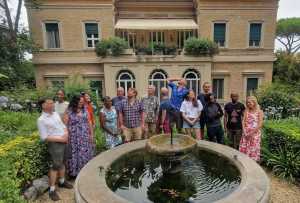
Mapping Ancient Africa participants on the Rome workshop (2023)
The Mapping Ancient Africa (MAA) project has an open call for contributions to a Special Issue of Quaternary International; the journal of our funder the International Union for Quaternary Research (INQUA). The concept for the special issue is agreed in principle with the journals editor-in-chief so now it is our task to collate a collection of manuscripts suitable to published in this international peer reviewed journal. The special issue will be based around papers discussed and presented at the MAA workshop in Rome and session at the INQUA congress in Rome in July 2023, but we are also happy to consider other manuscripts that fit within the MAA project area.
To find out if your manuscript idea might fit either explore the MAA web pages or contact a member of the editorial team:
The next four interviews with scientists who participated in the Mapping Ancient Africa workshop in Rome (2023) are now online (see below). You can find more interviews with scientists by clicking the names below:
The second part of the Mapping Ancient Africa session at the INQUA Rome congress contained eight talks. Busisiwe Hlophe (University of the Witwatersrand) kicked us off by showing us the power of looking at wood anatomy preserved in charcoal microfossils to determine the nature of past vegetation and climate. RahabKinyanjui (National Museums of Kenya) presented phytolith work from archaeological sites revealing a mixed woody and grassy vegetation associated with archaic Homo sapiens in Kenya.
Three talks from the Cape Region in South Africa then followed with Saul Manzano (University of Leon), StellaMoscher (University of Utah), and Asithandile Ntsondwa (Nelson Mandela University) using various palaeo ecological approaches to explore climate, vegetation and fire regime shifts during the Holocene. Adele Julier (University of Portsmouth) then took us a little further north to Namibia to think about the challenges of parameterising modern pollen-vegetation relationships in arid regions. The final southern African talk was given by Gemma Poretti (University of Cape Town) explored a new approache to tracking change in past rainfall patterns using charcoal material.
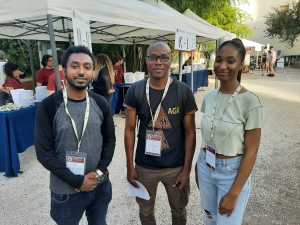
Mapping Ancient Africa participants at the INQUA Rome ice breaker event ready for action! Left to right: Bahru Zinaye Asegahegn, Alfred Houngnon, Busisiwe Hlophe.
The Mapping Ancient Africa (MAA) project has a double session of talks and a poster session at the INQUA congress in Rome 2023. Our session will be on Wednesday 19 July. Unfortunately a number of the originally planned speakers could not make it to Rome due to a combination of not obtaining visas, logistical challenges and ill health. We wish them all well and hope that they will continue to be involved in the project. Further, many thanks to all those who have agreed to step up and give a presentation at a late notice. Below is an updated schedule correct as of Sunday 16 July based on the information contained on the INQUA Rome App; if you are aware of any further problems or changes please let me know ASAP!
Giosan et al. When the desert was a lake: Providing context for Homo sapiens development in the northern Kalahari
Chase et al. Paleolakes and socioecological implications of glacial “greening” of the South African interior
Blinkhorn et al. Evaluating refugia in recent human evolution in Africa
Aureli et al. Homo sapiens behaviour and adaptation in East Africa. New evidence from an open-air site in a modern Ethiopian savannah environment: the GOT10 site
Effiom et al. Late Holocene palaeoecological studies at Lake St Lucia, KwaZulu-Natal
Tallavaara et al. Pan-African Climate and Vegetation over the Quaternary and Implications for Human Distribution
Quick et al. Palaeoenvironments of the Cape Floristic Region: New research & current developments
In person attendees (left to right): William Gosling (University of Amsterdam), Busisiwe Hlophe (University of Witwatersrand), Michela Leonardi (University of Cambridge), Soléne Boisard (University of Montréal), Rahab Kinyanjui (National Museums of Kenya), Trevor Hill (University of KwaZulu-Natal), Mathias Vinnepand (Johannes Gutenberg-University of Mainz), Tom Johnson (University of Massachusetts Amherst), Manu Chevalier (University of Bonn), Brian Chase (CNRS: Montpellier), Stefanie Kaboth-Bahr (Free University of Berlin), Markus Fischer (University of Potsdam), Bahru Zinaye Asegahegn (University of Cologne), Alfred Houngnon (AGIR), and Jemma Finch (University of KwaZulu-Natal); present but not in photo Angela Effion (University of Witswatersrand).
A further nine participants were anticipated to attend the workshop but, due to a combination of the non-issue of visas, logistical difficulties and ill health, they were not able to attend at the last moment. These were: Aliyu Adamu Isa (Ahmadu Bello University), George Biddulph (University of St Andrews), Olugbenga Boboye (University of Ibadan), Husna Mashaka (University of Nairobi), Emma Mbua (National Museums of Kenya), Aissatou Thiam Ndong (University of Cheikh Diop, Dakar), Adisa Ogunfolakan (Leventis Museum of Natural History), Alice Paine (University of Oxford), and Lynne Quick (Nelson Mandela University). Some people were able to attend partly online. Some have now made it to Rome and we hope to catch up at the INQUA Rome congress (Session 64) if not before. We hope that all will continue to be involved with the Mapping Ancient Africa project.





 Ecology of the past