Tribute to Daniel Livingstone and Paul Colinvaux

January 26, 2018
WDG

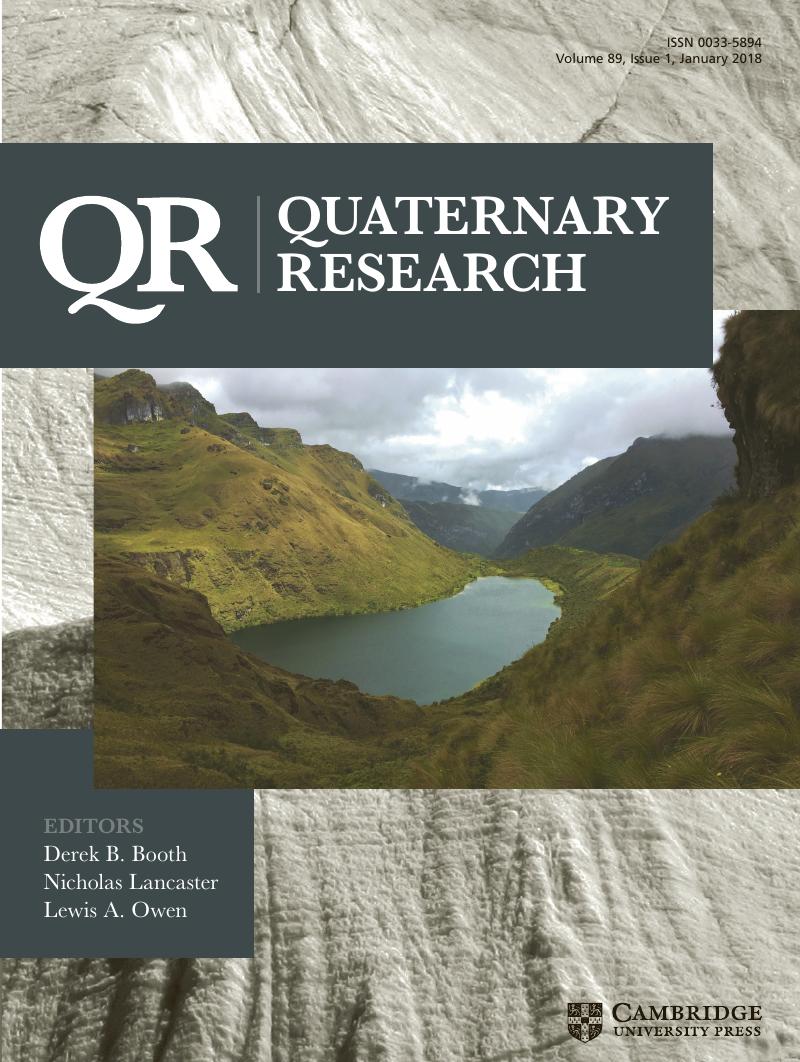
Mark Bush and I are proud to announce that a tribute to Prof. Daniel Livingston and Prof. Paul Colinvaux has recently been published in Quaternary Research. Dan and Paul were both pioneers of tropical pal(a)eoecology and both died in the spring of 2016 . To mark their passing Mark and I have guest edited ten new papers on palaeoecology drawn from researchers, and regions, of the tropics in which Dan and Paul worked (Bush & Gosling, 2018). We would like to thank Quaternary Research Senior Editor Derek Booth for giving us this opportunity and assisting greatly in the process of compiling the manuscripts. We would also like to thank all to contributing authors for their hard work and dedication to the project. We hope that you will enjoy reading the manuscripts and find them a fitting tribute to the life and work of these two great researchers.

Quaternary Research
Special Issue: Tribute to Daniel Livingstone and Paul Colinvaux
Volume 89 – Special Issue 1 – January 2018 Continue Reading

Identifying environmental drivers of fungal non-pollen palynomorphs in the montane forest of the eastern Andean flank, Ecuador.

October 23, 2017
WDG

Open acess, online:

Loughlin, N.J.D., Gosling, W.D. & Montoya, E. (2017) Identifying environmental drivers of fungal non-pollen palynomorphs in the montane forest of the eastern Andean flank, Ecuador. Quaternary Research. DOI: 10.1017/qua.2017.73

Landscape-scale drivers of glacial ecosystem change in the montane forests of the eastern Andean flank, Ecuador

October 20, 2017
WDG

Open acess, online:

Loughlin, N.J.D., Gosling, W.D., Coe, A.L., Gulliver, P., Mothes, P. & Montoya, E. (2017) Landscape-scale drivers of glacial ecosystem change in the montane forests of the eastern Andean flank, Ecuador. Palaeogeography, Palaeoclimatology, Palaeoecology. DOI: 10.1016/j.palaeo.2017.10.011

Pollen-vegetation richness and diversity relationships in the tropics

October 10, 2017
WDG

Online, open access:

Gosling, W.D., Julier, A.C.M., Adu-Bredu, S., Djagbletey, G.D., Fraser, W.T., Jardine, P.E., Lomax, B.H., Malhi, Y., Manu, E.A., Mayle, F.E. & Moore, S. (2017) Pollen-vegetation richness and diversity relationships in the tropics. Vegetation History and Archaeobotany. DOI: 10.1007/s00334-017-0642-y

Matthews-Bird, F., Brooks, S.J., Holden, P.B., Montoya, E. & Gosling, W.D. (2016) Inferring late-Holocene climate in the Ecuadorian Andes using a chironomid-based temperature inference model. Climate of the Past 12, 1263-1280. DOI: 10.5194/cp-12-1263-2016

Netherlands Annual Ecology Meeting 2016 – day 1

February 10, 2016
WDG

NAEM_0Netherlands Annual Ecology Meeting (NAEM) 2016
9 February 2016
Conference Centre “De Werelt”, Lunteren

The annual Dutch ecology conference is being held over two days at the in “remote” Lunteren and I am pleased to be able to attend all of the conference this year. The conference was kicked off this morning with a recognition that this year is 150 years since the birth of ecology as a science (Haeckel, 1866). The opening two keynotes focused on aspects of ecology which have sometimes been overlooked firstly, parasitism (Peter Hudson, Penn State University) and secondly, immunology (Irene Tieleman, University of Groningen). Following these I focused on just two sessions in the morning “linking diversity to function”, and in the afternoon “ecosystem cascades”. From the range of excellent talks in the sessions I have picked one from each as my favourite:

  1. Masha van der Sande (Wageningen University) The role of biodiversity and environment on productivity in tropical forests; evidence across scales
    By examining long-term tropical forest monitoring data van der Sande demonstrated that through time ecosystem traits changed significantly. She hypothesised that the lack of stability in ecosystem traits was due to past disturbance; although it is unclear what caused this disturbance (climate or humans), or when it occurred.
  2. Dries Kuijper (Mammal Research Institute, Poland) Landscapes of fear in Europe: Wolves and humans shaping ungulate top-down effects
    By tracking Wolf pack distributions in the Bialowieza forest (Poland) Kuijper showed that ungulates avoided Wolf pack  “core areas” for fear of predation, that the exclusion of ungulates lead to reduced browsing of the vegetation, and so consequently forests regenerated faster in Wolf pack core areas.

The evening lecture was given by Bart Knols (in2care) who gave an impassioned talk on the importance of communicating science beyond the academic sphere. Arguing that now is the time for ecologists to have an influence on policy making, politics and business, as well as showing us how he has done this.

Great day.

Continue Reading

Bakker, E.S., Gill, J.L., Johnson, C.N., Vera, F.W.M., Sandom, C.J., Asner, G.P. & Svenning, J. (2015) Combining paleo-data and modern exclosure experiments to assess the impact of megafauna extinctions on woody vegetation. Proceedings of the National Academy of Sciences. DOI: 10.1073/pnas.1502545112

Bakker, E.S., Pagès, J.F., Arthur, R. & Alcoverro, T. (2015) Assessing the role of large herbivores in the structuring and functioning of freshwater and marine angiosperm ecosystems. Ecography DOI:10.1111/ecog.01651

Dillehay, T.D., Ocampo, C., Saavedra, J., Sawakuchi, A.O., Vega, R.M., Pino, M., Collins, M.B., Scott Cummings, L., Arregui, I., Villagran, X.S., Hartmann, G.A., Mella, M., Gonzalez, A. & Dix, G. (2015) New Archaeological Evidence for an Early Human Presence at Monte Verde, Chile. PLoS ONE 10, e0141923. DOI: 10.1371/journal.pone.0141923

Göldel, B., Kissling, W.D. & Svenning, J. (2015) Geographical variation and environmental correlates of functional trait distributions in palms (Arecaceae) across the New World. Botanical Journal of the Linnean Society. DOI: 10.1111/boj.12349

Pardi, M.I. & Smith, F.A. (2015) Biotic responses of canids to the terminal Pleistocene megafauna extinction. Ecography.  DOI: 10.1111/ecog.01596

Roy, N., Woollett, J. & Bhiry, N. (2015) Paleoecological perspectives on landscape history and anthropogenic impacts at Uivak Point, Labrador, since AD 1400. The Holocene 25, 1742-1755. DOI: 10.1177/0959683615591350

Open access online:

Flantua, S.G.A., Hooghiemstra, H., Grimm, E.C., Behling, H., Bush, M.B., González-Arango, C., Gosling, W.D., Ledru, M., Lozano-García, S., Maldonado, A., Prieto, A.R., Rull, V. & Van Boxel, J.H. Updated site compilation of the Latin American Pollen Database. Review of Palaeobotany and Palynology 223, 104-115. DOI: 10.1016/j.revpalbo.2015.09.008

Journal articles

  • Clement, C.R., Denevan, W.M., Heckenberger, M.J., Junqueira, A.B., Neves, E.G., Teixeira, W.G. & Woods, W.I. (2015) The domestication of Amazonia before European conquest. Proceedings of the Royal Society of London B: Biological Sciences 282. DOI: 10.1098/rspb.2015.0813
  • Oliver, T.H., Heard, M.S., Isaac, N.J.B., Roy, D.B., Procter, D., Eigenbrod, F., Freckleton, R., Hector, A., Orme, C.D., Petchey, O.L., Proenca, V., Raffaelli, D., Suttle, K.B., Mace, G.M., Martin-Lopez, B., Woodcock, B.A. & Bullock, J.M. Biodiversity and Resilience of Ecosystem Functions. Trends in Ecology & Evolution. DOI: 10.1016/j.tree.2015.08.009
  • Watkins, C. (2015) Oliver Rackham OBE FBA 1939–2015. Landscape History 36, 5-8. DOI: 10.1080/01433768.2015.1044280
    COMMENT: One of the books that inspired me to enter this field of research was Rackham’s Trees and woodlands in the British landscape; published the year I was born…

Plus three papers discussed during the University of Amsterdam BSc Biology Tropical Ecology course trip to De Hortus Botanicus Amsterdam:

  • Bush, M.B. (1995) Neotropical plant reproductive strategies and fossil pollen representation. American Naturalist 145, 594-609. Stable URL: http://www.jstor.org/stable/2462970
  • Cárdenas, M.L., Gosling, W.D., Sherlock, S.C., Poole, I., Pennington, R.T. & Mothes, P. (2011) The response of vegetation on the Andean flank in western Amazonia to Pleistocene climate change. Science 331, 1055-1058. DOI: 10.1126/science.1197947
  • Logan, A.L. & D’Andrea, A.C. (2012) Oil palm, arboriculture, and changing subsistence practices during Kintampo times (3600–3200 BP, Ghana). Quaternary International 249, 63-71. DOI: 10.1016/j.quaint.2010.12.004


Ecology of the past on film: Hayley Keen

October 6, 2015
WDG

Whilst conducting her PhD research Hayley Keen helped produced two of short films about her research project Past environmental change on the eastern Andean flank, Ecuador:

  1. on her field work, which was the winning entry into the American Geophysical Union (AGU) student video competition in 2014, and
  2. a presentation summing up her PhD project in just 3 minutes!

First prize in the AGU student video competition (2014)

Three minute thesis (The Open University, 2014)

Follow Hayley’s ongoing research on this blog and on Twitter @Hayley1keen 

Blog at WordPress.com.