PhD Scholarship program for migrants in the Netherlands

April 5, 2024
WDG

The Dutch science foundation (NWO) currently has a call for proposals to support migrants to the Netherlands to undertake a PhD project.

Applicants must have:

  • a Dutch passport (or residency status),
  • a masters level degree from a university in the Kingdom of the Netherlands, and
  • have been born in specific regions outsides the Netherlands (or be the child of someone born outside the Netherlands)

For full details click here visit the NWO Mozaiek 2.0 call web page.

If you think you might fulfill all the criteria for application, and are interested in conducting a PhD on a “ecology of the past” related theme at the University of Amsterdam, please do not hesitate to get in contact. I am then happy to check eligibility and discuss if your skill set and interests would be appropriate to apply for a PhD scholarship with us. I would be delighted if we would be able to support an applicant to this scheme.

Deadline for applications: 21 May 2024 (but please get in contact as soon as possible so that we can make the relevant eligibility checks and discuss ideas).

Contact: William D. Gosling

Mapping Ancient Africa: Quaternary International special issue

April 5, 2024
WDG

The Mapping Ancient Africa (MAA) special issue of Quaternary International (QI) will open for submission on 30 April and will close 30 July 2024. To submit your article go to the QI submission portal and click “submit new article”, you will then be asked to “select article type”. From the drop down list select “SI: Mapping Ancient Africa”. This will ensure that your manuscript is directed to the guest editorial team. Submissions should follow the standard QI guideline (click here for details) and take account of the advice for submission to this special issue (click here for details).

The special issue is centered around work and papers presented in the MAA Rome workshop and sessions at the INQUA Rome congress (session 1, session 2), however, if you have a manuscript that you think would be appropriate for inclusion given the research themes of the project please also consider submitting. If you have any questions feel free to contact the editorial team in advance.

For further information on:

Presenters in the Mapping Ancient Africa session of the INQUA Rome congress 2023
INQUAlogo

SASQUA 2024

March 27, 2024
WDG

The Southern African Society for Quaternary Research (SASQUA) is hosting its 24th congress 19-24 May 2024 in the Cango Valley, South Africa. The congress will bring together scientists working on all aspects of the Quaternary in southern Africa. Poster and oral presentations possible.

  • Abstract submission and student support application deadline: 31 March 2024
  • Registration deadline: 20 April 2024

For the latest information click here to visit the SAQUA web pages.

Mapping Ancient Africa: Video of seminar 15

March 26, 2024
WDG

The 15th Mapping Ancient Africa seminar took place online on Friday 15th March 2024. The seminar was delivered by Bruk Lemma (Martin Luther University Halle-Wittenberg, Germany; Ethiopian Biodiversity Institute – EBI). In the seminar Bruk presented recent advances made in the application of biomarker and stable isotope techniques in revealing the climate dynamics of the Bale Mountains in Ethiopia. He showed that it is possible to identify some plant types using these approaches, but that degradation of the signal in the sedimentary environment is possible.

Details of this seminar can be found here. You can find more Mapping Ancient Africa seminar videos on the “Ecology of the Past” YouTube channel.

INQUAlogo

Mapping Ancient Africa: Writing workshop 2024

March 7, 2024
WDG

A workshop will be held at the National Museums of Kenya (Nairobi, Kenya) in June 2024. The aim of the workshop is to help authors prepare articles for the Mapping Ancient Africa (MAA) special issue proposed for publication in Quaternary International and lead by Dr. Stefanie Kaboth-Bahr. The workshop will be associated with the “1st Joint International Scientific Conference” (3-6 June). The MAA workshop is being organized by Dr. Rahab Kinyanjui, and the congress organization is being lead by Dr. Emmanuel Ndiema (click here to watch his 2022 MAA seminar) and Dr. Esther Kioko (Acting Director National Repository and Research).

For further information on attending the MAA workshop please contact Rahab directly.

To find out more about the Mapping Ancient Africa project click here.

INQUAlogo

Wet and dry events influenced colonization of a mid-elevation Andean forest

March 5, 2024
WDG

Sales, R.A., McMichael, C.N.H., Peterson, L.C., Stanley, A., Bennett, I., Jones, T.E., Walker, A.S., Mulhearn, M., Nelson, A., Moore, C., O’Connor, M., Sinkler, W., Banner, C., Church, W., VanValkenburgh, P. & Bush, M.B. (2024) Wet and dry events influenced colonization of a mid-elevation Andean forest. Quaternary Science Reviews 327, 108518. DOI: 10.1016/j.quascirev.2024.108518

Scientific international mobility fellowships

January 25, 2024
WDG

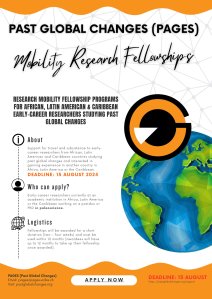
The call for the PAst Global changES (PAGES) research mobility fellowships for African, Latin American and Caribbean early career researchers studying past global changes is currently open.

Deadline: 15 August 2024

To find out more and how to apply click here.

Mapping Ancient Africa: Video of Seminar 10

January 12, 2024
WDG

The 10th Mapping Ancient Africa seminar took place on Tuesday 7th February 2023. The seminar was delivered by Cecile Blanchet (Helmholtz-Zentrum Potsdam) and highlighted recent work linking river sediments from the Nile with change in global climate systems, including El Nino.

Details of this seminar can be found here. You can find more Mapping Ancient Africa seminar videos on the “Ecology of the Past” YouTube channel.

References

  • Blanchet, C.L., Osborne, A.H., Tjallingii, R., Ehrmann, W., Friedrich, T., Timmermann, A., Brückmann, W. & Frank, M. (2021) Drivers of river reactivation in North Africa during the last glacial cycle. Nature Geoscience 14, 97-103. DOI: 10.1038/s41561-020-00671-3
  • Blanchet, C.L., Tjallingii, R., Schleicher, A.M., Schouten, S., Frank, M. & Brauer, A. (2021) Deoxygenation dynamics on the western Nile deep-sea fan during sapropel S1 from seasonal to millennial timescales. Climate of the Past 17, 1025-1050. DOI: 10.5194/cp-17-1025-2021
  • Blanchet, C.L., Ionita, M., Ramisch, A., Tjallingii, R., Brauer, A., Laruelle, L., Bagge, M. & Klemann, V. (2023) Pacemakers of extreme floods during warmer and wetter climates of the “Wild Nile” stage. PREPRINT (Version 1) available at Research Square DOI: 10.21203/rs.3.rs-3051876/v1
INQUAlogo

New PODCAST: Human & Biosphere

January 11, 2024
WDG

INQUAlogo

The International Union for Quaternary Research (INQUA) supports a number of commissions which focus on more specific aspects of Quaternary research. One of these, the Human & Biosphere Commission, or HABCOM, has recently launched a podcast introducing its members and activities. To find out more about HABCOM listen to the podcast below, or click this link to visit the related INQUA web pages.

Mapping Ancient Africa: Structuring a scientific article

December 19, 2023
WDG

INQUAlogo

The Mapping Ancient Africa (MAA) project is currently (late 2023 until early 2024) in the process of collecting submissions for a special issue of the INQUA (our sponsors) journal Quaternary International. The special issue will showcase research developed at the MAA workshop in Rome, and presented at the MAA sessions at the INQUA Rome congress. However, the editorial team is open to considering manuscripts relevant to the MAA goals that come from people not already involved in the project – so please contact us if you have ideas.

The process of developing articles for the special issue will be supported by the MAA community through a series of events. The first of these was a online workshop (2 October 2023) set out the frame of reference for the special issue, and included a short presentation on tips for structing a scientific article for this journal. If you missed the event and are thinking about writing an article for the special issue, or in a similar style, you can catch up with this on the Ecology of the Past YouTube channel. In person writing workshops are planned for 2024 in Africa. As full details emerge information will be published here.

Blog at WordPress.com.