The next seminar series of the Palynologische Kring (Dutch palynological society) will take place on 24 January 2025, at the Auditorium of TNO Utrecht. If you would like to attend please register by emailing the society (link).
PROGRAMME
13.00-13.15 Arrival
13.15-13.45 Irene Waajen (TNO): Re-evaluation of Early Weichselian pollen zones with new insights from the North Sea.
During the seminar afternoon (17 October) we heard four talks. The first from Harm Smeenge and Ariët Kieskamp (both Bosgroep) introduced the sites we were to visit on the excursion the next day. This focused on the landscape ecology and ecological history of the bogs on the eastern slopes of the Veluwe. The second talk, by Roy van Beek (Wageningen University & Research), focused on the Celtic field systems around the Veluwe. He explained the latest archaeological and archaeobotaincal work investigating the age and origins of these field systems. The third presentation was by Jasper Candel (Wageningen University & Research) and focused on the geomorphological features from glacial activity in the Veluwe region and how this has effected the development of mire ecosystems. I (William Gosling) gave the final talk, presenting the outputs of the research theses of Sanna Wessel, Chiara Raino and Roos Dik who all completed projects at the University of Amsterdam and worked together to investigate how different mega-herbivore populations in the Dutch landscape were represented by the dung fungal spores preserved in the soil.
13.00-13.30: Ontvangst met koffie / Arrival with coffee
13.30-14.00: Harm Smeenge & Ariet Kieskamp (Bosgroepen): Landscape ecological/historical ecological characteristics of bogs in the eastern slopes of the Veluwe
14.00-14.30: Roy van Beek (WUR): Archeological, archeobotanical and morphological aspects of the Celtic Field complex of Vaassen (Veluwe)
14.30-15.00: Koffiepauze / Coffee break
15.00-15.30 Jasper Candel (WUR): Geophysical research in the push moraine of the Veluwe and relation with peat development in valley mires
15.30-16.00: William Gosling (UvA): On the use of spores of coprophilous fungi in characterizing herbivory past and present in Dutch landscapes
Voor mensen die slecht ter been zijn, is er beperkte mogelijkheid om met eigen auto deel te nemen aan de excursie (max. 2 auto’s kunnen parkeren bij de excursiepunten). / For people with walking or cycling difficulties there is a limited opportunity to come in a car on the trip (maximum 2 cars can park at the excursion points).
For further information and costs please email Nelleke van Asch (secretary of the Palynologische Kring). Contact details can be found at: https://www.palynologischekring.nl/contact/
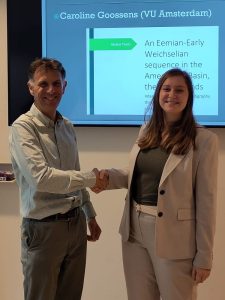
On Friday 24 May 2024 the Palynologische Kring (Dutch palynological society) held a seminar series and laboratory workshop at the Institute for Biodiversity & Ecosystem Dynamics (University of Amsterdam). During the afternoon we had the annual meeting of the society, the presentation of our MSc Thesis prize, four seminars and two laboratory demonstrations. The MSc thesis prize “Florschütz Award” was won by Caroline Goossens (VU Amsterdam) for her thesis entitle: “An Eemian-Early Weichselian sequence in the Amersfoort Basin, the Netherlands”; the project was supervised by Natalie Van der Putten, Cees Kasse and Jeroen Schokker. We hope that Caroline will present her thesis at a future Palynologishe Kring meeting.
Teye Aukes presenting on the diatoms of ancient Rome
The talk series was kicked off by Nina Witteveen (University of Amsterdam) who presented part of her PhD thesis (currently awaiting defense), entitled: “Long-term forest recovery in Amazonia insights from phytolith analysis”. Nina discussed the impact of past peoples on the vegetation of Suriname based on her work identifying phytoliths in soil samples collected at varying distances from an archaeological site. The second talk was given my Amanda Henry (Leiden University) who demonstrated how the analysis of starch grains extracted from archaeological context can provide insights in to past diets. She used these evidences to suggest that early humans and Neanderthals had a similar diversity of plants in their diets. The third talk was given by University of Amsterdam MSc researcher Teye Aukes and focused upon his identification of diatoms from an swampy lagoon environment near Ostia (Italy). He drew conclusions from these data about the antiquity of salt production in ancient Rome. The final talk was given online by Welmoed Out (Moesgaard Museum) who presented a detailed analysis of inter- and intra-analyst variability in phytolith morphometric analysis.
After the seminars we moved upstairs to the microscope laboratory where Nina Witteveen and Ana Smuk (University of Groningen) showed off phytoliths from their study site in South America and the Netherlands.
Some of the Palynologische Kring members enjoying some refreshment after the event.
Using phytolith analysis to detect palm enrichment in AmazoniaNina Witteveen (University of Amsterdam)
Starch grains as indicators of plant food consumption in Neanderthals and Early Modern HumansAmanda Henry (University of Leiden)
Paleoenvironmental history of an archaeological lagoon in Central Italy: Insights from diatom analysisMajoi Nacimiento, Teye Aukes & Jan Sevink (University of Amsterdam)
15:45-17:30 – Laboratory activities
Advances in topical phytolith identificationNina Witteveen (University of Amsterdam)
Finding Suitable Grounds – combining the on/off site approach through phytolith investigation in FlevolandAna Smuk (Rijksuniversiteit Groningen)
The June 2023 meeting of the Dutch palynological society (Palynologische Kring) took place at the offices of the Dutch National Cultural Heritage Agency (Rijksdienst Cultureel Erfgoed) in Amersfoort. The focus of this meeting was the past forest landscape of the Netherlands. The meeting included the annual report of the society, three scientific talks, and a prize giving for the best MSc thesis.
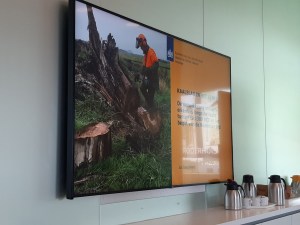
Presentation of Jos Bazelmans showed the huge amount of woody material extracted from Dutch peat bogs.
The scientific part of the meeting was kicked off my Roy van Beek who presented results from his ongoing project on the peatlands of the Netherlands which suggest peatland expansion occurred between 5500 and 3500 years ago (van Beek et al., 2023). The second talk was by our host, Otto Brinkkemper, and traced the history of woodlands across the Netherlands on the basis of macrofossil finds; including huge tree stumps remarkably preserved in peatlands (Bazelmans et al., 2021; Kooistra et al., 2006). The final talk was given by Jos Bazelmans who showed the remarkably high volume of tree stumps that have been recovered from the Netherlands, and how tree rings from these 100s of record are being used to reconstruct forest histories and past climate change. It was interesting to hear that the average age of the tree stumps found was around 250 years, and that some of the trees had lived to around 400 years in exceptional cases.
Kelly with her proud supervisors Stefan Uitdehaag (right), and I (left)
The final section of the meeting was the prize giving. Corrie Barkels, on behalf of the independent judging panel, announced Kelly van Leeuwen as the winner for her thesis entitled “Using soils samples and footwear to improve forensic palynology”. Her thesis was conducted at the University of Amsterdam as part of her MSc Earth Sciences degree and was conducted in collaboration with the Netherlands Forensic Institute. Congratulations Kelly!
The next meeting of the Palynologische Kring will take place on the afternon of Tuesday 13 June in Amersfoort. There will be scientific seminars from Roy van Beek (Wageningen University & Research), Otto Brinkkemper (Cultural Heritage Agency), and Jos Bazelmans (Cultural Heritage Agency) focused on the development of the Dutch landscape. In addition the prize for best palynological MSc thesis in the Netherlands – the Florschütz Award – will be given out.
To find out more details and how to register click here.
On the 19 May the Palynologische Kring (Dutch palynological society) held a hybrid seminar meeting under the theme “Dutch palynologists then and now”.
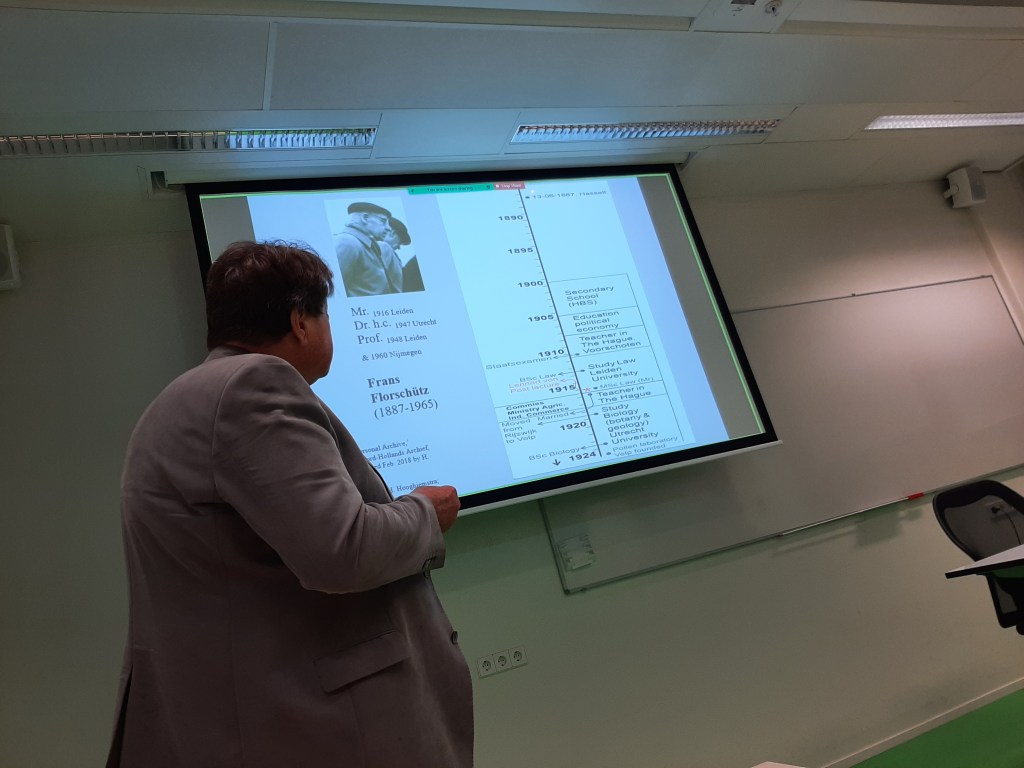
The meeting was opened by Prof. dr. Henry Hooghiemstra (University of Amsterdam) who focused on the “then” and presented a biopic of pioneering Dutch palynologist Frans Florschütz. Florschütz became one of the major figures in establishing palynology within the Netherlands during the 1900s. Originally, he studied political economy and law, but went on to become the Secretary to the Board of Governors of the Agricultural School in Wageningen. From his position in Wageningen Florschütz had a base to develop his interests in palynology and past environmental change. He started work on the seminar work “Nederland in Ijstijd” (The Netherlands in the Ice Age) in 1939 and it was published in 1950. During his career Florschütz also held positions at Utrecht University (obtaining his doctorate), University of Leiden (endowed chair, until 1958) and University of Nijmegen (post retirement). Click here for further information on Frans Florschütz visit.
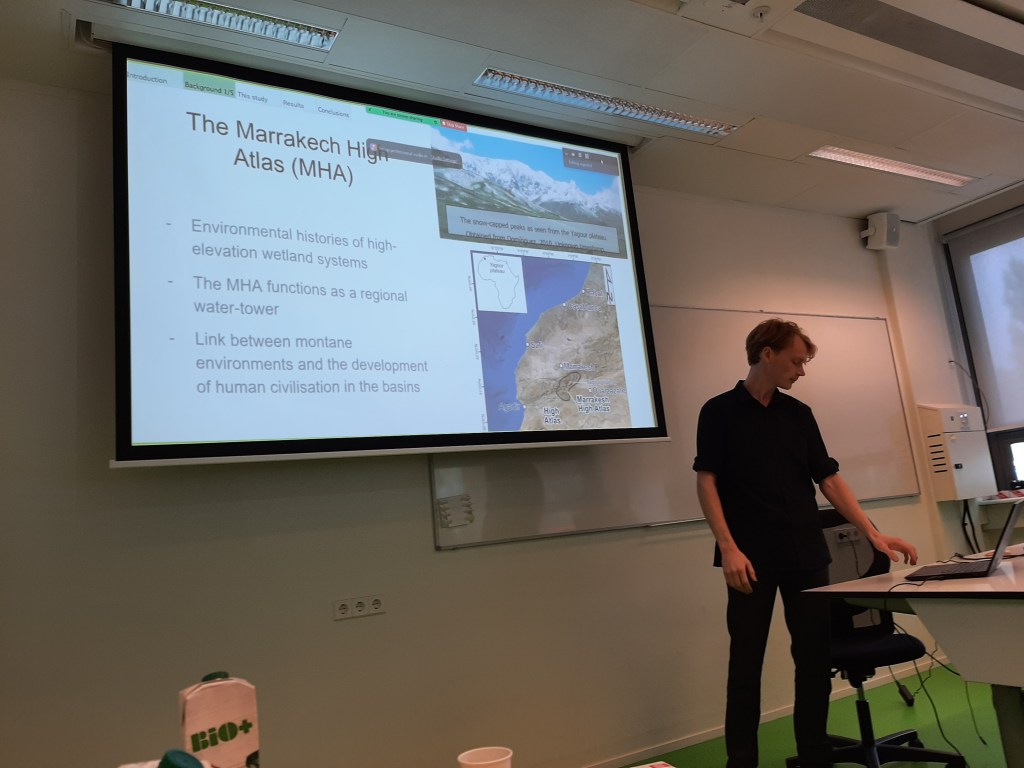
The second part of the meeting focused on the “now” with presentations form three Dutch researchers engaged in research abroad. First up with Eric de Boer (Universidad de Granada, Spain), then Thya van den Berg (University of Hull, UK), and finally Henk Cornelissen (University of Manchester, UK). Eric presented new data on the human and climate impacts on the Iberian Peninsula. Thya presented her work in two parts focused on the new datasets on past environmental change from Yorkshire (UK) and then the development of modelling approached to estimate landscape cover on the basis of pollen datasets. Henk took us to the high atlas of Morocco and showed how pollen and chemical data can be integrated to reveal past human presence and impacts.
The next scheduled event will be in the annual excursion which this year will be to Leiden. For further details and to find out more about the Palynologische Kring visit the web pages here.
I am pleased to announce the next seminar series from the Palynologische Kring“Dutch Palynologists Then and Now: A brief history or Frans Florschütz, and new research from scientists who have been working abroad”
The meeting will take place on the afternoon of the 19th May at the Institute for Biodiversity & Ecosystem Dynamics (University of Amsterdam); if you are not a member of the society and want to follow the talk online or attend in person please contact me for details.Full program below.
The next online seminar day of the Palynologishe Kring will take place on Friday 18 February.
Programma
13:00 Welcome
13:10 – 13:30 Annual General Meeting – finances, activities and board election. New Board member: Nelleke van Asch
13:30 – 14:00 Sander Houben (TNO) – Advances in Palaeozoic stratigraphy in the Netherlands
14:00 – 14:30 Marjolein van der Linden & Lucy Kubiak-Martens (BIAX) – What goes up must come down: The Neolithic human diet based on coprolites from the Swifterbant sites
14:30 – 14:45 Break
14:45 – 15:00 Announcement of Florschütz award winner 2021
15:00 – 15:30 Iris de Wolf and Thomas Giesecke (UU) – Unlocking the wealth of Dutch Pollen data: A new data portal and highlights
15:30 – 16:00 Stefan Uitdehaag (NFI) – Pollen – Silent witness to solving homicides








 Ecology of the past