Gosling, W.D., Miller, C.S., Shanahan, T.M., Holden, P.B., Overpeck, J.T. & van Langevelde, F. (2022) A stronger role for long-term moisture change than for CO2 in determining tropical woody vegetation change. Science 376, 653-656. https://doi.org/10.1126/science.abg4618
To access this article FREE through the Science author referral service click here.
For more on the palaeoecological dataset underpinning this research check out the PhD thesis of Charlotte Miller by clicking here or here.
I wanted to share the details of Scholars at Risk Network with people today. This is an organisation that the University of Amsterdam is working with to provide support to scholars around the world who find themselves in difficult situations. The university is currently working with Scholars at Risk to see if there are additional possibilities to support people effected by the current crisis in Ukraine.
We are seeking to recruit an experienced educator and researcher in the field of climate dynamics, linked to Earth system functioning and/or land-surface processes. The position will be tenured, subject to a positive evaluation of your performance during the initial 12-month temporary appointment.
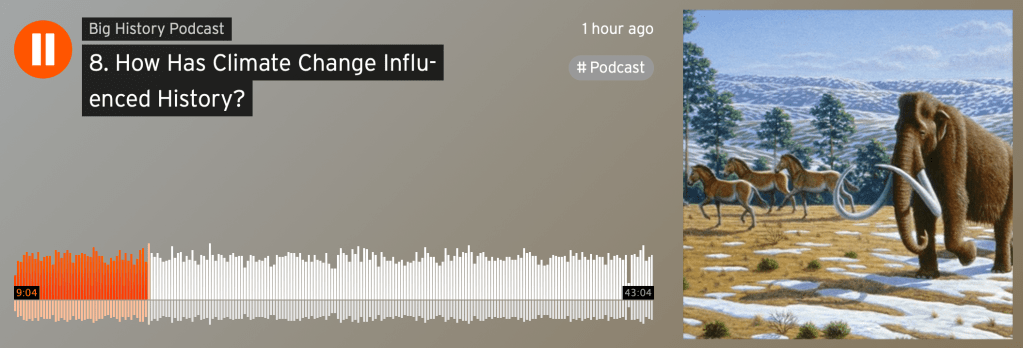
As part of the (on-line) bachelor level “Big History” course from the Institute for Interdisciplinary Studies at the University of Amsterdam I recently recorded a podcast with Henry Hooghiemstra. Under the banner of “How Has Climate Change Influenced History?” among other things we discussed: (i) the principles of how we can obtain information on past climatic and environmental change, (ii) how global climate changed between cold (glacial states) and warm (interglacial states) during the last 2.6 million years (Quaternary), and (iii) past human impacts and influences on environmental and climatic change.
Palaeoecology and past environmental research central to the work at the Institute for Biodiversity & Ecosystem Dynamics (University of Amsterdam); check out the new institute video, spot the palaeoecology researchers, and see what else is going on at IBED:
Prof. dr. Willem Renema Special Chair in Marine Palaeobiodiversity
Willem Renema, head of the Marine Biodiversity research group at Naturalis, has been appointed as a Special Chair in Marine Palaeobiodiversity within the Department of Ecosystem & Landscape Dynamics at the University of Amsterdam. I am delighted that Willem has joined the team coupling his expertise in marine tropical systems with our existing focus on terrestrial tropical settings will, I am sure, provide many new avenues of scientific endeavour. Catalysing collaboration between Naturalis and UvA will be five PhD researchers, employed on the Marie Skłodowska-Curie Innovative Training Network, who will be jointly supervised by Naturalis and UvA staff.
To find out more about Willem and his appointment click here.
Do you have a PhD in Physical Geography, Environmental Sciences, Landscape Ecology or Soil Ecology? Have you got educational and research experience working with digital data to contribute to climate, geographic or biodiversity science? If so please consider applying for the 4-year post-doctoral position “Digital Environmental Sustainability” currently available within the Department of Ecosystem & Landscape Dynamics (Institute for Biodiversity & Ecosystem Dynamics, University of Amsterdam).
Luckily, in spite of these trying times, we are allowed to continue our research in Amsterdam and on the Veluwe to determine the effects of air pollution on airborne pollen grains. Unfortunately for us (but generally perhaps one of the few silver linings of this situation), the COVID-19 lockdown has largely eliminated our main variable of interest; air pollution.
With traffic in the city at a minimum, any chemical differences might not be as pronounced between the city and rural areas. However, this may actually provide us with a unique opportunity to get a baseline of the pollen chemistry in Amsterdam with relatively little pollution. This baseline may also be of interest to projects working on urban air quality and greenifying urban spaces, such as the projects in the Amsterdam Knowledge Mile Park, which is included amongst our sampling locations.
This slideshow requires JavaScript.
For more about our project on pollen and pollution in the Netherlands see other posts:
Kirschner, J.* & Hoorn, C. (2019) The onset of grasses in the Amazon drainage basin, evidence from the fossil record Frontiers of BiogeographyDOI:10.21425/F5FBG44827