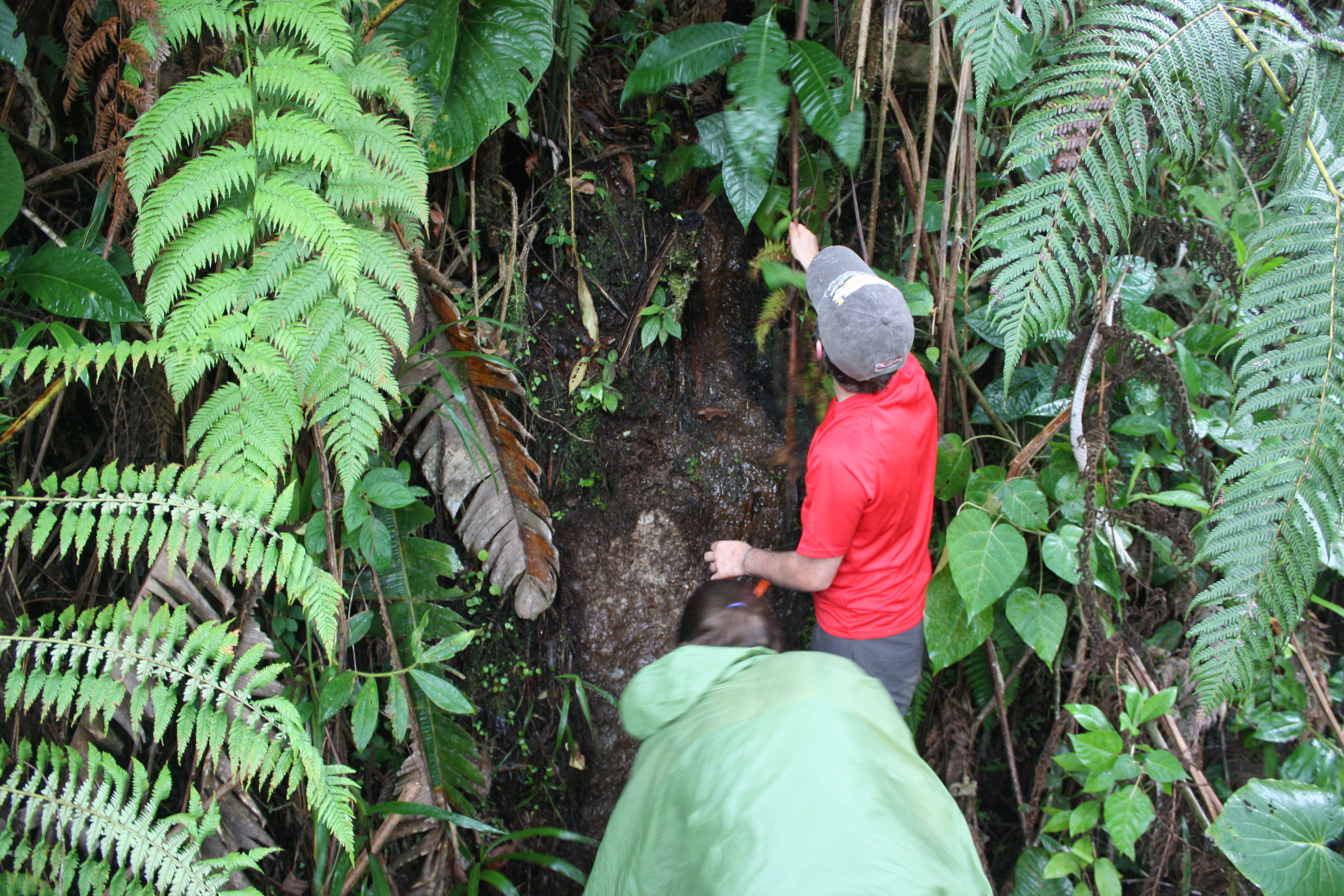
We have now spent two days in sampling sedimentary sections near the Rio Tigre close to Mera in Ecuador. The sections are peat deposits interspersed with volcanic ash and contain many wood macrofossils. It seems likely that the depositional environment was a shallow water swamp or bog. Although we will have to wait for the analysis of the fossil record to know the composition of the vegetation at the site.
I am writing this August post from the Hotel Rincon Escandinavo (Quito, Ecuador) most of this month has been pretty hectic as we have been preparing for this field work trip and trying to get as many things out the way before hand.
We seem to have been quite involved in conference activity: Lottie presented “500,000 years of vegetation change from West tropical Africa” at the International Paleolimnology Association Symposium in Glasgow, Hayley had an abstract on “Pollen counting for diverse tropical ecosystems” accepted for the Linnean Society Palynology Group meeting (1 November) and group members also submitted abstracts for consideration to be presented at the American Geophysical Union Congress and British Ecological Society meeting (both in December); fingers crossed these will be accepted as well.
Regarding the field work. Preparation seems to have gone well and we have arrived in Quito with all out bags, despite a short (1 hour) connection in Madrid. Tomorrow we will meet up with Dr Patricia Mothes (Instituto Geofisico) and set out our detailed plans. As I have now been up for more than 24 hours I should probably get some sleep… Plan is to blog more about the trip as it happens.
PCRG members taking part in the Milton Keynes NSPCC Half Marathon, 8 July (left to right: Charlotte Miller, Wesley Fraser and William Gosling)
I have been really excited with the increase in the number of posts and various contributions to this blog over the last month or so. So thanks to everyone who has contributed. The excellent content allows me to focus on just a few research and teaching events which have not been previously covered.
1) Welcome to Wesley Fraser who has joined us officilally as a visiting postdoc for a few months. We hope to develop a paper and another grant submission looking at pollen/spore chemistry during this time; for further details see “Do plants wear sunblock” post.
2) Well done to Frazer and Hayley for performing well in their end of year 1 mini-vivas. Both projects are progressing well and we are all looking forward to field work at the end of the month. Hopefully most of the prepartation and equipment are now in place…
3) Potential for more exiting collaborations was also developed at two meetings. The first, at the Natural History Museum and, in conjunction with long term collaborator Steve Brooks was with old friends Mick Frogley (Sussex) and Alex Chepstow-Lusty. Both Mick and Alex taught me when I was at Cambridge and it would be super exiting to develop a new collaboration with them looking at Chironomids in Andean lakes. The second was at the Univesity of Nottingham as I took part in a UK Tropical Peatlands meeting which brought together ecologists and palaeoecologists from Nottingham, Leeds, Leicester and The OU. The aim of the meeting was to coordinate papers and grant applications.
4) At the end of July beginning of August I taught on the “Sedimentary Rocks and Fossils in the field” topic for the new Practical Science, Earth & Environment (SXG288) module which The OU now offers. Longridge Towers School (no children around this time of year) provided the perfect base for investigating the sedimentary geology of the region. The small group of students had the opportunity to make field observations and test hypotheses related to past environmental change. Everyone was very excited to find numerous fossils and interesting sedimentary structres and had fun trying to work out what they all meant! Congratulations to Angela Coe for putting together this great event.
I whish I could start with “ Once upon a time…” because that would be the easiest way to begin this paragraph (or a paper). Besides, to some extend, “Once upon a time” can be appropriate because this is a story related to the OLD friends of the Paddington Bear. By that, I mean a story about the mega fauna in South America.
Macrauchenia drawn by Kobrina Olga (Photo credit: Wikipedia)
Our whistle-stop tour of the UK brought us to the PCRG on the 26-27 June. We are undertaking a multiproxy (ostracods, gastropods, forams) study of different coastal lagoons along the south coast of Jamaica in order to reconstruct coastal environmental change over the last Millennium. Jamaica lies not only within the firing line of Atlantic tropical cyclones but also forms part of the Gonave microplate, which has been responsible for a series of large earthquakes within the region, including the infamous 2010 earthquake in Port au Prince, Haiti. As a consequence, one of our main challenges is to distinguish between sediments deposited during abrupt climatic and tectonic events over the last ca. 1000 years.
Figure 1: A section of the sediment record from Albion Ponds.
The purpose of our UK visit this year was to split cores recovered from Albion Ponds in preparation for ITRAX XRF core scanning at Aberystwyth University in August. We are very grateful for the hospitality at PCRG and look forward to developing further collaboration on projects in the very near future.
A growing body of evidence suggests that plants alter their chemical composition in relation to the amount of incoming solar radiation (“insolation“) they are exposed to during life. Chemical changes are induced in order to provide protection against the deleterious effects of ultraviolet (UV) radiation; a relatively small, but important component of the total solar spectrum. UV radiation is linked with a range of detrimental biological effects, primarily stemming from damaged DNA. As sessile organisms, plants need to employ various mitigation mechanisms to prevent/reduce damage induced by UV radiation. Such mechanisms include effective DNA repair pathways, physiological adaptations, and UV-absorbing compounds. It is this last mechanism, UV-absorbing compounds (UACs), that is discussed here.
Lycopodium spore chemistry can be divided into two distinct groups; aliphatic components and phenolic components.
On Tuesday the UK participation in the International Continental scientific Drilling Program (ICDP) was officially launched at the British Geological Survey (Keyworth). The ICDP is designed to help scientists with the aquisition of samples to answer fundemental questions related to geological and enviornmental science. Now that the UK has membership to the ICDP, thanks to investment from the BGS, UK based scientists can take more of a lead in developing projects. Having worked on two projects based on ICDP sediments (Lake’s Titicaca and Bosumtwi) I am delighted by this development and hope over the next few years to be able to get involved in further exciting research.
I am delighted to report that Dr Encarnacion Montoya Romo (currently of the Botanical Institute of Barcelona) has been awarded a NERC Fellowship to join the PCRG. The project is entitled “Evaluation of tropical forests sensitivity to past climate change” (FORSENS) and will examine environmental change at four study sites from different regions of the Neotropics: 1) Khomer Kotcha (Bolivia; 17oS, 4100 m above sea level [asl]) [1-3], 2) Consuelo (Peru, 13oS; 1400 m asl) [4-5], 3) Banos (Ecuador; 0oS, 4000 m asl), and 4) a new lowland site from Columbia/Ecuador to be collected during field work during the project.
I have been engaged with two major activities during June: 1) submission of a research proposal to NERC, and 2) excitement of my first online teaching module going live to students, Cyprus activity, within Practical science: Earth and environment module (SXG288). Other members of the group have been writing up methods chapters (Natalie), number crunching and submitting abstract to the International Paleolimnology Symposium (Lottie), and submitting first year probation reports (Hayley and Frazer).


 Ecology of the past