An African Pollen Database data steward training event was held at the Institute for Biodiversity & Ecosystem Dyanmics (University of Amsterdam, 27-29 January 2020) where training in the use of the Neotoma database was provided by Eric Grimm. The participants are now enabled curate and archive data within Neotoma. If you have a palaeoecological data set that you would like to contribute to Neotoma, or if you would like training as well, these people can now help you. Contact details below:
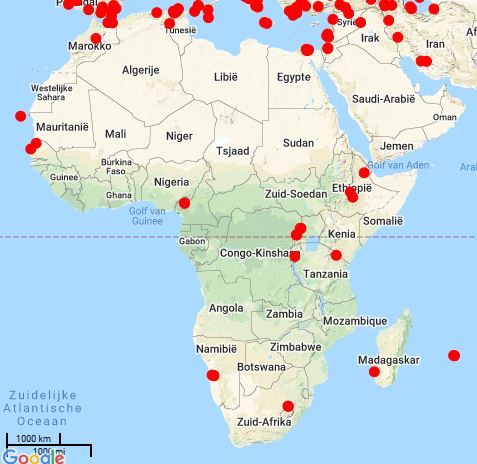
Pollen data recorded in Neotoma for Africa on 24 January 2020. Hopefully after the data steward training event we will have a few more dots on the map, and the potential for many more.
We are delighted to be able to host sixteen researchers of many nationalities conducting research in many different countries. The aim of the training event is to provide researchers with the skills to manage Neotoma and strengthen the African pollen research community. I am excited to be involved, I am confidence that much new research will be brought together, and I hope that we can get good plans in place for further steps and growth of this network.
REFERENCES Vincens, A., Lézine, A.-., Buchet, G., Lewden, D. & Le Thomas, A. (2007) African pollen database inventory of tree and shrub pollen types. Review of Palaeobotany and Palynology 145, 135-141. DOI: 10.1016/j.revpalbo.2006.09.004
Williams, J.W., Grimm, E.C., Blois, J.L., Charles, D.F., Davis, E.B., Goring, S.J., Graham, R.W., Smith, A.J., Anderson, M., Arroyo-Cabrales, J., Ashworth, A.C., Betancourt, J.L., Bills, B.W., Booth, R.K., Buckland, P.I., Curry, B.B., Giesecke, T., Jackson, S.T., Latorre, C., Nichols, J., Purdum, T., Roth, R.E., Stryker, M. & Takahara, H. (2018) The Neotoma Paleoecology Database, a multiproxy, international, community-curated data resource. Quaternary Research 89, 156-177. DOI: 10.1017/qua.2017.105
Detecting the presence, and impact, of peoples past impact in ecosystems and landscapes in the tropics is a challenging because the traces that they leave behind are few and disentangling them from ‘natural’ (non-human related) variability is a challenge. As an Associate Editor for Vegetation History & Archaeobotany (VHAA) I enjoy handling manuscripts that think about these issues and explore the role of humans in tropical landscapes. Two recent papers published in VHAA touched on this subject (one of which I “communicated” as an editor).
Bodin et al. (2020) studied charcoal recovered from soil at sites with a gradient of archaeological evidence for past human activity in French Guiana.
Goethals & Verschuren (2019) explored the relationship between the amount of dung fungi found in lake sediments and the herbivore populations living around the lakes.
Gosling, W.D., Sear, D.A., Hassall, J.D., Langdon, P.G., Bönnen, M.N.T., Driessen, T.D., van Kemenade, Z.R., Noort, K., Leng, M.J., Croudace, I.W., Bourne, A.J. & McMichael, C.N.H. (2020) Human occupation and ecosystem change on Upolu (Samoa) during the Holocene. Journal of Biogeography DOI: 10.1111/jbi.13783
Note: Co-authors Bönnen, Driessen, van Kemenade, and Noort all contributed to this work as part of the research projects related to their MSc or BSc degrees within the Department of Ecosystem & Landscape Dynamics at the University of Amsterdam.
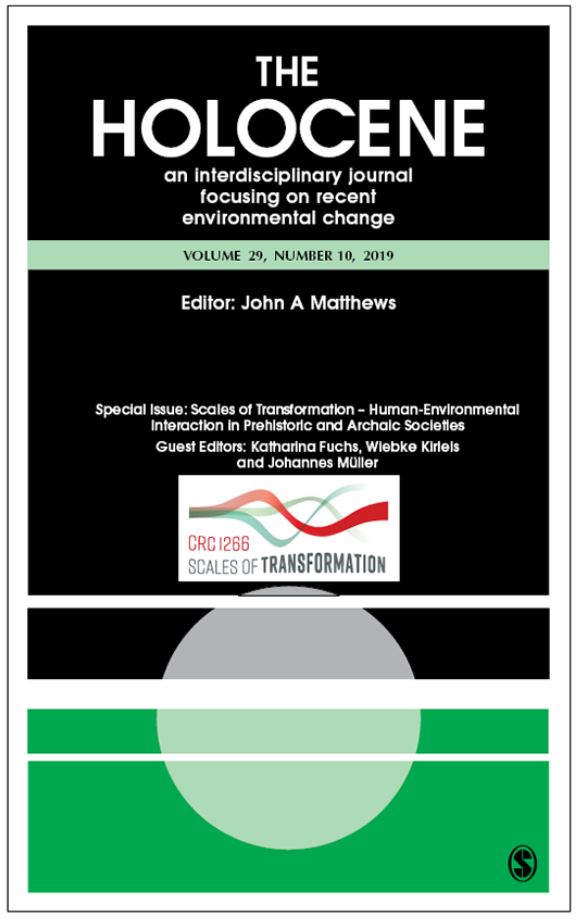
Jardine, P.E., Fraser, W.T., Gosling, W.D., Roberts, C.N., Eastwood, W.J. & Lomax, B.H. (2019) Proxy reconstruction of ultraviolet-B irradiance at the Earth’s surface, and its relationship with solar activity and ozone thickness. The Holocene DOI: 10.1177/0959683619875798
Zhang, Y., van Geel, B., Gosling, W.D., McMichael, C.N.H., Jansen, B., Absalah, S., Sun, G. & Wu, X. (2019) Local vegetation patterns of a Neolithic environment at the site of Tianluoshan, China, based on coprolite analysis. Review of Palaeobotany and Palynology 271, 104101. DOI: 10.1016/j.revpalbo.2019.104101
Teunissen van Manen, M., Jansen, B., Cuesta, F., León-Yánez, S. & Gosling, W.D. (2019) Leaf wax n-alkane patterns of six tropical montane tree species show species-specific environmental response. Ecology and Evolution. DOI: 10.1002/ece3.5458
IBED is looking for an Earth scientist/ecologist with expertise and interest in soil carbon cycling, in relation to the role of soil microbial communities therein to support ongoing work within the Department of Ecosystem & Landscape Dynamics (ELD). We are particularly looking for a researcher with an international track record with expertise in one, or more, of the following areas:
Interactions between organic carbon and the mineral soil.
Microbe-organic C interactions.
Molecular and computational approaches for analysing soil microbial communities and their functionality.
Scaling of soil carbon cycling processes from microbe to globe.
Linking global carbon cycle models and laboratory experiments.
This is one of two positions currently open in Earth Systems Science within ELD. The other position is related to Environmental Chemistry and we will be looking at complimentary between the two appointments.
For further details and information on how to apply click here.
IBED is looking for an environmental chemist/environmental scientist experienced in studying sources, transport, transformation and degradation and fate of chemicals in ecosystems to support ongoing work within the Department of Ecosystem & Landscape Dynamics (ELD), and create links with the Department of Freshwater & Marine Ecology. We are particularly looking for a researcher with an international track record with expertise in one, or more, of the following areas:
The fate and effects of organic contaminants of emerging concern in the environment.
The mitigation of environmental pollution.
Environmental policy and circular economy.
Regional and larger-scale systems analysis of human impacts on the environment.
This is one of two positions currently open in Earth Systems Science within ELD. The other position is related to Soil Carbon Cycling and we will be looking at complimentary between the two appointments.
For further details and information on how to apply click here.
 An African Pollen Database data steward training event was held at the Institute for Biodiversity & Ecosystem Dyanmics (University of Amsterdam, 27-29 January 2020) where training in the use of the Neotoma database was provided by Eric Grimm. The participants are now enabled curate and archive data within Neotoma. If you have a palaeoecological data set that you would like to contribute to Neotoma, or if you would like training as well, these people can now help you. Contact details below:




 Ecology of the past