Video by Thiago Rangel explaining our recent paper (Rangel et al., 2018).
July 27, 2018
Video by Thiago Rangel explaining our recent paper (Rangel et al., 2018).
July 26, 2018
 20th Congress of the International Union for Quaternary Research (INQUA)
Abstract submission is now open for INQUA 2019 in Dublin Ireland (25-31 July 2019). Please consider submitting to the special session I am co-organizing on landscape change in the tropics. Submissions welcome from the fields of biogeography, palaeoecology, geomorphology, volcanology, and archaeology. Click here to submit your abstract. TITLE: The changing tropical landscape
ORGANIZERS: William D. Gosling and Crystal N.H. McMichael (University of Amsterdam)
Eighteenth century explorers marveled at the diversity of tropical ecosystems seemingly untouched by human activity. As a result of these observations, the notion of tropical stability, in terms of vegetation and climate, came to underpin theories of evolution, ecology, and biogeography. Gradually, however, it has become apparent that tropical landscapes have changed markedly through time in response to global climate cycles, (a)biotic factors, and human activity. For example, Continue Reading
July 23, 2018
Open access:
 Woutersen, A., Jardine, P.E., Bogota-Angel, R.G., Zhang, H., Silvestro, D., Antonelli, A., Gogna, E., Erkens, R.H.J., Gosling, W.D., Dupont-Nivet, G. & Hoorn, C. (2018) A novel approach to study the morphology and chemistry of pollen in a phylogenetic context, applied to the halophytic taxon Nitraria L.(Nitrariaceae). PeerJ 6, e5055. DOI: 10.7717/peerj.5055
July 20, 2018

 AFQUA: The African Quaternary environments, ecology and humans
2ndInternational Conference and Workshops
14-22 July 2018-07-15 National Museum, Nairobi, Kenya
Day 6
The final day of talks at AFQUA 2018 took a more applied approach in the first session “Applying the Quaternary: The role of the past in supporting the future”. This session focused on how we can focus Quaternary science to produce outputs that directly meet concerns and needs of society. Examples included the quantification of the fossil charcoal record to provide insights into the nature and impact of fires in the past (C. Adolf), how we can use information on past vegetation change and disturbance factors to anticipate how ecosystems on Madagascar might respond to future changes (E. Razanatsoa), and how climate histories can be extended through tree ring data (D. Colombaroli).
July 19, 2018
 Rangel, T.F., Edwards, N.R., Holden, P.B., Diniz-Filho, J.A.F., Gosling, W.D., Coelho, M.T.P., Cassemiro, F.A.S., Rahbek, C. & Colwell, R.K. (2018) Modeling the ecology and evolution of biodiversity: Biogeographical cradles, museums, and graves. Science 361, . DOI: 10.1126/science.aar5452
July 18, 2018
AFQUA: The African Quaternary environments, ecology and humans
2ndInternational Conference and Workshops
14-22 July 2018-07-15 National Museum, Nairobi, Kenya
Day 5
The fifth day of the AFQUA conference started with the second session on “Archaeological Landscapes”. Talks included: (i) a tribute to the work of Dick Grove in Quaternary work in Africa since the 1950’s, including possibly the earliest definition of the African humid period in his paper Grove & Warren (1968) (D.S.G. Thomas), and (ii) a highlight of new work on the Kisese II Rock Shelter in Tanzania (K. Ranhorn). Then to take us up to lunch Prof. David Nash treated us to a tour de force through the use of historical records in reconstructing past climates; including quotes from the fantastically named Holloway Helmore a missionary to Lekatlong in 1851 commenting on drough and how to turn this type of information into a regional/continental synthesis!
 The afternoon session focused around the theme of “East Africa”. This session started with two talks on one of the “least known ancient civilization” in Ethiopia the Aksumite and pre-Aksumite peoples, and the resilience of these peoples to environmental and land-use change (V. Terwilliger and Z. Eshetiu). Other work presented on the morphometry of hominin skulls showing gradual development from 500,000 to 315,000 years ago which lead up to the appearance of anatomically modern humans (E. Mbua).
July 17, 2018
AFQUA: The African Quaternary environments, ecology and humans
2ndInternational Conference and Workshops
14-22 July 2018-07-15 National Museum, Nairobi, Kenya
Day 4
Yesterday (day 3) was excursion day of the AFQUA conference (photos to follow). Day 4 of the meeting was back in the National Museum Nairobi and kicked off with a session on “African archaeological landscapes”. The opening talk reviewed the career of Karl Butzer who coined the term ‘geoarchaeology’ back in the 1970’s when writing about his work integrating geological, archaeological and anthropological information (C.A. Cordova). Two talks then followed highlighting work on Lake Makagadikgadi from the perspective of archaeology and landscapes (D.S.G Thomas) and geochemical fingerprinting of stone tools to determine their source (D.J. Nash).
 To take us up to lunch Boris Vanniere and Daniele Colombaroli gave a ‘double header’ plenary talk highlighting the exciting advances in the development of the Global Charcoal Database and how understanding past fire histories in Africa is key to interpreting environmental change. The after lunch session continued the palaeo-fire theme with records from Lake Botswana (C.E. Cordova), Lake Bosumtwi (W.D. Gosling – me), and Madagascar presented (A. Razafimanantsoa); as well as work on the usefulness of the morphometric’s of charcoal in determining the plant of origin (L.Bremond).
In the final session of the day we were back to “Southern Africa” as a theme. Under which banner we were “boggled” by sea-surface and sub-surface temperature reconstructions (M.A. Berke), shown how to extract climate records from Hyrax middens (B.M. Chase) and given insights into the past flora of the Cape Floristic region from fossil pollen records spanning 130,000 years (L.J. Quick).
July 16, 2018
Loughlin, N.J.D., Gosling, W.D., Mothes, P., Montoya, E. (2018) Ecological consequences of post-Columbian indigenous depopulation in the Andean-Amazonian corridor. Nature Ecology and Evolution. DOI : 10.1038/s41559-018-0602-7

July 16, 2018
AFQUA: The African Quaternary environments, ecology and humans
2ndInternational Conference and Workshops
14-22 July 2018-07-15 National Museum, Nairobi, Kenya
Day 2
The second day of the AFQUA conference commenced with the second session on “East Africa” and Prof. Tom Johnson asking the question “Should we drill Lake Victoria?”… and a request for ideas from people to join in with ideas for the proposals for obtaining new sedimentary records from the lake. The East Africa session continued with exploration of Lake Kivu using organic biomarkers to see if past lake ‘explosions’ could be detected (M.E. Berke) and the use of strontium isotopes to detect past climate from lakes in the Turkana Basin (H.J.L. van der Lubbe).
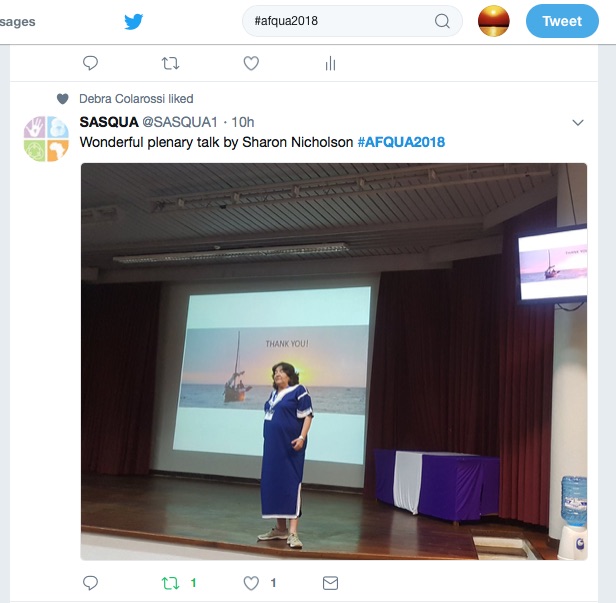 Before lunch the second plenary talk of the conference was delivered by Prof. Sharon Nicolson who made it very clear that the Inter Tropical Convergence Zone does NOT play an important role in controlling rainfall patterns across Africa (see Nicholson, 2018).
After lunch the first oral sessions covered “Southern Africa” and included d13C records from Bobab trees (S. Woodborne and E. Razanatsoa), early human finds in cascade tufas (M.A. Pickford), and quantitative climate reconstructions from pollen using the CREST software (M. Chevalier). After the break we were back for “Quantitative palaeoclimatology, modelling and data-model comparison” thinking about what is abrupt (M. Claussen), the impact of atmospheric CO2 on plants (V.J. Hare), and connectivity between lakes in the Kenyan rift (R. Dommain). Then it was off to the hotel bar to watch the football…
July 15, 2018
AFQUA: The African Quaternary environments, ecology and humans
2ndInternational Conference and Workshops
14-22 July 2018-07-15 National Museum, Nairobi, Kenya
My first AFQUA conference really began the day before the conference proper started in the Kenyan immigration queue where I met a number of fellow delegates who were flying in from all over the world. It was great to start to put faces to names of people who’s work I had read for many years. Once out of the airport transfer to the hotel was smooth, and it was with some excitement that the following morning I made the short walk from the hotel to the famous Nairobi National Museum for the start of the conference.
Day 1
Prof. Andy Cohen (one of my fellow delegates in the immigration line) kicked off the AFQUA conference with a plenary giving an overview of African continental drilling projects. He traced the dream of the recovery of long continental records back to Daniel Livingstone and Neil Opdyke’s workshop from 1980 that set out the dream of obtaining long records from the continent. He then went on to give examples of how multi-millennial lake records, including Lake Malawi, can be used to understand the tempo of ecological change.
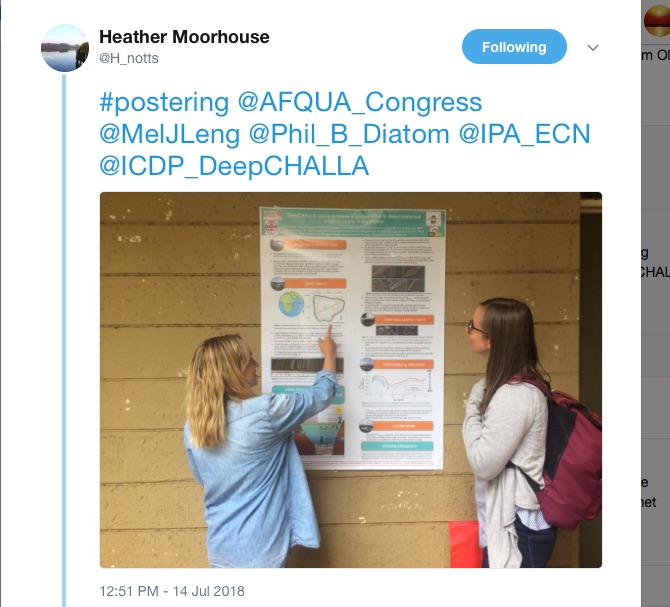 The first session of the conference, entitled “East Africa”, included: exciting evidence of Deinotherium the largest land mammal of the Quaternary (J.-P. Brugal), the use of d13C in determining homonin ecology (V.M. Iminjili), and evidence from a new c. 200,000 year old site at Natodomeri (Kenya) that contains evidence of homonids, elephids, giant lions and pigmy hippos (F.K. Manthi).
The second session of AFQUA covered “The environmental context for homonin evolution and dispersal”. This started with geochemical data from Chew Bahir that sheds light on potential drivers of climatic shifts (F. Schabitz), and included examination of changes climate between c. 500,000 and 320,000 years ago that coincided with the shift from hominid use of large cutting tools to smaller implements (R. Potts), and discussion of the environment the route which hominids took out of Africa (F. Henselowsky).
 Ecology of the past