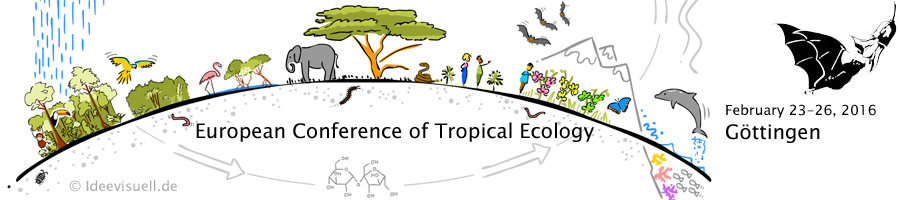
This is my first time attending the European Conference of Tropical Ecology and my second visit to Germany. The conference attracted c. 350 delegates; big enough to have plenty of interesting science, and yet small enough to find everyone you wanted to. The keynote speakers chosen to head the days provided some exciting insights into various new developments across the tropics, including: the importance of biogeography (Richard Corlett), metabolism and carbon cycles (Yadvinder Malhi), diversity and resilience (Lourens Poorter), tropical peatlands (Sue Page), agricultural landscapes (Ravi Prabhu), and mutualism of figs and fig wasps (Martine Hossaert-McKay).
From the many other interesting talks five in particular grabbed my attention, these were:
The British Ecological Society (BES) awards grants for “Research”, “Training and Travel”, “Ecologists in Africa”, and “Outreach”. Funding for individual grants is up to GBP 20,000. I am therefore delighted to announce that “palaeoecology” has been added to the list of categories under which funding can be applied for. For further details click here.
In the light of this change I would like to encourage palaeoecologists to:
Join the BES,
Join the BES peer review college, and
Apply for BES grants!
To register and apply to join the BES peer review committee or for a grant click here.
My undergraduate studies were interdisciplinary in nature: I did a BSc Beta-Gamma (Institute for Interdisciplinary Studies (IIS), UvA) where students are taught to collaborate between different disciplines. Ecology has always been an interest of mine, so I was quick to specialize in that field. In my final year of my bachelor I came in contact with paleoecology and did not hesitate to make sure my first master’s project (MSc Biological Science, IBED, UvA) would be with the P&L research group (IBED) – a worked on a project on tropical rainforest dynamics in Miocene Amazonia. After that I got the chance to test my skills outside research institutes: during the Tesla consultancy Minor (IIS) I got firsthand practical experience in developing urban green areas from start to finish for the municipality of Amsterdam. The focus of that project was to increase the ecologic, educational, scientific, and social value of the natural areas on Amsterdam Science Park. It was great to see my scientific background put to good use outside the research community. The project is still active today.
After a short period of working in education and sustainability consultancy I seized the opportunity to, once more, join the P&L research group – this time as a Ph.D. student under the watchful eyes of William Gosling and Boris Jansen. My project revolves around characterizing biomarker and modern pollen-rain signals across the altitude of the Ecuadorian Andes vegetation. A great opportunity at the frontier of tropical research!
If the first week is any indication, I foresee to a lot of collaboration, hard work, exploration and adventure in the coming years!
The WordPress.com stats helper monkeys prepared a 2015 annual report for this blog.
Here’s an excerpt:
The concert hall at the Sydney Opera House holds 2,700 people. This blog was viewed about 11,000 times in 2015. If it were a concert at Sydney Opera House, it would take about 4 sold-out performances for that many people to see it.
Posted on behalf of Barry Lomax Linnean Society Palynology Specialist Group meeting Tuesday 24 November 2015
Provisional program
10:30 – 11:00 Barry Thomas (Aberystwyth University). Ecological interpretations of Asturian and Cantabrian lycophyte microspore floras of the Variscan Foreland and the Appalachian Province of the Central Coalfields of the U.S.A
11:00 – 11:30 Adele Julier (Open University). Can FTIR spectroscopy be used to identify grass pollen?
14:00 – 14:30 Viktória Baranyi1 (Oslo Universiy). Morphology and wall-ultrastructure of Froelichsporites traversei, an enigmatic sporomorph from the Late Triassic in North America.
14:30 – 15:00 Hannah Banks (Royal Botanic Gardens Kew). Functional and phylogenetically useful structures in Caesalpinioid legume pollen.
15:00 – 15:30 Sam Slater (Sheffield University). A quantitative analysis of Middle Jurassic vegetation dynamics based on dispersed spore/pollen assemblages from the Ravenscar Group, North Yorkshire, UK.
Afternoon tea 15:30 – 16:00
16:00 – 16:30 Alex Askew (Sheffield University). A palynological investigation of the Middle Devonian of northern Spain: hunting for the Kačák event.
16:30 – 17:00 Phil Jardine (Open University). A new use for old pollen: reconstructing past solar irradiance using pollen chemistry.
Wine reception
To register please contact Barry Lomax (Group secretary)
Posted on behalf of Thomas Giesecke:
EUROPEAN POLLEN DATABASE
Meeting and training workshops
1-3/06/2016
Aix-en-Provence, France
We offer exciting keynote lectures, an extensive poster session to showcase your research, and two days of training with experts in software, databases, and modelling.
We want your opinion on how to develop the European Pollen Database (EPD) to make it a better resource for research, education, and data storage.
NO registration fee
Workshop topics include:
Plotting and archiving palaeoecological data, using Tilia and Neotoma
Charcoal analysis software and database
How to use modern surface samples for ‘analogue’ reconstructions of the past
Last week I took part in my first “palynologendagen” (pollen days) with the Palynologische Kring (Dutch palynology society). Unfortunately, due to a prior commitment (Chairing a British Ecological Society careers webinar) I was only able to take part on the second day.
Day two of the pollen days was “op de fiets” (on bikes) in true Dutch style. We met at Twente Fiets to pick up 36 bicycles and one tandem and headed out into the countryside!
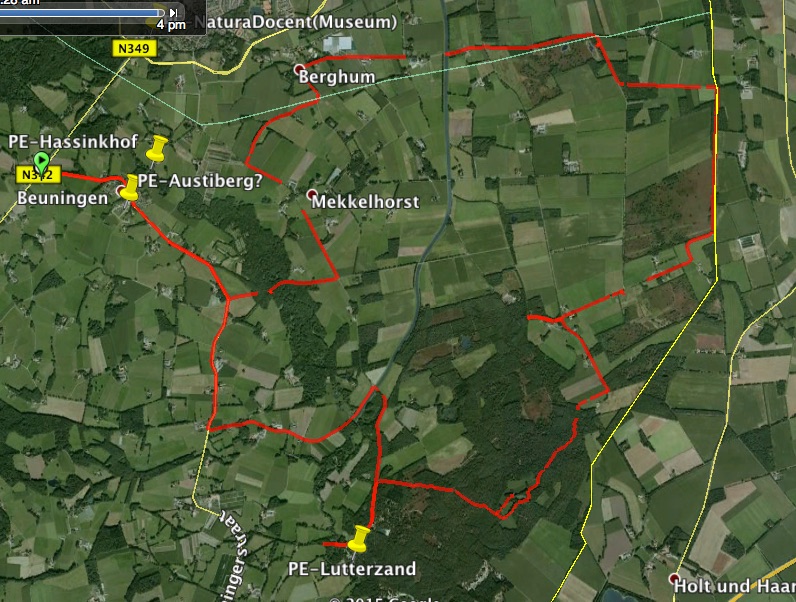
Figure 1: Route of the bicycle tour (max speed 21.8 kmph, distance 23.24 km)
Our route (Fig. 1) took in around 14 point of interest. At each point Harm provided interesting insights into the landscape history and how humans had interacted and shaped it. The presentations were in Dutch so I had to concentrate hard to get 50% of the information.
Two particularly nice sites (which I think I understood) were:
the site of an old toll house at the split in the old road to Germany (east) and Scandinavia (north), and
a sedimentary cross section, revealed by river down cutting, which showed the impact of cart wheels on the sediment along the site of an old road.
In addition to the tour it was also fantastic to meet many other fellow palynologists based in the Netherlands. I looking forward to being able to participate in many future Palynologische Kring events, and I am also pleased to say attending this years event has inspired me again to try and push on with learning Dutch again!
9:00-9:30 Marian Cabrera (UvA): Paramo response to human influence: A trait-based approach.
9:30-10:00 Caterina Cúcio (UvA): The seagrass rhizobiome and its role in the sulfur cycle.
10:00-10:30 Vitor Gomes (Naturalis): Endangered tree species future in Amazon.
Coffee Break
11:00-11:30 Catarina Jacovac (WUR): Effects of land use on forest succession in the Amazon.
11:30-12:00 Andre van Proosdij (WUR/Naturalis): Assessing botanical diversity patterns in Gabon using Species Distribution Models: methods & applications.
12.00-12.30 André Junqueira (WUR): Legacies of anthropogenic soils on forests and cultivation systems in Amazonia.










 Ecology of the past