Introducing Corine Driessen

July 7, 2015
corine102

DriessenCHi Everyone,

It’s very nice to be invited to write something for this blog, let me introduce myself a little bit.

I am a MSc Earth Sciences student at the University of Amsterdam. Currently I am working on my master thesis at Naturalis Biodiversity Center, under supervision of Niels Raes, Willem Renema and William Gosling. We are looking at species migration between Australia and Asia during the Miocene, and we compare it to migration between N and S America at the dawn of the Great American Biotic Interchange. To do so I’m analysing data on fossil occurrences in Australia and Southeast Asia. Hopefully this research will lead to interesting new insights.

Before starting my MSc Earth Sciences I did a bachelor in Biology at Leiden University. I decided to do a master’s in Earth Sciences because it offered a broader perspective of the natural world and its processes.

I like analysing and sorting out data like I’m currently doing for my thesis with fossil occurrence data. It also played a major role in my internship at TNO – Caribbean Branche Office, where I was involved in starting a database containing information on Aruba’s subsurface. During my internship I also experienced the “Green Aruba” conference and was involved in organising a geological excursion for some of the attendants. I am very interested in environmental issues and solutions, such as the transition to renewable energy. New technologies spike my interest a lot and I like being aware of innovations in a whole lot of fields.

Hopefully I will have my thesis ready within a couple of months, and can give an update about some of the findings.

Corine

Andean bear

April 30, 2015
WDG

WDG's avatarPalaeoenvironment

Bear-zoomOn our first field day three of the XPERT team (Valerie, Barry and Sarah) claim  they saw an Andean or spectacled bear (Tremarctos ornatus) in the paramo of the Cayambe-Coca National Park… Valerie did manage to provided some supporting evidence in the way photos.

An Andean bear, or a black dog? An Andean bear, or a black dog? (photo: van den Bos)

For more information on Andean bears visit: Andean bear foundation

View original post 20 more words

Sediment coring in Lake Erazo

April 14, 2015
WDG

XPERT field school is underway…

stxal8's avatarPalaeoenvironment

Lake Erazo Sediment coring on Lake Erazo. Photo by Valerie van den Bos (who spent the flight over reading a book on how to take the perfect photo)

By Alexandra Lee and Nick Primmer

To study the palaeo-environmental record of the Andean cloud forest, sediment cores were taken from the recently discovered Erazo lake. In mixed conditions of blazing sun and pouring rain, 14 researchers, one bus driver and several Ecuadorian guides hauled what felt like a ton of equipment up to the lake 2,300 m asl. In the centre of the lake, a wooden coring platform was mounted between two boats securely anchored at three positions. Using a modified Livingston corer with a drop hammer, five cores were successfully recovered from the lake up to a maximum depth of two metres. The main challenge encountered was the stability of the platform which resulted in several complications limiting the number of cores…

View original post 29 more words

There And Back Again: Returning To The South Pacific

Ecology of the past blogger Tessa (https://ecologyofthepast.info/2015/02/16/introducing-tessa-driessen/) will be working on the pollen from these Samoa cores. Exciting times…

Jon Hassall's avatarPalaeoenvironmental Laboratory

Last year I was told that my fieldwork in Samoa and New Caledonia was the best I’d ever experience; turns out that was a lie. This year I was fortunate enough to return to Samoa, and even more fortunate to go to the small island of Atiu in the Cook Islands. There was one very simple reason for me, along with Prof. David Sear and Dr Pete Langdon, to return to the South Pacific: we needed more sediment from the lakes on these islands. This sediment is crucial to determine how a massive band of rain – called the South Pacific Convergence Zone (SPCZ) – has moved in the past. Millions of people are dependent on the SPCZ for drinking water. Data from satellites has shown that various climatic phenomena that operate in the Pacific Ocean cause the South Pacific Convergence Zone to move. With future climate change likely…

View original post 464 more words

Tropical Botany in Belize: Part 2 – Las Cuevas

April 1, 2015
nicholasloughlin

Tropical Botany in Belize

By Nick Loughlin

Las Cueavs Forest Reseach Station (Photograph by Anna Turbelin)

Figure 1: Las Cueavs Forest Reseach Station (Photograph by Anna Turbelin)

As mentioned in my last post I have recently returned from a 2 week field course in tropical botany run by the Royal Botanic Garden Edinburgh (RBGE) in conjunction with their MSc course on the ‘Biodiversity and Taxonomy of Plants’. The field course allowed for 10 NERC funded PhD students in relevant fields to accompany the MSc students out to Belize to learn a host of valuable skills in tropical botany and ecology.

To find out what we did read on…

Continue Reading

People, Politics and the Planet – Any Questions?

March 17, 2015
WDG

People, Politics and the Planet – Any Questions?
9 March 2015 The Light, Euston Road, London
British Ecological Society

Find out what UK politicians think about the environment ahead of the forthcoming UK general election.


The panellists were:

  • Lord de Mauley TD (Conservatives, Parliamentary Under Secretary of State for the Natural Environment and Science)
  • Barry Gardiner MP (Labour, MP for Brent North and Shadow Minister for the Natural Environment)
  • Baroness Parminter (Liberal Democrats, Environment Spokesperson)
  • Natalie Bennett (Green, Party Leader and Parliamentary Candidate for Holborn and St. Pancras)
  • Dr Eilidh Whiteford MP (Scottish National Party, MP for Banff and Buchan)
  • William Cash (UK Independence Party, Heritage and Tourism Spokesperson)


Introducing Tessa Driessen

February 16, 2015
TessaDriessen

Tessa DriessenHi I’m Tessa and really excited to introduce myself here!

I’m an Environmental Biology Master student from Utrecht University (UU) doing a research internship in Amsterdam with William Gosling and Rike Wagner of the UU. Most people would describe me as a typical biologist because I like identifying plants and know some birds by their name. Personally I disagree because I lack the beard and hardly wear woollen socks. Besides looking at birds and plants I’m also interested in biodiversity and palaeoecology, and I will try to combine these interests in my research project on a sediment core from Samoa. I will be working on lake sediment cores from Samoa and hope fossil record can give me an overview of the natural history of the island (past c. 10,000 years); and an insight into what impact human colonisation had on the biodiversity. To explore the islands natural history I will be looking at pollen, charcoal and non pollen palynomorphs.

The sediment core on which I will be working has already been recovered and currently resides in beautiful Southampton (UK). So I’m spared of a 30 hour trip to tropical Samoa and the opportunity to return with some Samoan tattoo’s and a tan… So thanks to David Sear and his team at the University of Southampton with whom I will be collaborating for this project.

I have a long standing interest in tropical islands. Before commencing this research internship I did my first masters internship at WWF Indonesia. For my WWF internship I spent three months in the tropics collecting baseline ecological data on timber companies located in a new reserve in Sumatra. Furthermore, during my bachelor degree, I did a research internship at Naturalis Biodiversity Center investigating the “Correlation between higher altitudes and endemic plant species” in the Malayan archipelago. Our results turned out much better then we hoped for and fingers crossed our article will be accepted soon!

In three weeks I will be starting in the lab in Amsterdam and hopefully in a few months will be able to post an update about my results here.

Tessa

Tropical Botany in Belize: Part 1 – An Introduction

February 12, 2015
nicholasloughlin

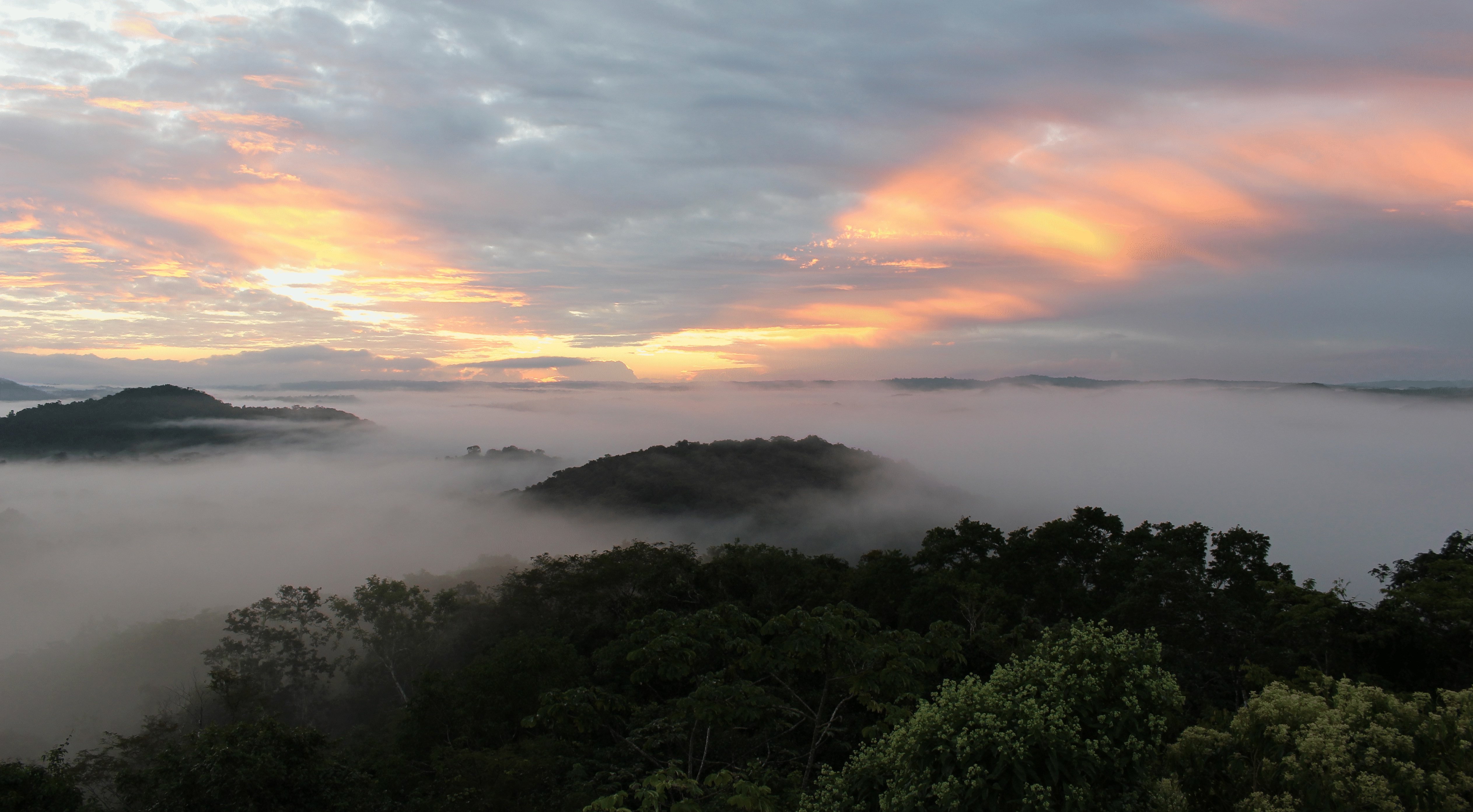
Sunrise in Belize (Photograph by Anna Turbelin)

Sunrise in Belize (Photograph by Anna Turbelin)

Tropical Botany in Belize
by Nick Loughlin

Getting back to the UK after fieldwork is always jarring and this time is certainly no different, the change from 32°C days walking through the savanna and lowland forests of Belize to the -2°C early mornings walking through snow in Milton Keynes is an abrupt transition. I have recently returned from a 2 week field course in tropical botany run by the Royal Botanic Garden Edinburgh (RBGE) in conjunction with their MSc course on the ‘Biodiversity and Taxonomy of Plants’. The field course allowed for 10 NERC funded PhD students in relevant fields to accompany the MSc students out to Belize to learn a host of valuable skills in tropical botany and ecology. During our time in Belize we visited 2 main locations, Las Cuevas Research Station within the Chiquibul forest reserve and the Rio Bravo Conservation and Management Area (RBCMA), in my next two posts I will briefly cover the places we visited and the botany we learned.

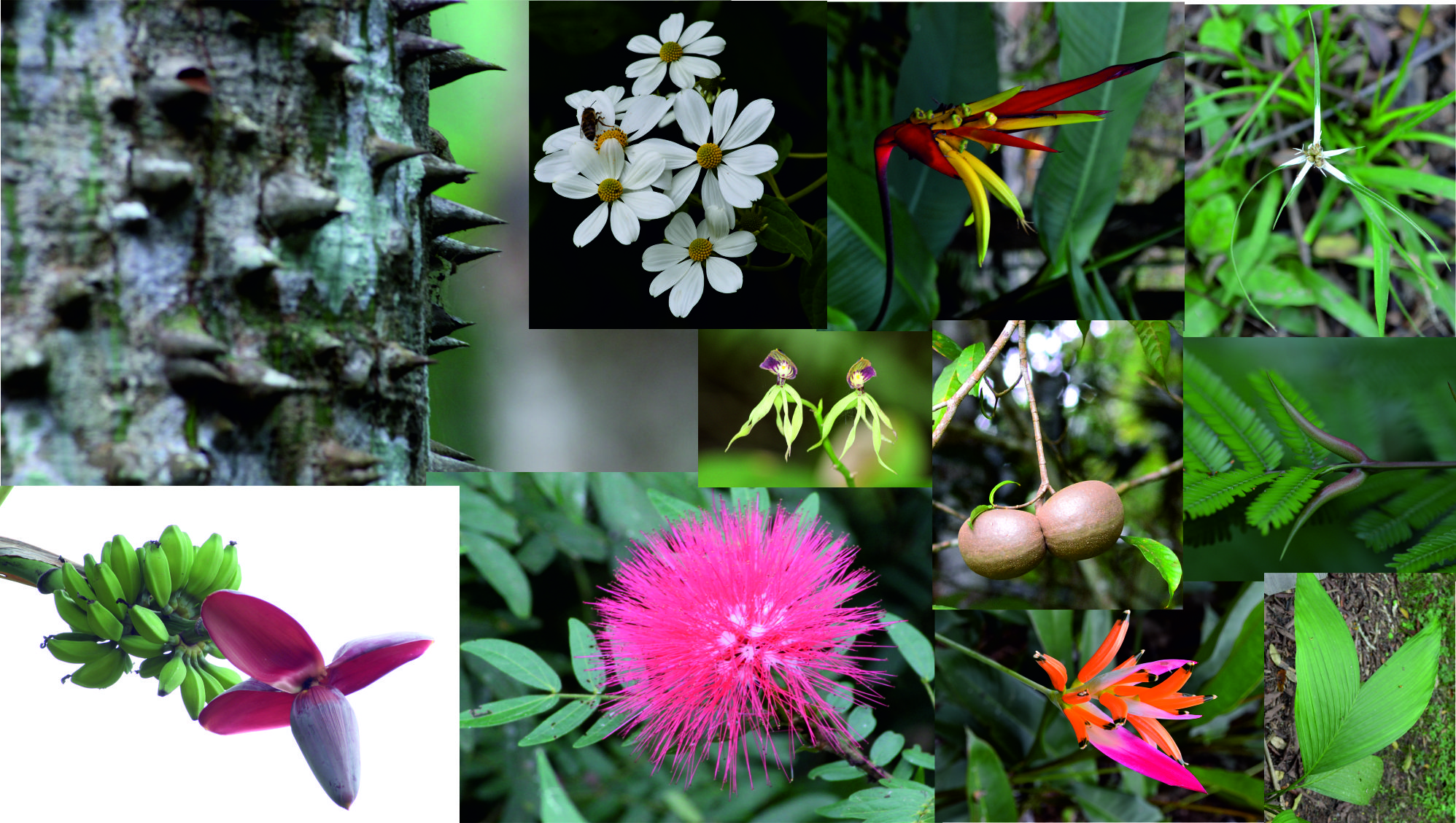
A very small selection of the plants we sampled and identified during the course (Photographs by Anna Turbelin and Nick Loughlin)

A very small selection of the plants we sampled and identified during the course (Photographs by Anna Turbelin and Nick Loughlin)

Before I get going I would just like to thank all of the staff from the RBGE who led the field course, (David, Louis, Tiina, Becky, Chris and Helen) their ability to teach the major characteristics of 70+ tropical families to many of us who are not botanists or taxonomists in an engaging way was astounding, although I don’t believe I will ever be able to identify a Euphorbiaceae from its vegetative characteristics. Also thanks to the students from the MSc course who were great fun, if any of you move away from botany and taxonomy and want more of an idea about the world of tropical palaeoecology, give me a shout.

On our way to see the Mayan ruins at Xunantunich (Photograph by Anna Turbelin)

On our way to see the Mayan ruins at Xunantunich (Photograph by Anna Turbelin)

Blog at WordPress.com.