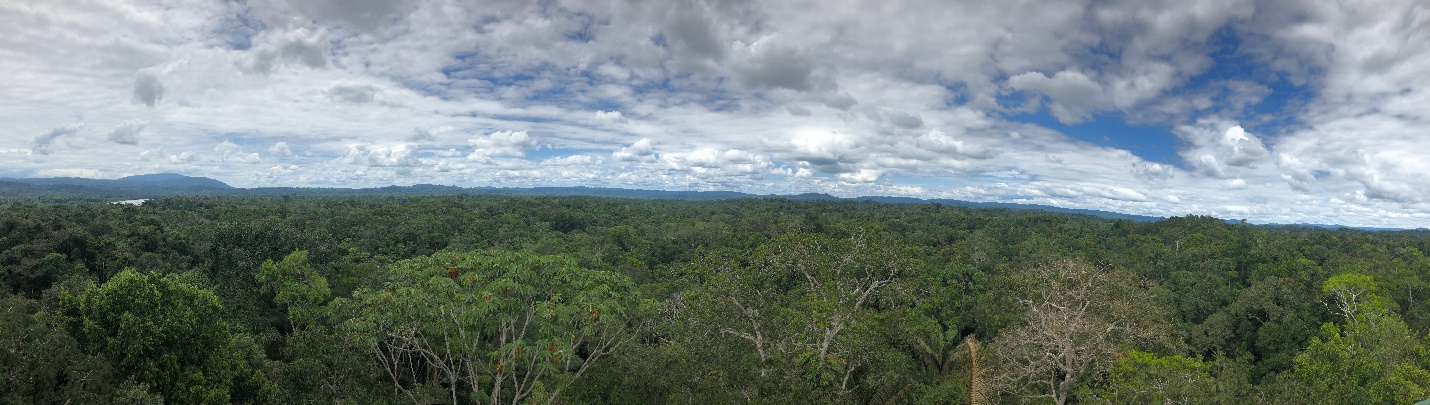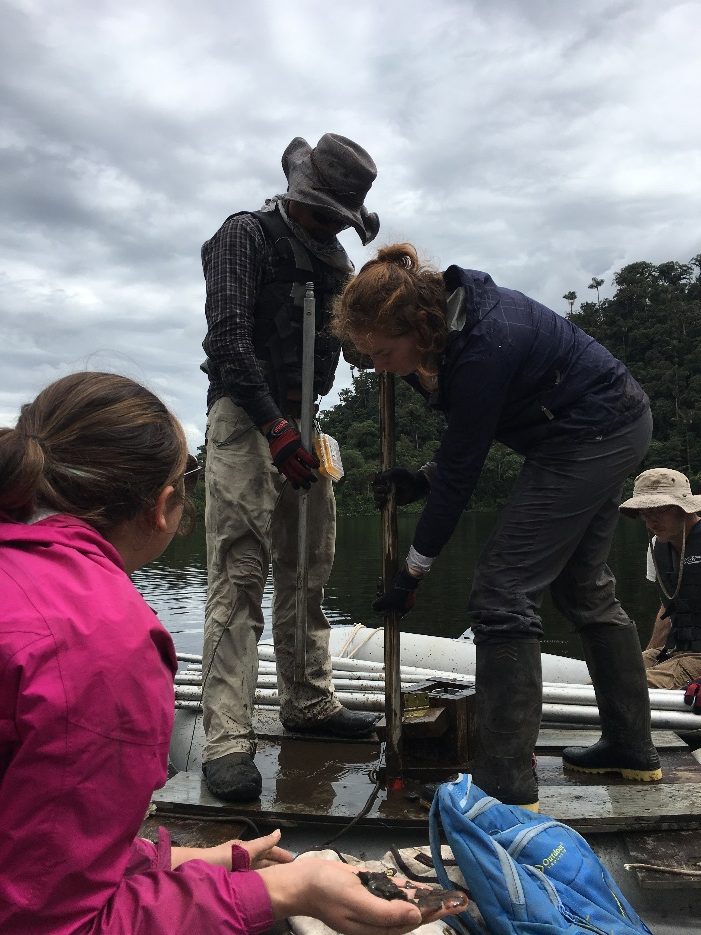
Hello all! You might have been wondering if I died in the middle of Amazonian nowhere, since I haven’t come back to writing a blog after we left for fieldwork in July. Given we were in an Amazonian region full of venomous snakes that could have been the case, but the good news is I just didn’t get around writing it because I got carried away by the findings of my project! We actually had a very successful field trip – apart from some minor issues like the lake swallowing equipment, sinking waist-high into the mud each step of our 7 hour long ‘trail’ to the lakes, and almost not getting my precious samples through airport security.
On Jan 1, 2018 I (Crystal McMichael) get to ring in the New Year in the best way possible by heading off to the tropics to do fieldwork! And this time I get to take two students with me. Britte Heijink and Veerle Vink are both in the Biological Sciences MSc program (Ecology and Evolution track), and they are going to work on research projects that are associated with a recent grant that I was awarded through the Smithsonian Tropical Research Institute CTFS-ForestGEO Research Grants Program.
Veerle examines a cliff exposure during the Palaeoecology course, and has loved microfossils ever since!
Britte (far left) raises her first sediment core during the Palaeoecology course in 2016!
The Llanos de Moxos in Bolivia is an area the size of England that has one of the highest densities of archaeological sites in the Amazon basin. I travelled there for the first time earlier this month for the fourth International Meeting of Amazonian Archaeology. As the airplane crossed from the Andes into the Amazon plains, I could tell this was a very different ‘Amazonia’ compared with the forests that I know from Peru, Ecuador, and western Brazil. The Llanos de Moxos is a seasonally flooded savanna and it was so…open! I immediately realized that the perception of ‘Amazonia’ varies widely among individuals, and I think that is one of the reasons why those of us who study the human history of Amazonia tend to disagree so frequently.
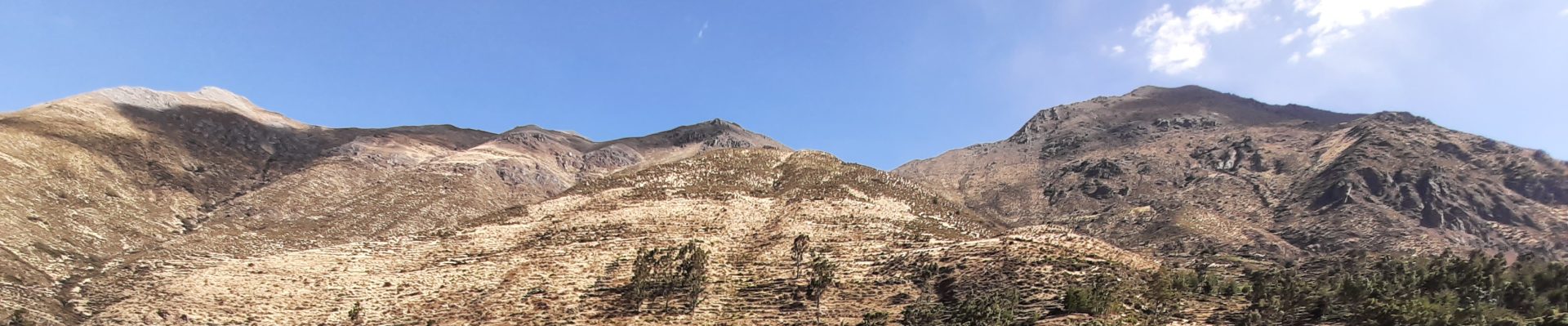
When I first heard about this class in Peru, I had no idea that I was going to experience so much in such a short period. Our goal was to visit two lakes in Peru and raise sediment cores for paleoecology. The first lake that we went to was Laguna Huayabamba, which sits at about 3250 m elevation in the La Libertad region of the Peruvian Andes.
However, getting to this lake was no easy task. Before the hike even started, we had to obtain the necessary permits and permission from the local people. After several days of visiting different town officials and waiting for approval, we could set out on our adventure.
IBEDs Crystal McMichael hard at work sampling sediments in the Andes
Insights into recent field work in Ecuador by a team lead by Crystal McMichael can be found in a recent blog from our collaborators at the Instituto Geofisico, Escuela Politecnica Nacional, Quito (Ecuador).
Last week I took part in my first “palynologendagen” (pollen days) with the Palynologische Kring (Dutch palynology society). Unfortunately, due to a prior commitment (Chairing a British Ecological Society careers webinar) I was only able to take part on the second day.
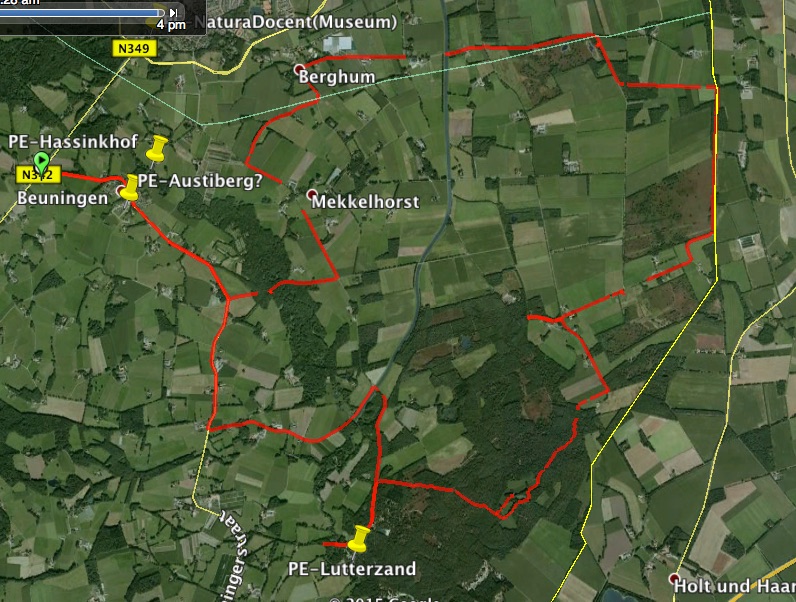
Day two of the pollen days was “op de fiets” (on bikes) in true Dutch style. We met at Twente Fiets to pick up 36 bicycles and one tandem and headed out into the countryside!
Figure 1: Route of the bicycle tour (max speed 21.8 kmph, distance 23.24 km)
Our route (Fig. 1) took in around 14 point of interest. At each point Harm provided interesting insights into the landscape history and how humans had interacted and shaped it. The presentations were in Dutch so I had to concentrate hard to get 50% of the information.
Two particularly nice sites (which I think I understood) were:
the site of an old toll house at the split in the old road to Germany (east) and Scandinavia (north), and
a sedimentary cross section, revealed by river down cutting, which showed the impact of cart wheels on the sediment along the site of an old road.
In addition to the tour it was also fantastic to meet many other fellow palynologists based in the Netherlands. I looking forward to being able to participate in many future Palynologische Kring events, and I am also pleased to say attending this years event has inspired me again to try and push on with learning Dutch again!
The month-long palaeoecology module at UvA is coming to an end. We have had two weeks of lectures and microscope work, an introduction to quantitative palaeoecology, and we just finished a week of fieldwork in Twente, which is in the easternmost part of the Netherlands.
Students working in the field (photo: M. Groot)
Will Gosling and I tried something new for the field excursion this year. We split the class into eight groups, and gave each group a set of pollen and phytolith samples from an ‘unknown location’. Unknown in this context means being from one of the eight primary sites that we would visit during the field excursion. The students were required to perform vegetation surveys and characterize soils at each of the primary sites that we visited. The goal of each group was to figure out which location their set of ‘unknown’ samples came from. Basically, we had them doing forensic palynology, with idea that they could then better visualize the different vegetation assemblages seen in the palaeoecological records. Continue Reading