Palynologishe Kring: Seminar day (May 2022)

June 15, 2022
WDG

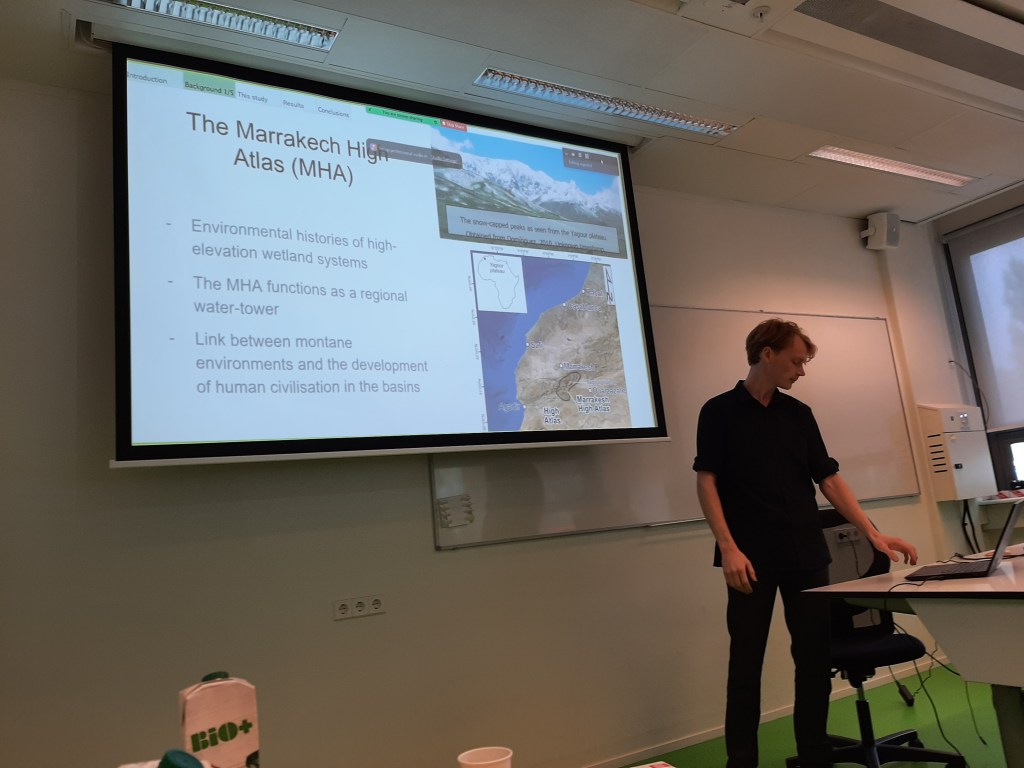
On the 19 May the Palynologische Kring (Dutch palynological society) held a hybrid seminar meeting under the theme “Dutch palynologists then and now”.

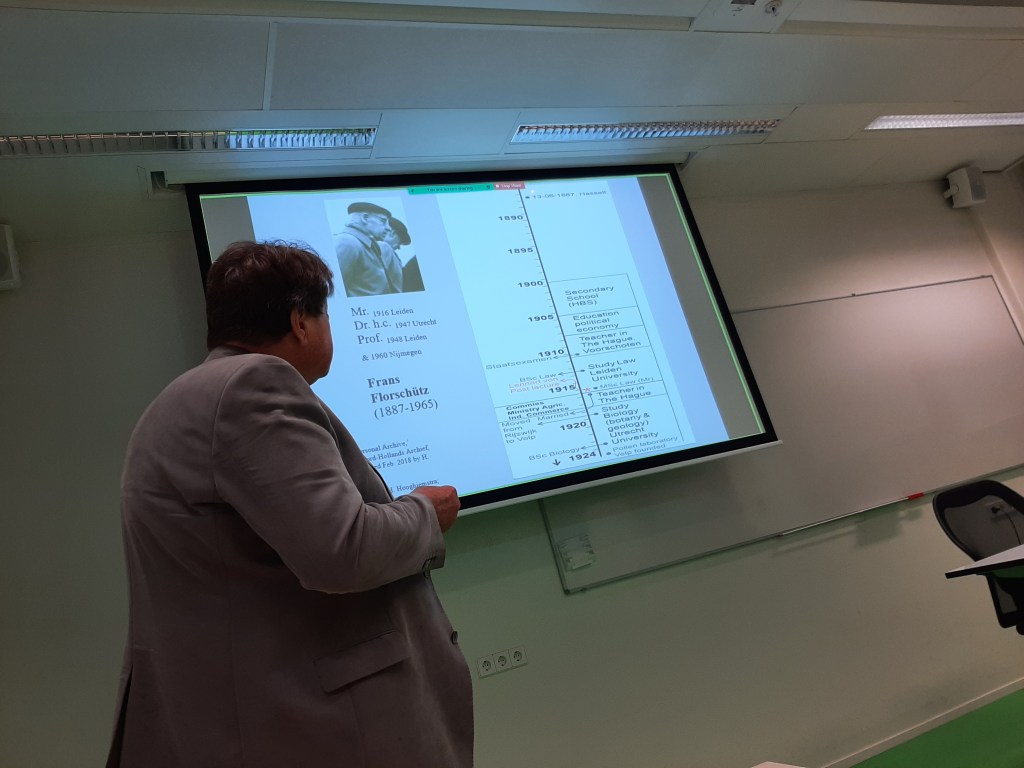
The meeting was opened by Prof. dr. Henry Hooghiemstra (University of Amsterdam) who focused on the “then” and presented a biopic of pioneering Dutch palynologist Frans Florschütz. Florschütz became one of the major figures in establishing palynology within the Netherlands during the 1900s. Originally, he studied political economy and law, but went on to become the Secretary to the Board of Governors of the Agricultural School in Wageningen. From his position in Wageningen Florschütz had a base to develop his interests in palynology and past environmental change. He started work on the seminar work “Nederland in Ijstijd” (The Netherlands in the Ice Age) in 1939 and it was published in 1950. During his career Florschütz also held positions at Utrecht University (obtaining his doctorate), University of Leiden (endowed chair, until 1958) and University of Nijmegen (post retirement). Click here for further information on Frans Florschütz visit.

The second part of the meeting focused on the “now” with presentations form three Dutch researchers engaged in research abroad. First up with Eric de Boer (Universidad de Granada, Spain), then Thya van den Berg (University of Hull, UK), and finally Henk Cornelissen (University of Manchester, UK). Eric presented new data on the human and climate impacts on the Iberian Peninsula. Thya presented her work in two parts focused on the new datasets on past environmental change from Yorkshire (UK) and then the development of modelling approached to estimate landscape cover on the basis of pollen datasets. Henk took us to the high atlas of Morocco and showed how pollen and chemical data can be integrated to reveal past human presence and impacts.

The next scheduled event will be in the annual excursion which this year will be to Leiden. For further details and to find out more about the Palynologische Kring visit the web pages here.

Video: Sediment coring in South Africa

January 21, 2022
WDG

New sediment coring videos from Lynne Quick and her team at Nelson Mandela University. Find out more about their work on Twitter (@The_Palaeolab) and on their Palaeoecology Lab web pages.

Nelson Mandela University’s Palaeoecology Research Group: Sediment coring fieldwork campaign to the Zuurberg Mountains, Eastern Cape, September 2021. Enjoy…

Mapping Ancient Africa: Video of seminar 3

January 18, 2022
WDG

The third of a seminars in the Mapping Ancient African project took place on Monday 17 January 2022 and was given by Emmanuel Ndiema (National Museums of Kenya). You can watch the seminar now on the Ecology of the Past YouTube channel. Seminar details can be found here.

INQUAlogo

Scientific Archaeology 2021

November 13, 2021
WDG

The Science in Archaeology 2 course, run as part of the minor in “Archaeology Today” by the Amsterdam Centre for Ancient Studies and Archaeology (ACASA), is currently underway. This year I have again contributed to this course with a weeks worth of activity related to detecting past human impacts. During this week we have focused on what sorts of evidence contained within the sedimentary record can be used to track human actions. We focused in particular on the manipulation of fire regimes and the the abundance of animals in landscapes (i.e. extinctions vs. introductions of domestic species). To illustrate how past human activities can be detected in landscapes I tapped into some recent publications I have been involved with (eastern Andean flank, Samoa and Mauritius) and the students selected papers in line with their own focus to discuss. Here is what they came up with…

Continue Reading

Mapping Ancient Africa: Report of kick off meeting

October 22, 2021
WDG

INQUAlogo

The kick off meeting of the INQUA funded Mapping Ancient Africa project took place on the 14 and 15 October 2021. This hybrid meeting linked up face-to-face meetings in Kenya, South Africa, Germany and the USA online. In total around 35 people participated in the meeting over the two days. It was great to start to get researchers back into rooms together, and to take advantage of the online link ups to connect people within regions who could not travel, and people in different continents. The purpose of the meeting was to introduce the researchers to each other and to start to think about how we can work together to deliver the project goals of collating and synthesising data related to past climate, vegetation and hominin activity from across the continent.

Continue Reading

Scientific Archaeology 2020

November 20, 2020
WDG

This year my contribution to the Science in Archaeology course (VU Amsterdam) was done online due to the COVID-19 restrictions. The course comprised live online lectures, pre-recorded video clips and case study discussions. The focus was how to detect past human impacts on the landscape and we explored many proxies including: charcoal, diatoms, egg shells, non-pollen palynomorphs, phytoliths, and pollen. In the final session of the humans impacts section of the course each student presented a case study paper that they had chosen. Here is what they chose:

Continue Reading

Keep on pollen sniffing

May 5, 2020
WDG

By Cas Verbeek (University of Amsterdam)

Luckily, in spite of these trying times, we are allowed to continue our research in Amsterdam and on the Veluwe to determine the effects of air pollution on airborne pollen grains. Unfortunately for us (but generally perhaps one of the few silver linings of this situation), the COVID-19 lockdown has largely eliminated our main variable of interest; air pollution.

With traffic in the city at a minimum, any chemical differences might not be as pronounced between the city and rural areas. However, this may actually provide us with a unique opportunity to get a baseline of the pollen chemistry in Amsterdam with relatively little pollution. This baseline may also be of interest to projects working on urban air quality and greenifying urban spaces, such as the projects in the Amsterdam Knowledge Mile Park, which is included amongst our sampling locations.

This slideshow requires JavaScript.

For more about our project on pollen and pollution in the Netherlands see other posts:

Pollen in the Netherlands

April 21, 2020
WDG

By Letty de Weger (Leiden University Medical Centrum)

In the coming weeks lots of pollen can be collected. Due to the nice, sunny weather birch trees are in full flower and release their pollen into the air.  This is of course not so good news for the individuals sensitized to the pollen of birch because they can suffer from hay fever symptoms.

Next to birch also the ash trees are flowering. The black buds of the ash branches have bursted, releasing the purple anthers (first figure). Among those anthers you can see some that release their yellow pollen  (second figure).

For more about our project on pollen and pollution in the Netherlands see other posts:

Blog at WordPress.com.