Paleoecology course University of Amsterdam

September 29, 2014
Valerie

Students examining a sediment core extracted with a Russian corer

Students examining a sediment core extracted with a Russian corer

Last week, Will – our new associate professor at the University of Amsterdam – joined us on the field residential module of the undergraduate “Paleoecology” course; 7 days exploring the sediments and vegetation of the Twente region of the Netherlands. The experience provided Will with a lot of information on Dutch language, landscapes, and students; which should be useful to him next year as he will be coordinating the course!

Students examining peat exposures.

Students examining peat exposures.

During this very intensive (4-week) paleoecology course, students get background lectures in past environmental change, learn to identify microfossils in the laboratory (pollen and chironomids), and go on the excursion to experience fieldwork. The field module involves excursions during the day, when students have to identify plant species indicative of different vegetation types in relation to soil nutrient availability and moisture content. The evenings are reserved for the students own paleoecological research investigation; this year students were reconstructing the vegetation history and climate change during the late-glacial from a lake sediment core from Germany. Once data collection was completed the students had to interpret the pollen assemblages they found using the knowledge of modern day ecosystems they gained throughout the week. On the final evening they presented their work to the whole group. The final results they achieved were quite impressive.

Students presenting findings from the days work

Students presenting findings from the days work

I am very curious as to what the course will be like next year, led by Will, and how he will tweak and turn it to his liking.


Debating the Vera hypothesis
Debating the Vera hypothesis


Teaching in the field: Foundations, feedback and fun

September 16, 2014
WDG

My final teaching job for The Open University was to help deliver the “Sedimentary Rocks & Fossils in the Field” section of the Level 2 Practical Science module (SXG288) offered by the Science Faculty. I have been involved in all three presentations of this section of the SXG288 module, which will now cease to be offered, and a number of other Earth and environmental science residential schools over the last 9 years.

Showing students the rocksHaving the opportunity to engage directly with students and enthuse them face-to-face about the subject I specialise in is a privilege I have gained a lot from. Furthermore, my over-riding impression from the students I have taught is that they feel they benefit greatly from the opportunity to explore first hand the concepts and subjects which they have previously studied in books and online. Based on my experiences on “Sedimentary Rocks and Fossils”, and other modules as both a tutor and a student, I am convinced that to effectively teach geological, geographical, environmental and ecological subjects effectively an element of field-based teaching is required.

Continue Reading

Sedimentary Rocks and Fossils in the Field

July 31, 2013
WDG


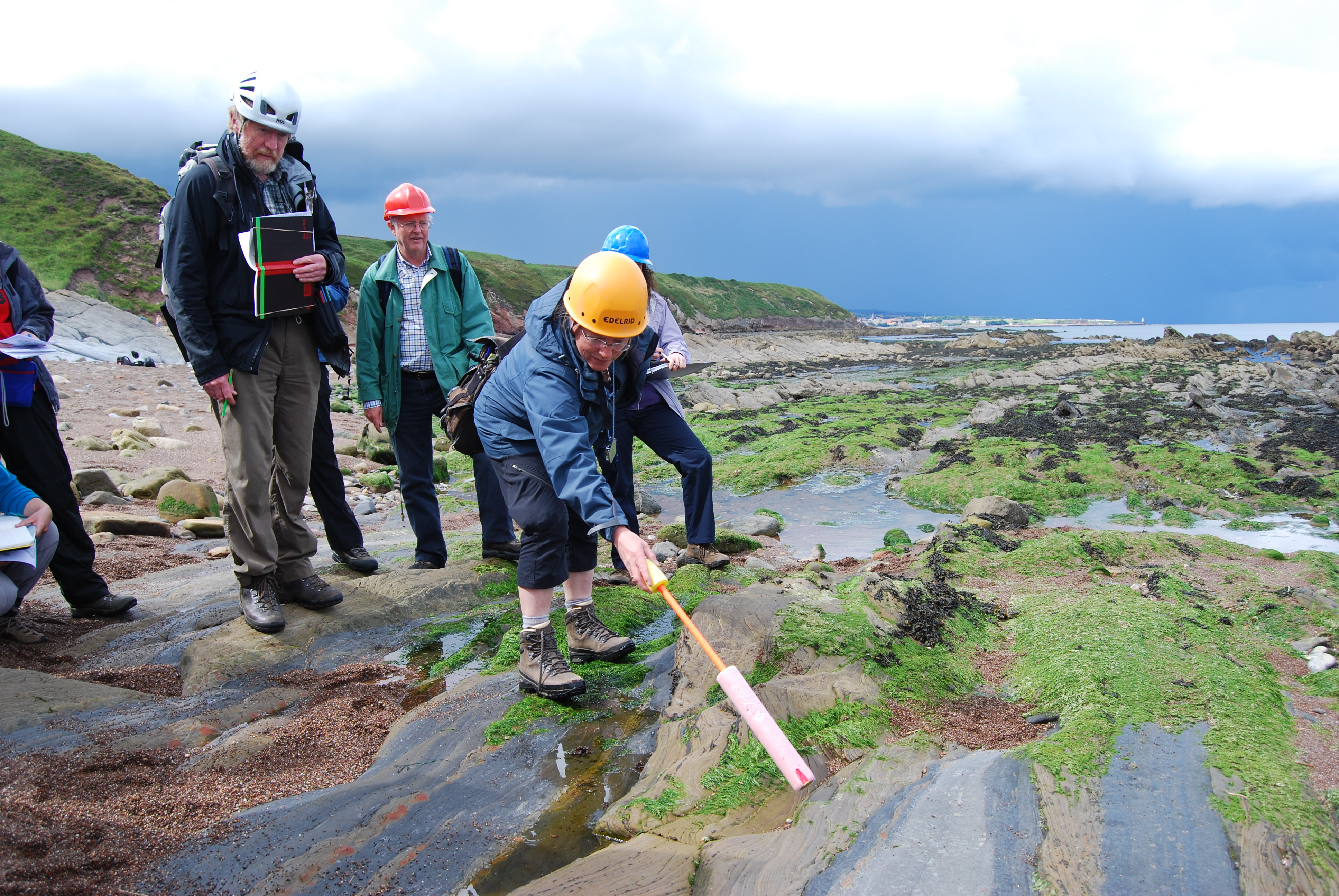
Students examining the sedimentary deposits at Howick Haven

Students examining the sedimentary deposits at Howick Haven

SXG288 Practical science: Earth and environment
Sedimentary Rocks & Fossils in the Field
23-29 July 2013

Face-to-face teaching of practical skills in field geology is one of the most interesting and rewarding aspects of being a lecturer at The Open University. Over the last few days I have been lucky enough to participate in the running of the Sedimentary Rocks & Fossils in the Field topic within our second level Practical Science module (SXG288). This is one of two opportunities that students taking this module get to head into field, examine rocks, develop observational skills and test scientifc hypotheses; the other field based topic is Igneous & Metamorphic Rocks in the Field.

Sedimentary Rocks & Fossils is based from Longridge Towers School in Northumberland (whilst the regular students are away). Longridge provides the ideal base for this topic because of its close proximity to some world class sedimentary rock and fossil exposures. Over an intensive three day field experience students examine sedimentary deposits from the Silurian and Carboniferous exposed mainly along the Northumberland coast; however, this is not a simple guide to the geology of the region. The topic is founded on the principle of problem based learning and at each field location students are expected to make observations, record them accurately and interpret the past environment. Findings are consolidated and dicussed during evening lab sessions.

On the rocks at Scremerston

On the rocks at Scremerston

This year we were delighted to welcome >40 students, some of who flew in from abroad, to study this topic over two sessions. Given the positive feeback recieved so far I think all enjoyed the topic and gained important geological field skills (for evidence of this also see photos below). I wish them all luck in their future studies and hope that they continue to be interested in Earth Science and progress towards our Natural Science degree qualification.

For further photos see below, follow #SXG288 on twitter, or visit the SXG288 Facebook page.

  Continue Reading

Blog at WordPress.com.