Zhang, Y., van Geel, B., Gosling, W.D., McMichael, C.N.H., Jansen, B., Absalah, S., Sun, G. & Wu, X. (2019) Local vegetation patterns of a Neolithic environment at the site of Tianluoshan, China, based on coprolite analysis. Review of Palaeobotany and Palynology 271, 104101. DOI: 10.1016/j.revpalbo.2019.104101
Teunissen van Manen, M., Jansen, B., Cuesta, F., León-Yánez, S. & Gosling, W.D. (2019) Leaf wax n-alkane patterns of six tropical montane tree species show species-specific environmental response. Ecology and Evolution. DOI: 10.1002/ece3.5458
By Rachel Sales (Florida Institute of Technology, USA)
My bike is angry at me.
I’m rattling down an unpaved road in the Ecuadorian Amazon. The brakes screech at every turn, and the chain is close to falling off. Unsurprisingly, the rain is pouring, turning the road into a maze of puddles and mud. The road follows the Anzu River, and I can hear its roar off to my right.
I’m forcing a perfectly innocent bike to brave the Amazon because this road leads to the Herbario Amazónico of the Universidad Estatal Amazónica (ECUAMZ). ECUAMZ (an acronym for “Ecuador Amazon”) is the only herbarium in the Amazon, and contains a repository of plant specimens for preservation and help with field identifications. It was established by Dr. David Neill, a specialist in the Fabaceae (legume) family and world-renowned expert in tropical botany, and Dr. Mercedes Asanza, the coordinator of the herbarium. They have agreed to mentor me over the summer and teach me about tropical plants. The Herbario Amazónico, which contains over 17,000 vascular plant species, is the perfect place to learn.
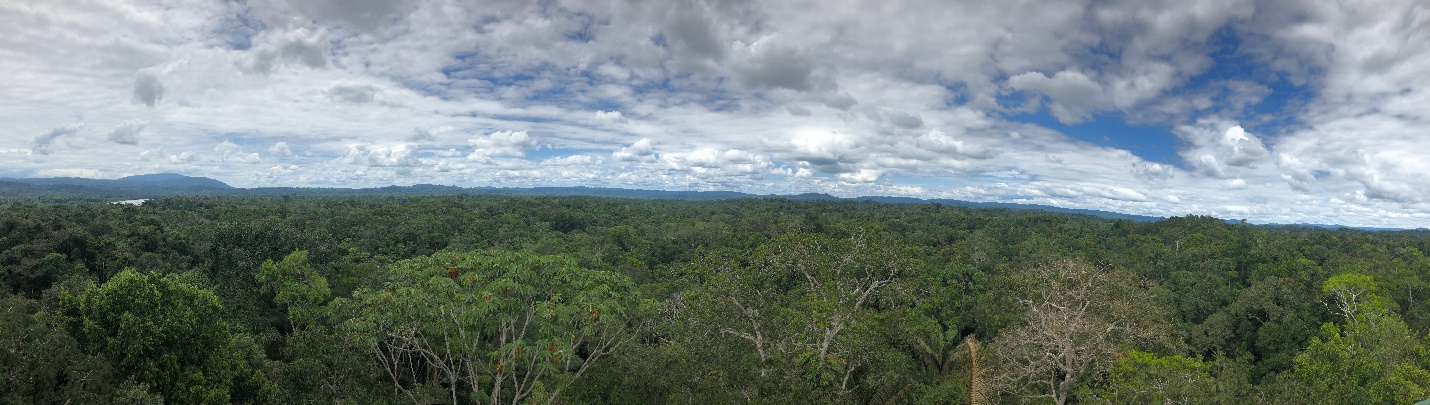
The view from the top of the tower at Jatun Sacha.
IBED is looking for an Earth scientist/ecologist with expertise and interest in soil carbon cycling, in relation to the role of soil microbial communities therein to support ongoing work within the Department of Ecosystem & Landscape Dynamics (ELD). We are particularly looking for a researcher with an international track record with expertise in one, or more, of the following areas:
Interactions between organic carbon and the mineral soil.
Microbe-organic C interactions.
Molecular and computational approaches for analysing soil microbial communities and their functionality.
Scaling of soil carbon cycling processes from microbe to globe.
Linking global carbon cycle models and laboratory experiments.
This is one of two positions currently open in Earth Systems Science within ELD. The other position is related to Environmental Chemistry and we will be looking at complimentary between the two appointments.
For further details and information on how to apply click here.
IBED is looking for an environmental chemist/environmental scientist experienced in studying sources, transport, transformation and degradation and fate of chemicals in ecosystems to support ongoing work within the Department of Ecosystem & Landscape Dynamics (ELD), and create links with the Department of Freshwater & Marine Ecology. We are particularly looking for a researcher with an international track record with expertise in one, or more, of the following areas:
The fate and effects of organic contaminants of emerging concern in the environment.
The mitigation of environmental pollution.
Environmental policy and circular economy.
Regional and larger-scale systems analysis of human impacts on the environment.
This is one of two positions currently open in Earth Systems Science within ELD. The other position is related to Soil Carbon Cycling and we will be looking at complimentary between the two appointments.
For further details and information on how to apply click here.
There is a 18 month post-doctoral research position within the Department of Theoretical & Computational Ecology at IBED focused on Global Ecology, we are looking for someone with skills and experience the following areas:
PhD in ecology, biodiversity or a related discipline
quantitative skills and statistical analyses
species distribution modelling
analyses of species composition, functional traits and species interactions
Zhang, Y., van Geel, B., Gosling, W.D., Sun, G., Qin, L. & Wu, X. (2019) Typha as a wetland food resource: evidence from the Tianluoshan site, Lower Yangtze Region, China. Vegetation History and Archaeobotany. DOI: 10.1007/s00334-019-00735-4
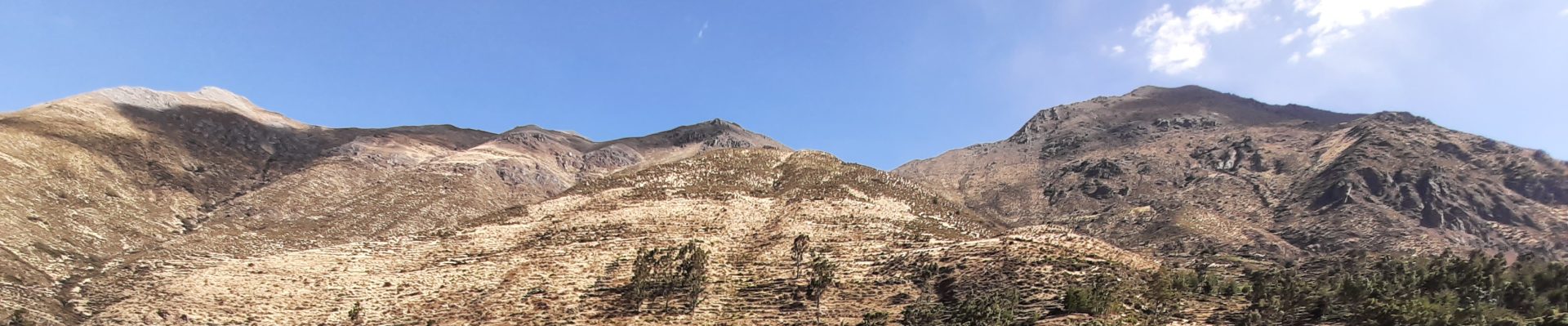
Vegetation responses to late Holocene climate changes in an Andean forest By Klaas Land (currently studying MSc Biological Sciences (Ecology & Evolution) at the University of Amsterdam.
The discussion during the APC meeting on the 19th of March was on the paper by Schiferl et al. (2018), a very recent study on the climatic shifts in the late Holocene and their effects on the South American tropics. The study had analysed a core going back about 3800 years from Lake Palotoa, which was in the Andean foothills (1370m elevation). They found that subtle changes to the fossil pollen record could be identified around the estimated periods for the Little Ice Age (LIA) and Medieval Climate Anomaly (MCA). The focus in the paper Continue Reading
 Zhang, Y., van Geel, B., Gosling, W.D., McMichael, C.N.H., Jansen, B., Absalah, S., Sun, G. & Wu, X. (2019) Local vegetation patterns of a Neolithic environment at the site of Tianluoshan, China, based on coprolite analysis. Review of Palaeobotany and Palynology 271, 104101. DOI: 10.1016/j.revpalbo.2019.104101



 Ecology of the past