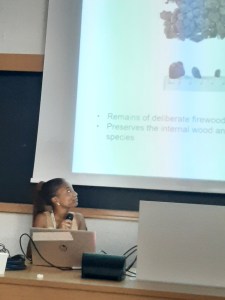
The second part of the Mapping Ancient Africa session at the INQUA Rome congress contained eight talks. Busisiwe Hlophe (University of the Witwatersrand) kicked us off by showing us the power of looking at wood anatomy preserved in charcoal microfossils to determine the nature of past vegetation and climate. RahabKinyanjui (National Museums of Kenya) presented phytolith work from archaeological sites revealing a mixed woody and grassy vegetation associated with archaic Homo sapiens in Kenya.
Three talks from the Cape Region in South Africa then followed with Saul Manzano (University of Leon), StellaMoscher (University of Utah), and Asithandile Ntsondwa (Nelson Mandela University) using various palaeo ecological approaches to explore climate, vegetation and fire regime shifts during the Holocene. Adele Julier (University of Portsmouth) then took us a little further north to Namibia to think about the challenges of parameterising modern pollen-vegetation relationships in arid regions. The final southern African talk was given by Gemma Poretti (University of Cape Town) explored a new approache to tracking change in past rainfall patterns using charcoal material.
Every picture tells a story. This one is a snapshot I took of Dan Livingstone’s African palaeolimnology group in June1984, when I spent a few months at Duke University, North Carolina, at Dan’s invitation. I had started work on the pollen analysis of a Holocene core from Cameroon that I’d collected in 1981 and Dan was keen to help me as far as possible. He was making plans for his lake coring projects a few years later in Cameroon (Barombi Mbo).
Back row (L-R) is me (Keith Richards age 24), Margaret Adebisi Sowunmi, Alice Tucker, Lida Burney, George Kling and Dan Livingstone. Front row (L-R) is David Burney, Wendy Watson, Susan Gerbeth-Jones and Patricia G. Palmer.Continue Reading
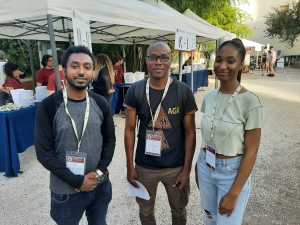
Mapping Ancient Africa participants at the INQUA Rome ice breaker event ready for action! Left to right: Bahru Zinaye Asegahegn, Alfred Houngnon, Busisiwe Hlophe.
The Mapping Ancient Africa (MAA) project has a double session of talks and a poster session at the INQUA congress in Rome 2023. Our session will be on Wednesday 19 July. Unfortunately a number of the originally planned speakers could not make it to Rome due to a combination of not obtaining visas, logistical challenges and ill health. We wish them all well and hope that they will continue to be involved in the project. Further, many thanks to all those who have agreed to step up and give a presentation at a late notice. Below is an updated schedule correct as of Sunday 16 July based on the information contained on the INQUA Rome App; if you are aware of any further problems or changes please let me know ASAP!
Giosan et al. When the desert was a lake: Providing context for Homo sapiens development in the northern Kalahari
Chase et al. Paleolakes and socioecological implications of glacial “greening” of the South African interior
Blinkhorn et al. Evaluating refugia in recent human evolution in Africa
Aureli et al. Homo sapiens behaviour and adaptation in East Africa. New evidence from an open-air site in a modern Ethiopian savannah environment: the GOT10 site
Effiom et al. Late Holocene palaeoecological studies at Lake St Lucia, KwaZulu-Natal
Tallavaara et al. Pan-African Climate and Vegetation over the Quaternary and Implications for Human Distribution
Quick et al. Palaeoenvironments of the Cape Floristic Region: New research & current developments
The Mapping Ancient Africa (MAA) project has a double session of talks and a poster session at the INQUA congress in Rome 2023. Our session will be on Wednesday 19 July.
Giosan et al. When the desert was a lake: Providing context for Homo sapiens development in the northern Kalahari
Chase et al. Paleolakes and socioecological implications of glacial “greening” of the South African interior
Biddulph et al. Spatiotemporal variability in the initiation and development of peatlands across the central Congo Basin
Blinkhorn et al. Evaluating refugia in recent human evolution in Africa
Aureli et al. Homo sapiens behaviour and adaptation in East Africa. New evidence from an open-air site in a modern Ethiopian savannah environment: the GOT10 site
Dembele Climatic fluctuations during the last millenium and their impact on political history and human settlements in West Africa
Porchier et al. Annually resolved hydroclimate variability in the East African Rift Valley at a time critical for hominin dispersion
Effiom et al. Late Holocene palaeoecological studies at Lake St Lucia, KwaZulu-Natal
The Mapping Ancient Africa (MAA) workshop in Rome will take place on the 12 and 13 July 2023. The workshop supported by International Union for Quaternary Research (INQUA) and hosted by the Royal Netherlands Institute in Rome. During the workshop we will be working towards aims of the MAA project to strengthen the research community of Quaternary scientists working across Africa, and to further our scientific goals of understanding past climate change. To achieve this we will work collaboratively to:
simulate past climate change in Africa,
develop the proposed Special Issue of Quaternary International, and
plan the next steps for the MAA project.
Twenty-seven people are registered for the workshop and we look forward to seeing them in Rome. If you are not registered for the workshop but still want to participate this is possible. On the 13 July between 15:00 and 18:00 CEST the workshop sessions will be online via Zoom. To obtain the Zoom link either visit the MAA Slack channel, or contact William Gosling. During the online part of the meeting we will present the outputs from the palaeoclimate mapping activity, the plans for the special issue, and outline the ideas future of MAA. Feedback from the wider MAA community will be very welcome.
The thirteenth Mapping Ancient Africa seminar was delivered by Andrea Manica on the 18th May 2023. In the seminar Andrea introduced the pastclim R package and gave examples of how it can be applied to address questions related to human evolution and dispersal.
Related publication: Leonardi, M., Hallett, E.Y., Beyer, R., Krapp, M. & Manica, A. (2023) pastclim 1.2: an R package to easily access and use paleoclimatic reconstructions. Ecography 2023, e06481. DOI: 10.1111/ecog.06481
The seminar will be delivered via Zoom. The link for the seminar can be obtained from the MAA Slack channel or by contacting the chair of this seminar (William Gosling). If you want to know more about the Mapping Ancient Africa project visit our web pages and please do not hesitate to get in contact if you want to get involved.
Ondrej Mottl and Suzette Flantua will be presenting an African Pollen Database (APD) practical tutorial about working with paleoecological data in R ! Please join us Wed, April 26 at 9am EDT (time zone converter). Please email sji15@psu.edu for the zoom link and instructions.
At this workshop, you will learn to use the new Ratepol package (info here and here):
search for APD sites from Neotoma in R
begin making age models
calculate rates of change for vegetation from pollen records
For more information, check out the schedule below and see past workshops here.
Having recently traveled to South Africa as part of the Landscape Dynamics field course run by our graduate school, and to be thinking again about trying to obtain funding to further research in Africa, I thought it might be fun to turn to the journals in which I have an editorial hand (Plant Ecology & Diversity, Vegetation History & Archaeobotany, and The Holocene) and see what new work was coming out on African ecosystem dynamics. From each of these journals I have selected two recent papers to highlight here.
The papers come from across the continent and all have a component of the ecology of the past, but they range in focus from developing methods to extract new insights about past ecological change (Le Moyne et al., 2023) through to the application of our understanding of past ecosystems to the management of conservation areas (Wilkinson et al., 2022).
The study by Le Moyne et al. (2023) examined modern reference material of nine grass species to determine how they might be better identified in the archaeological and palaeoecological record from the phytoliths they produce. Three of the studies use different lines of evidence of past ecological dynamics to explore change over the last few thousands of years.
Champion et al. (2023) shed light on past agricultural practices in western Africa (Nigeria) through the examination of macro-botanical evidence from 50 archaeological sites and dating back c. 3500 years, hypothesizing a new route for the spread of pearl millet out of the central Sahara into the central Nigerian savannahs.
Prader et al. (2023) present a c. 4000 year geochemical, palynological and and charcoal record from Table Mountain National Park in South Africa, showing changes in the abundance of fynbos and forest plants and how this was modified by people.
Hildebrand et al. (2022) collated multiple lines of evidence of past environmental change from eastern Africa to assess changes in human activity during and after the African Humid Period (15,000-5000 years ago), highlighting the complex relationship between changes in human resource acquisition practice (fishing, hunting, gathering, and pastoralism) and environmental change.
The longest timescale perspective is provided by Milton et al. (2022) who investigated plant speciation in the Namib Desert. They combined a phylogenetic, morphometric and experimental genetic approaches to explore the evolutionary history of Senecio flavus and S. engerianus and produce palaeo-distribution models. From these data they suggest that the wider ranged species (S. flavus) is in fact derived from the smaller ranged parent (S. engerianus) and that this separation was caused by aridification during the Pleistocene.
The final paper, Wilkinson et al. (2022), take evidence for past abundances of elephants and compare them with the abundances in national parks today. They argue that modern elephant densities in national parks could be higher than the historical levels and that this could be detrimental to the flora and other fauna in the parks.
The African Pollen Database community is hosting a series of workshops including practical data tutorials and discussions to help paleoecologists working in Africa integrate these data into research and teaching.
Our theme for Spring 2023 is “using R to understand African paleoecology”, and the schedule is posted here.
Our first workshop will be February 22 at 9am EST. Chris Kiahtipes will be provided a guided tutorial that can be followed live to help you use R and RMarkdown to develop reproducible research workflows for pollen data. This will be ~1 hour. Please register in advance by emailing Chris (chris.kiahtipes@gmail.com) to receive the zoom link and a guide to setup your workspace ahead of the workshop.
To see our launch meeting from February 8 that includes a tour of the African Pollen Database on the Neotoma Paleoecology Database, watch this video.








 Ecology of the past