Kirschner, J.* & Hoorn, C. (2019) The onset of grasses in the Amazon drainage basin, evidence from the fossil record Frontiers of BiogeographyDOI:10.21425/F5FBG44827
Gomes, V.H.F., Mayle, F.E., Gosling, W.D., Vieira, I.C.G., Salomão, R.P. & ter Steege, H. (2020) Modelling the distribution of Amazonian tree species in response to long-term climate change during the Mid-Late Holocene. Journal of Biogeography DOI: 10.1111/jbi.13833
14:10-14:30: Characterization of phytoliths in mid-elevation Andean forestsSeringe Huisman (University of Amsterdam/Treub grant awardee)
14:30 –14:50: Extinction-driven changes in frugivore communities on tropical islands: worldwide and in MauritiusJulia Heinen (University of Copenhagen, Denmark)
14:50 – 15:10: Are the current Amazonian fires unprecedented?Crystal N.H. McMichael (University of Amsterdam)
15:10 – 15:30: On the relationship between tiger conservation and water managementJasper Griffioen, Hanne Berghuis & Ewa van Kooten (Utrecht University)
15:30-16:00: TEA
16:00 – 16:45: Assembling the diverse rain forest flora of SE Asia by evaluating the fossil and molecular record in relation to plate tectonicsRobert J. Morley (Palynova, and Southeast Asia Research Group, Royal Holloway University of London, UK)
The three part guest blog posts “Can you go back?” by Prof. Mark Bush (Florida Institute of Technology) contained images collated by Mark over his career, here they are all together for you to enjoy.
By Rachel Sales (Florida Institute of Technology, USA)
My bike is angry at me.
I’m rattling down an unpaved road in the Ecuadorian Amazon. The brakes screech at every turn, and the chain is close to falling off. Unsurprisingly, the rain is pouring, turning the road into a maze of puddles and mud. The road follows the Anzu River, and I can hear its roar off to my right.
I’m forcing a perfectly innocent bike to brave the Amazon because this road leads to the Herbario Amazónico of the Universidad Estatal Amazónica (ECUAMZ). ECUAMZ (an acronym for “Ecuador Amazon”) is the only herbarium in the Amazon, and contains a repository of plant specimens for preservation and help with field identifications. It was established by Dr. David Neill, a specialist in the Fabaceae (legume) family and world-renowned expert in tropical botany, and Dr. Mercedes Asanza, the coordinator of the herbarium. They have agreed to mentor me over the summer and teach me about tropical plants. The Herbario Amazónico, which contains over 17,000 vascular plant species, is the perfect place to learn.
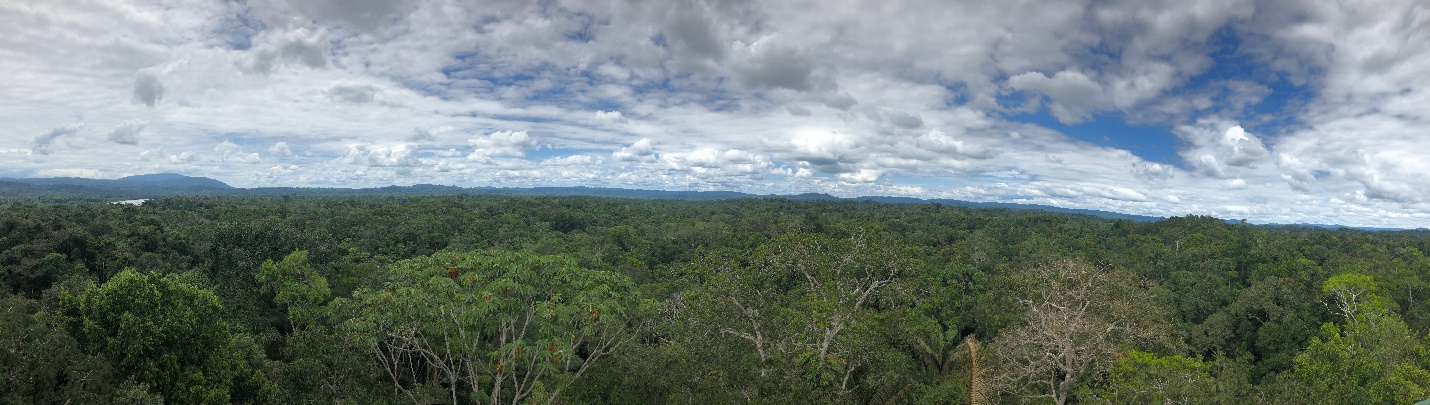
The view from the top of the tower at Jatun Sacha.
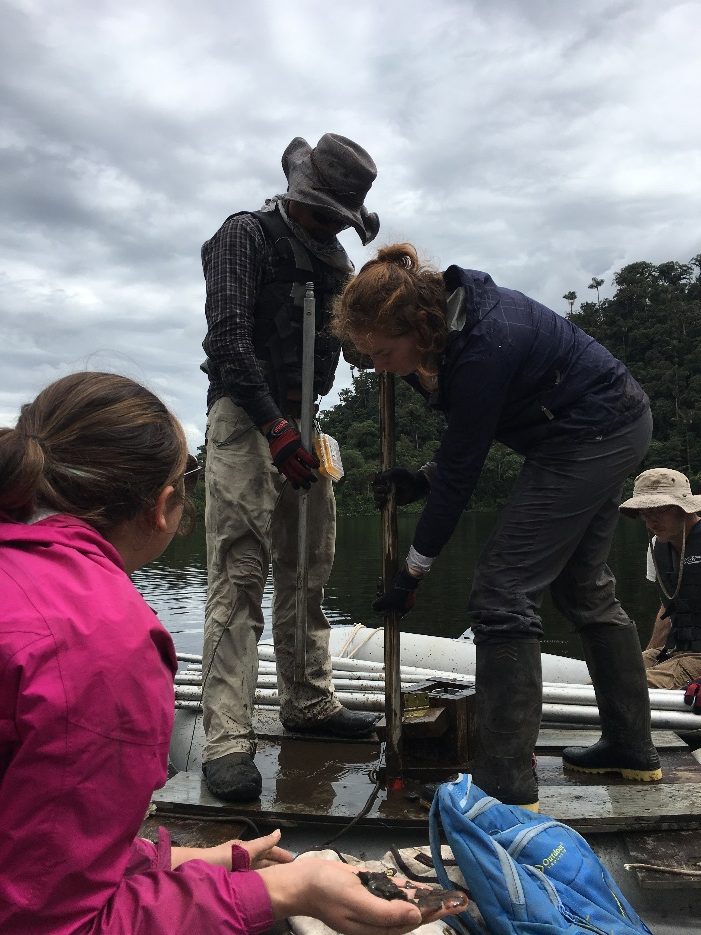
Rachel Sales, Bryan Valencia, and Majoi de Novaes Nascimento coring a different lake. In this picture, we have just pulled a core of mud up from the bottom of the lake. Photo credit: Seringe Huisman
I am sitting on the shore of Lago Condorcillo in Southern Ecuador, after a long day of travel, trying to control my shivering. At roughly 10,500 ft. above sea level, the lake is very cold, with wind that howls over the barren hills dotted with giant boulders. The lake is also almost always blanketed by thick fog and pelted by driving rain. When you’re surrounded by the thick fog punctuated by lightning bolts, it’s easy to believe that some lost civilization lurks just out of sight. Tonight we are experiencing lightning storms, which is adding to the feeling that some angry, ancient life form must live at Lago Condorcillo.
Tomorrow, I will be out in the cold and rain, balancing on an inflatable boat and fighting frostbite. Mark Bush, who is my Ph.D. advisor, Courtney Shadik, who is my lab partner and tent buddy, and I will be collecting cores of mud from the bottom of Condorcillo. We will create our rig for coring by tying two inflatable boats together, and placing a wooden platform between them. Mark, Courtney, and I will then collect our mud cores from this platform.
As I’m contemplating the hazards of camping in a lightning storm, Mark says, “Tell me everything that went wrong today.” Courtney pulls a sleeping bag closer to her. I begin to describe how Google Maps can’t seem to understand distance in the Andes, and so traveling to Lago Condorcillo took much longer than we anticipated. Courtney laughs beside me and adds, “We don’t have any matches to start a fire.” Despite our troubles, I am grinning from ear to ear, no doubt spoiling the grim mood Mark is attempting to cultivate and Lago Condorcillo is doing its best to enforce.
Main purpose: Based at St Andrews, the PDRA will play an important role in a NERC-funded project working on the distribution and dynamics of peat-forming ecosystems in Amazonia. The post-holder will be required to undertake palaeoenvironmental research (including fieldwork, lab analyses, data analysis and write-up) in order to reconstruct the developmental history of the palm swamps, pole forests, and ‘open peatlands’ over the course of the Holocene. Some technical support for routine laboratory tasks will be available.
Deadline: 31 October 2018
For further information click here.
The montane cloud forests of South America are some of the most biodiverse habitats in the world, whilst also being especially vulnerable to climate change and human disturbance.
Today much of this landscape has been transformed into a mosaic of secondary forest and agricultural fields. This thesis uses palaeoecological proxies (pollen, non-pollen palynomorphs, charcoal, organic content) to interpret ecosystem dynamics during the late Quaternary, unravelling the vegetation history of the landscape and the relationship between people and the montane cloud forest of the eastern Andean flank of Ecuador. Two new sedimentary records are examined from the montane forest adjacent to the Río Cosanga (Vinillos) and in the Quijos Valley (Huila). These sites characterise the natural dynamics of a pre-human arrival montane forest and reveal how vegetation responded during historical changes in local human populations.
Non-pollen palynomorphs (NPPs) are employed in a novel approach to analyse a forest cover gradient across these sites. The analysis identifies a distinctive NPP assemblage connected to low forest cover and increased regional burning. Investigation into the late Pleistocene Vinillos sediments show volcanic activity to be the primary landscape-scale driver of ecosystem dynamics prior to human arrival, influencing montane forest populations but having little effect on vegetation composition.
Lake sediments at Huila from the last 700 years indicate the presence of pre-Hispanic peoples, managing and cultivating an open landscape. The subsequent colonization of the region by Europeans in the late 1500’s decimated the indigenous population, leading to the abandonment of the region in conjunction with an expansion in forest cover ca. 1588 CE. After approximately 130 years of vegetation recovery, montane cloud forest reached a stage of structural maturity comparable to that seen in the pre-human arrival forest. The following 100 years (1718-1822 CE) of low human population and minimal human impact in the region is proposed as a shifted ecological baseline for future restoration and conservation goals. This ‘cultural ecological baseline’ features a landscape that retains many of the ecosystem service provided by a pristine montane forest, while retaining the cultural history of its indigenous people within the vegetation. Continue Reading

 Kirschner, J.* & Hoorn, C. (2019) The onset of grasses in the Amazon drainage basin, evidence from the fossil record Frontiers of Biogeography DOI:10.21425/F5FBG44827





 Ecology of the past