 Open access:
Duchicela, S.A., Cuesta, F., Pinto, E., Gosling, W.D. & Young, K.R. (2019) Indicators for assessing tropical alpine rehabilitation practices. Ecosphere 10, e02595. DOI: 10.1002/ecs2.2595

February 8, 2019
Open access:
Duchicela, S.A., Cuesta, F., Pinto, E., Gosling, W.D. & Young, K.R. (2019) Indicators for assessing tropical alpine rehabilitation practices. Ecosphere 10, e02595. DOI: 10.1002/ecs2.2595
January 26, 2018
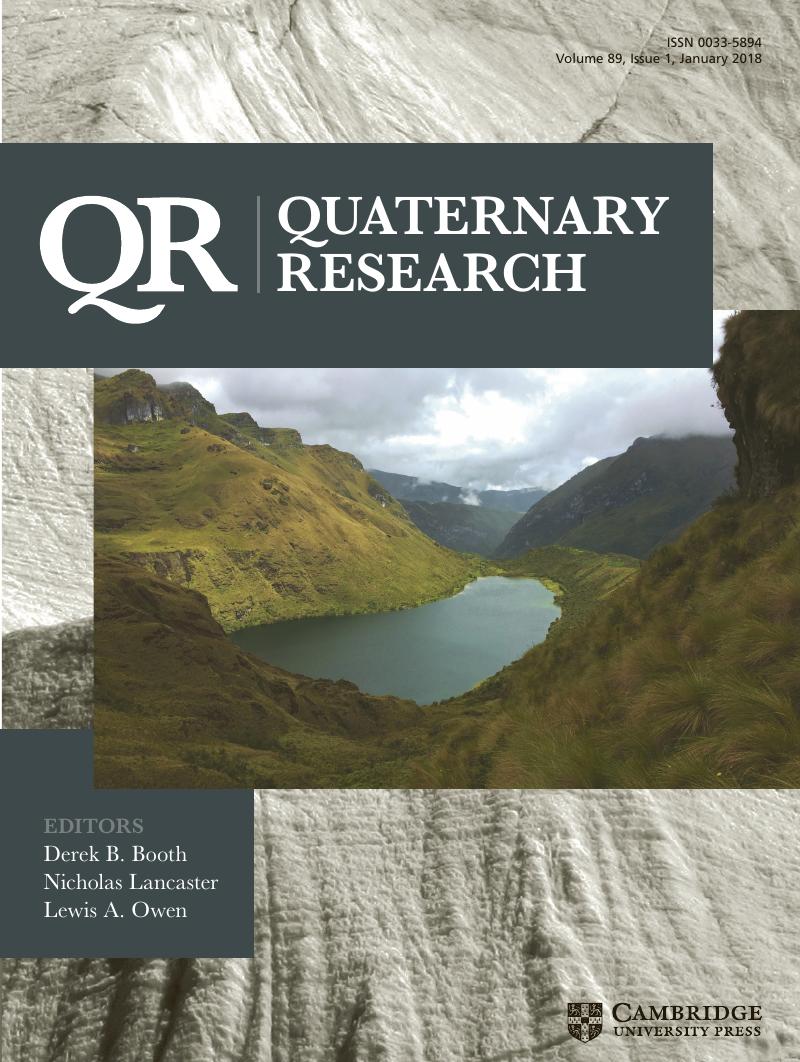 Mark Bush and I are proud to announce that a tribute to Prof. Daniel Livingston and Prof. Paul Colinvaux has recently been published in Quaternary Research. Dan and Paul were both pioneers of tropical pal(a)eoecology and both died in the spring of 2016 . To mark their passing Mark and I have guest edited ten new papers on palaeoecology drawn from researchers, and regions, of the tropics in which Dan and Paul worked (Bush & Gosling, 2018). We would like to thank Quaternary Research Senior Editor Derek Booth for giving us this opportunity and assisting greatly in the process of compiling the manuscripts. We would also like to thank all to contributing authors for their hard work and dedication to the project. We hope that you will enjoy reading the manuscripts and find them a fitting tribute to the life and work of these two great researchers.
Quaternary Research
Special Issue: Tribute to Daniel Livingstone and Paul Colinvaux
Volume 89 – Special Issue 1 – January 2018 Continue Reading
October 9, 2017
Online, open access:
Matthews-Bird, F., Brooks, S.J., Gosling, W.D., Gulliver, P., Mothes, P. & Montoya, E. (2017) Aquatic community response to volcanic eruptions on the Ecuadorian Andean flank: Evidence from the palaeoecological record. Journal of Paleolimnology 58: 437-453. DOI: 10.1007/s10933-017-0001-0
August 23, 2017
Part 1: Huayabamba
by Molly Kingston (a BSc Biological Sciences student at Florida Institute of Technology, taking part in an expedition lead by Prof. Mark Bush)
When I first heard about this class in Peru, I had no idea that I was going to experience so much in such a short period. Our goal was to visit two lakes in Peru and raise sediment cores for paleoecology. The first lake that we went to was Laguna Huayabamba, which sits at about 3250 m elevation in the La Libertad region of the Peruvian Andes.
However, getting to this lake was no easy task. Before the hike even started, we had to obtain the necessary permits and permission from the local people. After several days of visiting different town officials and waiting for approval, we could set out on our adventure.


July 18, 2017

Many BSc students undertook our “Palaeoecology” course prior to choosing to do a research project with us.
This year 15 (fifteen!) bachelors students completed their research projects in palaeoecology based within the Department of Ecosystem & Landscape Dynamics at the University of Amsterdam. The students had a variety of backgrounds with the majority coming from the BSc Biology and the BSc Future Planet Studies programs.
Each project was set up to test a particular ecological or biogeographic hypothesis. Investigations included the exploration of the role of humans in modifying ecosystems in Amazon, the nature of the pre-farming landscape in the the Netherlands, and how to chemically identify fossil charcoal. In undertaking their projects individual students had the opportunity to variously develop skills in microscopy, spatial modelling, or analytical chemistry. The high quality of the data produced means that hopefully many of these data sets can be used in future scientific publications. Well done to all!
If you are interested in conducting a similar project (at any academic level) with us please do not hesitate to get in contact. For further details of ongoing research within the Department of Ecosystems & Landscape Dynamics visit our web pages by clicking here.
March 5, 2015
 Valencia Castillo, B.G. (2014) From glacial to modern conditions: Vegetation and climate change under human influence in the Central Andes. PhD Thesis, Department of Environment, Earth & Ecosystems, The Open University.
Abstract
Conservation, restoration and management strategies are employed to maintain Earth’s biological diversity and physical environment to a near “natural” state. However, the concept of “natural” is generally inexact and may include degraded landscapes. In absence of long-term empirical data of natural baselines, impacted assemblages (human altered baselines) could be falsely assumed to be natural and set as conservation or restoration goals. Therefore, the identification of long-term ecological baselines becomes a pressing requirement especially in threatened biodiversity hotspots such as the tropical Andes that were under human pressure for several millennial.
This thesis aims to identify ecological baselines for tropical Andean ecosystems based on multi-proxy palaeoecological reconstructions from three Andean lakes. Trends of vegetation change are used to identify when landscapes became anthropogenic in the Andes. Because vegetation assemblages at c. 10 ka experienced negligible anthropogenic impacts and had modern-like climate condition, this time was considered the most recent period likely to provide insight into natural ecological baseline conditions.
Changes in vegetation assemblages were evaluated over time departing from 10 ka around Miski and Huamanmarca, two sites that remained virtually impervious to human impacts. Baselines in Miski and Huamanmarca drifted continuously over time and showed that baselines are dynamic entities. The vegetation assemblages derived from Miski and Huamanmarca suggest that that human impact was not homogeneous throughout the Andean landscape.
Once baselines were defined it was possible to evaluate if the spatial distribution of Andean woodlands represented by Polylepis was a product of human impacts. A MaxEnt model generated based on 22 modern environmental variables and 13 palaeoecological vegetation reconstructions showed that Polylepis woodlands were naturally fragmented before humans arrived in South America (14 ka). However, the influence of humans during the mid and late Holocene enhanced the patchiness of the forest generating a hyper-fragmented landscape.
Supervisors: Dr. William D. Gosling , Dr. Angela L. Coe (both The Open University) and Prof. Mark B. Bush (Florida Institute of Technology).
Examined by: Dr. Robert Marchant (University of York), and Prof. David Gowing (The Open University).
To borrow a copy from The Open University Library click here.
 Ecology of the past