McMichael, C.N.H., Vink, V., Heijink, B.M., Witteveen, N.H., Piperno, D.R., Gosling, W.D. & Bush, M.B. (2023) Ecological legacies of past fire and human activity in a Panamanian forest. Plants, People, Planet5, 281-291. DOI: 10.1002/ppp3.10344
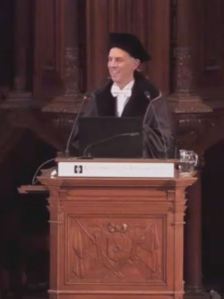
William Gosling giving his oratie “The Ecology of the Past” at the Aula (University of Amsterdam), 22 December 2022.
On the 22 December I gave my oratie (inaugural lecture), entitled “The Ecology of the Past”, related to my appointment as Professor of Palaeoecology & Biogeography at the University of Amsterdam. I really enjoyed the opportunity to mark this personal milestone with some many colleagues, friends and family. In case you missed the event you can watch it online via the universities portal by clicking here (or on the photo).
Note: (1) to flip between seeing the slides and the video feed just click on the screen, (2) running time of lecture until 50 minutes.
McMichael, C.N.H., Vink, V., Heijink, B.M., Witteveen, N.H., Piperno, D.R., Gosling, W.D. & Bush, M.B. (2022) Ecological legacies of past fire and human activity in a Panamanian forest. Plants, People, Planet. DOI: 10.1002/ppp3.10344
During the delivery of this years BSc Palaeoeclogy course at the University of Amsterdam (UvA) I discussed with a number of students about the nature and purpose of understanding the ecology of the past. This lead me to highlighting the research of Nick Loughlin (@PalaeoNick) from his PhD at The Open University and the subsequent work that he has done. I though it might be interesting to also share this here…
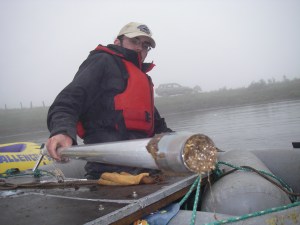
Nick Loughlin during his PhD field work in Ecuador
Nick’s study sought to understand better the ecological history of the biodiverse eastern Andean flank in Ecuador. To achieve this he went into the field and recovered sediments from a lake and a sedimentary section exposed by a road cutting. He analysed the sediments to reveal vegetation change (pollen analysis), fire histories (charcoal analysis), and past animals in the landscape (non-pollen palynomorphs, or NPPs). To extract extra ecological information from his samples he developed the methodological approach for examining NPPs in a tropical setting (Loughlin et al. 2018a). He then combined all the different palaeoecological approaches to reveal the drivers of vegetation change during the last glacial period (in the absence of humans; Loughlin et al. 2018b), and during the last 1000 years (when indigenous and European human populations radically altered the landscape; Loughlin et al. 2018c). The insights gained from Nicks research provided empirical evidence of how humans have been modifying this biodiversity hotspot on the timescales relevant to the lifecycles of tropical trees. These findings and ideas were collated in his PhD Thesis at The Open University which was supervised by Encarni Montoya, Angela Coe and myself (Loughlin, 2018a). Subsequently, Nick has been working to broaden the impact of his work and to communicate his findings to the broader scientific and conservation community. This has lead to two new publications focused on understanding baseline ecological function and conservation implications (Loughlin et al. 2022, Nogué et al. 2022).
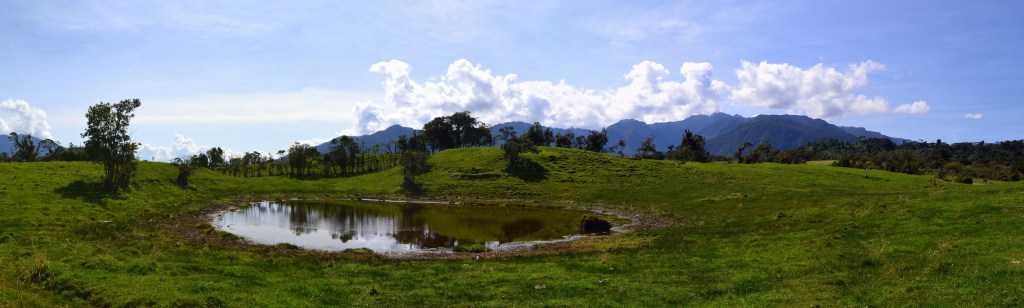
Evidence of past ecological change recovered from Lake Huila (Ecuador) revealed how past peoples had modified the landscape of the eastern Andean biodiversity hotspot.
The arch of research carried out by Nick, I think, really demonstrates the important of understanding the ecology of the past – without his detailed investigation of microfossils we could not have seen the impacts of indigenous communities on the past Andean landscape, or identify the consequences of the European depopulation; or been able to estimate the timescales of the ecological change!
The Palaeoecology Research Group within the Department of Archaeology at the Max Planck Institute for Geoanthropology, Jena, Germany is pleased to announce a new vacancy for a doctoral student exploring human-environment interactions in the Caribbean. The position will be based in Jena, Germany for a period of 3 years with the option for extensions and supervised by Dr. Yoshi Maezumi.
The Palaeoecology Research Group analyses palaeoecological and archaeobotanical proxies from sedimentary archives, including pollen, phytoliths, charcoal and stable isotopes to examine topics including the legacy of human land-use on ecosystems, spatio-temporal patterns of natural and human-driven fire activity, and the influence of natural and human disturbance regimes on the biogeographic distribution of plants and animals in past ecosystems.
Elliott, S., Maezumi, S.Y., Robinson, M., Burn, M., Gosling, W.D., Mickleburgh, H.L., Walters, S. & Beier, Z.J.M. (2022) The legacy of 1300 years of land use in Jamaica. Journal of Island and Coastal Archaeology. DOI: 10.1080/15564894.2022.2078448
Gosling, W.D., Miller, C.S., Shanahan, T.M., Holden, P.B., Overpeck, J.T. & van Langevelde, F. (2022) A stronger role for long-term moisture change than for CO2 in determining tropical woody vegetation change. Science 376, 653-656. https://doi.org/10.1126/science.abg4618
To access this article FREE through the Science author referral service click here.
For more on the palaeoecological dataset underpinning this research check out the PhD thesis of Charlotte Miller by clicking here or here.
There is a new PhD opportunity at Ecole doctorale Environnements-Santé (France) working with Boris Vannière (Director of Research, CNRS, University Bourgogne Franche-Comté, University of Bern), Richard Vachula (Assistant Professor, Auburn University, USA), and Elisabeth Dietze (Professor, University of Göttingen, Germany). The project is entitled: Leverage the meaning of paleofire data through metadata mining. Case studies in mediterranean, tropical and arctic ecosystems, closing date 9 May 2022.
Maezumi, S.Y., Elliott, S., Robinson, M., Betancourt, C.J., Gregorio de Souza, J., Alves, D., Grosvenor, M., Hilbert, L., Urrego, D.H., Gosling, W.D. & Iriarte, J. (2022) Legacies of Indigenous land use and cultural burning in the Bolivian Amazon rainforest ecotone. Philosophical Transactions of the Royal Society B: Biological Sciences 377, 20200499. https://doi.org/10.1098/rstb.2020.0499





 Ecology of the past