In June there will be a “European Pollen Database in Neotoma” meeting in Prague. For full details visit the European Pollen Database web site, click here.

February 28, 2022
In June there will be a “European Pollen Database in Neotoma” meeting in Prague. For full details visit the European Pollen Database web site, click here.
December 20, 2021
#Openaccess #Teameffort
Gosling WD, Maezumi SY, Heijink BM, Nascimento MN, Raczka MF, van der Sande MT, Bush MB, McMichael CNH. 2021. Scarce fire activity in north and north-western Amazonian forests during the last 10,000 years. Plant Ecology & Diversity. DOI: 10.1080/17550874.2021.2008040
December 2, 2021

The recently published volume of the Palaeoecology of Africa series contains a number of different types of papers: research articles, reviews, perspectives and data papers. One of the key reasons I was motivated to become involved in the project was to help mobilise palaeoecological data from Africa towards open access datasets (African Pollen Database, Neotoma). To hopefully get greater recognition to the great work done over the years and to help facilitate synthetic work that will provide a greater understanding of spatial variance in past climate change. Ultimately, four short data papers were included in the volume: an enhanced c. 16,000 year pollen record from the Bale Mountains in Ethiopia (Gil-Romera et al. 2021), two pollen and charcoal record from the southern Cape Coast in South Africa, c. 3200 and 650 years long respectively (du Plessis et al. 2021a; du Plessis et al. 2021b), and a c. 700 year long record from Madagascar (Razanatsoa et al. 2021). The records provide new insights in to landscape scale environmental change driven by both humans and climate. To find out more check out the open access articles and the data at:
Continue Reading
August 2, 2021
Maezumi SY, Gosling WD, Kirschner J, Chevalier M, Cornelissen HL, Heinecke T, McMichael CNH. 2021. A modern analogue matching approach to characterize fire temperatures and plant species from charcoal. Palaeogeography, Palaeoclimatology, Palaeoecology 578:110580. https://doi.org/10.1016/j.palaeo.2021.110580
January 9, 2021
 Open access:
McMichael, C.N., Heijink, B.M., Bush, M.B. & Gosling, W.D. (2020) On the scaling and standardization of charcoal data in paleofire reconstructions. Frontiers of Biogeography. https://doi.org/10.21425/F5FBG49431
November 24, 2020
January 22, 2020
 Detecting the presence, and impact, of peoples past impact in ecosystems and landscapes in the tropics is a challenging because the traces that they leave behind are few and disentangling them from ‘natural’ (non-human related) variability is a challenge. As an Associate Editor for Vegetation History & Archaeobotany (VHAA) I enjoy handling manuscripts that think about these issues and explore the role of humans in tropical landscapes. Two recent papers published in VHAA touched on this subject (one of which I “communicated” as an editor).
July 4, 2019
 Date: Thursday 4th July 2019
Location: Institute for Biodiversity & Ecosystem Dynamics (University of Amsterdam)
Talks
Laboratory
May 29, 2019
Huisman, S.N.*, Bush, M.B. & McMichael, C.N.H. (2019) Four centuries of vegetation change in the mid-elevation Andean forests of Ecuador. Vegetation History and Archaeobotany. DOI: 10.1007/s00334-019-00715-8
* conducted the research presented in this paper during her MSc Biological Sciences at the University of Amsterdam.
April 8, 2019
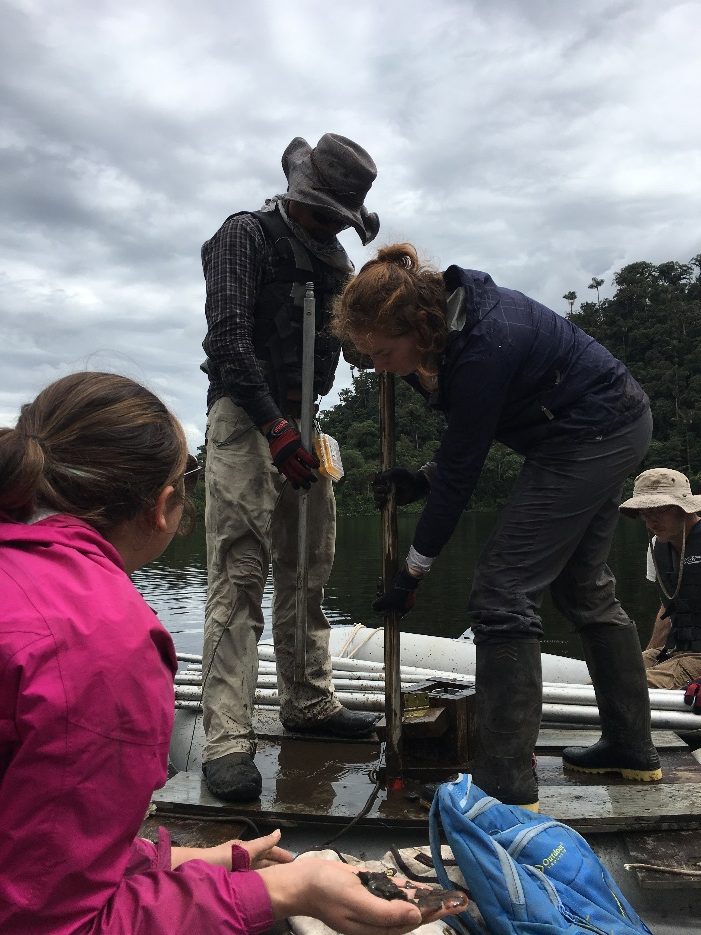
Rachel Sales, Bryan Valencia, and Majoi de Novaes Nascimento coring a different lake. In this picture, we have just pulled a core of mud up from the bottom of the lake. Photo credit: Seringe Huisman
Cloudy with a chance of adventure
By Rachel Sales (PhD researcher at the Institute for Global Ecology, Florida Institute of Technology)
I am sitting on the shore of Lago Condorcillo in Southern Ecuador, after a long day of travel, trying to control my shivering. At roughly 10,500 ft. above sea level, the lake is very cold, with wind that howls over the barren hills dotted with giant boulders. The lake is also almost always blanketed by thick fog and pelted by driving rain. When you’re surrounded by the thick fog punctuated by lightning bolts, it’s easy to believe that some lost civilization lurks just out of sight. Tonight we are experiencing lightning storms, which is adding to the feeling that some angry, ancient life form must live at Lago Condorcillo.
Tomorrow, I will be out in the cold and rain, balancing on an inflatable boat and fighting frostbite. Mark Bush, who is my Ph.D. advisor, Courtney Shadik, who is my lab partner and tent buddy, and I will be collecting cores of mud from the bottom of Condorcillo. We will create our rig for coring by tying two inflatable boats together, and placing a wooden platform between them. Mark, Courtney, and I will then collect our mud cores from this platform.
As I’m contemplating the hazards of camping in a lightning storm, Mark says, “Tell me everything that went wrong today.” Courtney pulls a sleeping bag closer to her. I begin to describe how Google Maps can’t seem to understand distance in the Andes, and so traveling to Lago Condorcillo took much longer than we anticipated. Courtney laughs beside me and adds, “We don’t have any matches to start a fire.” Despite our troubles, I am grinning from ear to ear, no doubt spoiling the grim mood Mark is attempting to cultivate and Lago Condorcillo is doing its best to enforce.
 Ecology of the past