INQUA fellow Alfred Hougnon continues his research into past environmental change in the Dahomey Gap (Benin). In the fourth video documenting his progress a short background to the project, and insights into field work, are given. Field work took place near the Ewe-Adakplame forest in the south east of Benin and involved the recovery of sediments using a Russian corer. The video also shows how interactions and engagement with the local community was developed during the research expedition.
To find out more above Alfreds project read posts on:
Alfred Houngnon was awarded an INQUA Fellowship in 2024 to develop his work on past environmental change in the Dahomey Gap (western Africa). Through the project Alfred is making a series of videos about his fellowship journey. In the first video Alfred introduced his project and collaborators (click here to watch the first part). In the two latest instalments (below) Alfred explains: (i) one of his key methodological approaches (modern pollen trapping), and (ii) the modern vegetation of the region and current threats to the vegetation.
I am delighted to be able to report that Alfred Houngnon (University of Abomey-Calavi, Benin) has beenawarded an INQUA Fellowship for 2024 to develop his research into past environmental change in the Dahomey Gap. This research will link up my laboratory, at the Institute of Biodiversity & Ecosystem Dynamics (University of Amsterdam), and the group of Dr Mireille S.S. Toyi(Laboratory of Applied Ecology, University of Abomey-Calavi). Below, and in the associated video report, Alfred explains the project and what he hopes to achieve during the project.
The Dahomey Gap project is designed to gain new insights on the West African palaeoenvironments using pollen, charcoal and dung fungal spore records to reconstruct past vegetation, fire and animal abundances. These empirical data will then be compared against paleoclimate models. Specifically, we will explore the interactions between fire, animals and vegetation around the Ewe-Adakplame forest in the south east of Benin Republic and highlight the role humans would have previously played in the modification of the landscape for millennia.
My name’s Alfred Houngnon, native of Benin Republic in West Africa. I hold an agricultural engineering degree in “Rangeland Management and Conservation” (Abomey-Calavi University). After gaining relevant field experience, I obtained a French Government Bursary to pursue an MSc degree in “Tropical Plant Biodiversity” at Montpellier (France). There, I learned about how to use indicators of past environmental and climatic change to give insights into projected future change.
It was a great scientific experience to participate in-person at the XXI INQUA Congress 2023 in Rome (Italy). This opportunity came under the supervision of William Gosling, and with the support of the Mapping Ancient Africa (MAA) project funded by INQUA’s Palaeoclimate commission (PALCOM). I have been working with Will for a number of years and published a first paper related to this work in 2021; a checklist of vascular plants from a ‘relict’ forest in Benin (Houngnon et al., 2021). A second manuscript is under development and was accepted for poster and oral presentation at INQUA 2023 congress that brought together around 4000 abstracts.
Interview 1: Alfred Houngnon (AGIR)
The bursary from the MAA project allowed me to also attend the MAA Rome workshops held at the Royal Netherlands Institute in Rome (12-13 July 2023). During the workshops, I was trained in two novel approaches to palaeoclimate modeling. The first based on interfacing paleoclimate models through the “pastclim” R package (Michela Leonardi), and the second on reconstructing palaeoclimates on the basis of ancient pollen data using the “CREST” program (Manu Chevalier). The workshops helped me to sharpen the communication of my ideas and in so doing strengthened the manuscript in preparation for submission to an international journal for publication.
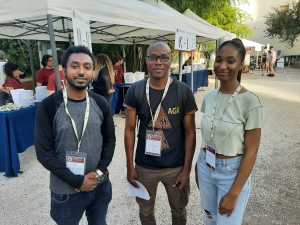
Mapping Ancient Africa participants at the INQUA Rome ice breaker event ready for action! Left to right: Bahru Zinaye Asegahegn, Alfred Houngnon, Busisiwe Hlophe.
The Mapping Ancient Africa (MAA) project has a double session of talks and a poster session at the INQUA congress in Rome 2023. Our session will be on Wednesday 19 July. Unfortunately a number of the originally planned speakers could not make it to Rome due to a combination of not obtaining visas, logistical challenges and ill health. We wish them all well and hope that they will continue to be involved in the project. Further, many thanks to all those who have agreed to step up and give a presentation at a late notice. Below is an updated schedule correct as of Sunday 16 July based on the information contained on the INQUA Rome App; if you are aware of any further problems or changes please let me know ASAP!
Giosan et al. When the desert was a lake: Providing context for Homo sapiens development in the northern Kalahari
Chase et al. Paleolakes and socioecological implications of glacial “greening” of the South African interior
Blinkhorn et al. Evaluating refugia in recent human evolution in Africa
Aureli et al. Homo sapiens behaviour and adaptation in East Africa. New evidence from an open-air site in a modern Ethiopian savannah environment: the GOT10 site
Effiom et al. Late Holocene palaeoecological studies at Lake St Lucia, KwaZulu-Natal
Tallavaara et al. Pan-African Climate and Vegetation over the Quaternary and Implications for Human Distribution
Quick et al. Palaeoenvironments of the Cape Floristic Region: New research & current developments
The Mapping Ancient Africa (MAA) project has a double session of talks and a poster session at the INQUA congress in Rome 2023. Our session will be on Wednesday 19 July.
Giosan et al. When the desert was a lake: Providing context for Homo sapiens development in the northern Kalahari
Chase et al. Paleolakes and socioecological implications of glacial “greening” of the South African interior
Biddulph et al. Spatiotemporal variability in the initiation and development of peatlands across the central Congo Basin
Blinkhorn et al. Evaluating refugia in recent human evolution in Africa
Aureli et al. Homo sapiens behaviour and adaptation in East Africa. New evidence from an open-air site in a modern Ethiopian savannah environment: the GOT10 site
Dembele Climatic fluctuations during the last millenium and their impact on political history and human settlements in West Africa
Porchier et al. Annually resolved hydroclimate variability in the East African Rift Valley at a time critical for hominin dispersion
Effiom et al. Late Holocene palaeoecological studies at Lake St Lucia, KwaZulu-Natal



 Ecology of the past