The International Conference on Past Plant Diversity, Climate Change, and Mountain Conservation was aimed to address this question, with a focus on mountain (montane) species. As climate warms, there are several outcomes for montane species. They can migrate upslope, go extinct, or adapt to the warming conditions. Given these options, we got together to discuss our most recent datasets, and the best strategies for the conservation of montane species. Effective conservation strategies are crucial for the survival of many rare and endemic montane species, because climate is indeed warming, regardless of what Trump or Fox News tries to tell people.
13.45-14.15: Dr Robert-Jan Wille
History Department, Utrecht University Dutch colonial science in the age of Melchior Treub: evolution, development and symbiosis as political and scientific themes in the late nineteenth century
Montoya, E., Keen, H.F., Luzuriaga, C.X. & Gosling, W.D. (2018) Long-term vegetation dynamics in a megadiverse hotspot: The Ice-Age record of a pre-montane forest of central Ecuador. Frontiers in Plant Science 9, 196. doi: 10.3389/fpls.2018.00196
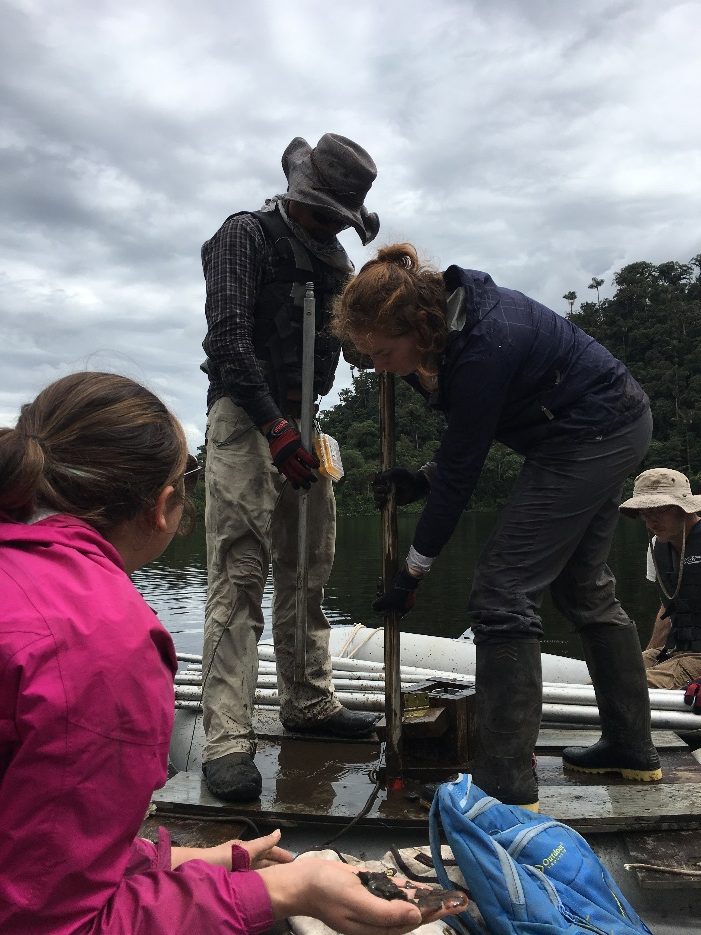
Hello all! You might have been wondering if I died in the middle of Amazonian nowhere, since I haven’t come back to writing a blog after we left for fieldwork in July. Given we were in an Amazonian region full of venomous snakes that could have been the case, but the good news is I just didn’t get around writing it because I got carried away by the findings of my project! We actually had a very successful field trip – apart from some minor issues like the lake swallowing equipment, sinking waist-high into the mud each step of our 7 hour long ‘trail’ to the lakes, and almost not getting my precious samples through airport security.
Since being appointed as an Associate Editor of Vegetation History & Archaeobotany last year I have the pleasure of working on a number of exciting and interesting manuscripts from the tropics. I am particularly delighted that the first of these (Astudillo, 2018) has now been published. I particularly liked this manuscript because of: (i) the close relationship that was shown between the historical and fossil records, and (ii) the clear signal shown from working on a island system. This linkage is something I have been thinking about in my own research on Mauritius recently (Gosling et al., 2017) and is, I believe, particularly valuable to do because it demonstrates the validity of techniques to track human activity when applied in contexts without historical documentation. The impact of people on the Galapagos is shown by Astudillo (2018) from investigation of multiple proxies (charcoal, phytoliths and macrofossils) to build up a comprehensive picture of human impacts on one of the most famous places for biodiversity on Earth. Hopefully this study is just the start of investigations into past human impacts on the Galapagos islands, and I hope that you enjoy reading the manuscript!
Loughlin, N.J.D., Gosling, W.D. & Montoya, E. (2017) Identifying environmental drivers of fungal non-pollen palynomorphs in the montane forest of the eastern Andean flank, Ecuador. Quaternary Research. DOI: 10.1017/qua.2017.73
Loughlin, N.J.D., Gosling, W.D., Coe, A.L., Gulliver, P., Mothes, P. & Montoya, E. (2017) Landscape-scale drivers of glacial ecosystem change in the montane forests of the eastern Andean flank, Ecuador. Palaeogeography, Palaeoclimatology, Palaeoecology. DOI: 10.1016/j.palaeo.2017.10.011
Matthews-Bird, F., Brooks, S.J., Gosling, W.D., Gulliver, P., Mothes, P. & Montoya, E. (2017) Aquatic community response to volcanic eruptions on the Ecuadorian Andean flank: Evidence from the palaeoecological record. Journal of Paleolimnology 58: 437-453. DOI: 10.1007/s10933-017-0001-0
IBEDs Crystal McMichael hard at work sampling sediments in the Andes
Insights into recent field work in Ecuador by a team lead by Crystal McMichael can be found in a recent blog from our collaborators at the Instituto Geofisico, Escuela Politecnica Nacional, Quito (Ecuador).
Hi all! My name is Seringe (Dutch for lilac flower), and unsurprisingly I am a biology student. I completed my BSc Biology at the VU University, specializing in ecology. Being fascinated by tropical rainforest since I was a kid, I attended a Tropical Ecology course at the University of Amsterdam (UvA), resulting in a research project with Crystal McMichael from the Palaeoecology & Landscape Ecology group on the late-Holocene fire history of western Amazonia. Besides performing this palaeoecological project, focusing on the aspect of ancient human activity, I followed courses of Latin America Studies to broaden my perspectives on the current socio-environmental complexity and conservation status of the area. This year, I have gotten the amazing opportunity to join Crystal McMichael on a fieldwork expedition to the Ecuadorian Amazon!
Seringe Huisman in the field…
The fieldwork will be part of my Master’s thesis, elaborating on the regional patterns of vegetation composition changes in relation to human disturbance. I will be taking sediment cores from two lakes in the Sangay region of Ecuador, perform charcoal and phytolith analysis to reconstruct fire and vegetation assemblages over the late Holocene and compare the results to previously established records across western Amazonia. While I am currently attending the MSc Biological Sciences Limnology & Oceanography Master’s track at UvA, I could not help but directing my first project into Paleoecology again! My field trip is largely made possible by obtaining €1150 of grants through the Treub-Maatschappij and the Amsterdam University Fund, for which I am very grateful.
I am super excited to be heading to Ecuador soon, and will be back in a month with field stories, mosquito bites and hopefully some suitable sediments!