The aim of this thesis was to provide insight into past human activities in Amazonia, and the long-term forest recovery that followed, using phytolith analysis. The first part of this thesis focused on improving phytolith analysis as a proxy for vegetation changes in Amazonia. The morphological variation of 24 Amazonian palm phytoliths were assessed (Chapter 2) to improve the taxonomic resolution of palm phytolith identification, and results indicate the potential to differentiate Euterpe, Bactris, Oenocarpus, Attalea, Iriartea deltoidea, and Socratea exorrhiza. Chapter 3 demonstrated that phytolith assemblages (from terrestrial soil cores) varied across a gradient of (modern) human disturbance in Surinamese rainforests. In Chapters 4-6, we developed beta regression and GLM models to predict forest cover and biomass changes within 200 m and 1 km of Amazonian lakes, respectively, using grass phytoliths. Applying these innovations in Chapters 5-6 demonstrated that past human activities were on localized scales in Suriname and temporally heterogenous in Ecuador. Palm enrichment of Attalea, Oenocarpus and Astrocaryum occurred within 0 km, 1 km, and 8 km of an archaeological site in Suriname (Chapter 5). In Ecuador, forest cover and biomass ranged between 48-84% and 77-247 Mg/ha, respectively, and the largest decreases (between 1000-1255 CE) were paired with fires (Chapter 6). Overall, the type, intensity, timing, and frequency of disturbances are important factors influencing long-term forest recovery and ecological legacies in Amazonia.
Witteveen, N.H., Kleijwegt, Z.S., Geara, H., Kool, C., Blaus, A., Saenz, L.C., Gomes, B.T., Philip, A., Bush, M.B. & McMichael, C.N.H. (2024) Quantifying past forest cover and biomass changes in the Ecuadorian Amazon. New Phytologist. DOI: 10.1111/nph.20237
This paper is the latest to come from the PhD thesis of Nina Witteveen who defended at the University of Amsterdam earlier in 2024. To find out more about Nina’s PhD click here.
Ivory, S.J., MacDougal, E., Mason, A., Pereboom, E., Garelick, S., Ficken, K., Wooller, M.J., Nakileza, B. & Russell, J. (2024) Highland forest dynamics across equatorial East Africa during the end of the African humid period. Quaternary International. DOI: 10.1016/j.quaint.2024.10.007
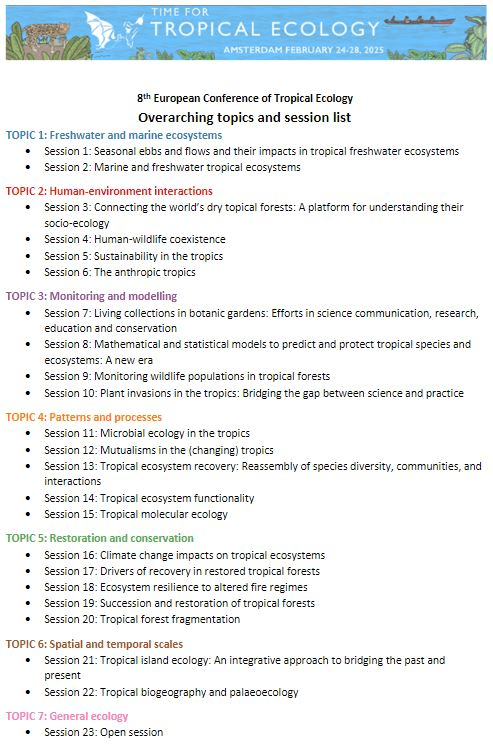
The European Conference of Tropical Ecology will take place in Amsterdam between 24 and 28 February 2025. The event will be centered around thematic oral and poster sessions. There are twenty-three different thematic sessions organized into seven broad topics:
Alfred Houngnon was awarded an INQUA Fellowship in 2024 to develop his work on past environmental change in the Dahomey Gap (western Africa). Through the project Alfred is making a series of videos about his fellowship journey. In the first video Alfred introduced his project and collaborators (click here to watch the first part). In the two latest instalments (below) Alfred explains: (i) one of his key methodological approaches (modern pollen trapping), and (ii) the modern vegetation of the region and current threats to the vegetation.
Amazonian rainforests are incredibly biodiverse and provide global ecosystem services, but are threatened by fires, which completely alter ecosystem function and structure. Fires, especially in western Amazonia, almost always have an anthropogenic origin. However, much is unknown about the long-term recovery and multi-generational successional processes following fire events. Due to the long lifespan of tropical trees, past fires may have left ecological legacies in modern forest composition in Amazonia. The goal of this thesis is to investigate how past fire events impact successional trajectories of past vegetation change and whether these fire events and related human impacts have left ecological legacies in modern Amazonian forests. I specifically focus on western Amazon and changes in palm abundances and composition through time, as palms were an economically important plant family to past peoples. I compared lake charcoal records across the Amazon Basin and found fire was least prevalent in western Amazonia. On a local scale, very limited evidence of past disturbances was present in forest plots in northwestern Amazonia. Palm abundances have been increasing since the mid-Holocene, but this increase is not related to past fire events. Past fire likely have left low to none ecological legacies in these forest plots. Modern trait composition across western Amazonia is associated with past fire events, but more research is necessary to disentangle relationships between past fire, soils, and modern vegetation. Overall, western Amazonia likely contains the least intense ecological legacies in comparison with the rest of Amazonia.
Sales, R.A., McMichael, C.N.H., Peterson, L.C., Stanley, A., Bennett, I., Jones, T.E., Walker, A.S., Mulhearn, M., Nelson, A., Moore, C., O’Connor, M., Sinkler, W., Banner, C., Church, W., VanValkenburgh, P. & Bush, M.B. (2024) Wet and dry events influenced colonization of a mid-elevation Andean forest. Quaternary Science Reviews 327, 108518. DOI: 10.1016/j.quascirev.2024.108518
I am delighted to be able to report that Alfred Houngnon (University of Abomey-Calavi, Benin) has beenawarded an INQUA Fellowship for 2024 to develop his research into past environmental change in the Dahomey Gap. This research will link up my laboratory, at the Institute of Biodiversity & Ecosystem Dynamics (University of Amsterdam), and the group of Dr Mireille S.S. Toyi(Laboratory of Applied Ecology, University of Abomey-Calavi). Below, and in the associated video report, Alfred explains the project and what he hopes to achieve during the project.
The Dahomey Gap project is designed to gain new insights on the West African palaeoenvironments using pollen, charcoal and dung fungal spore records to reconstruct past vegetation, fire and animal abundances. These empirical data will then be compared against paleoclimate models. Specifically, we will explore the interactions between fire, animals and vegetation around the Ewe-Adakplame forest in the south east of Benin Republic and highlight the role humans would have previously played in the modification of the landscape for millennia.







 Ecology of the past